Glossier Loyalty Program: Lessons from a Brand That Built Loyalty Beyond Points
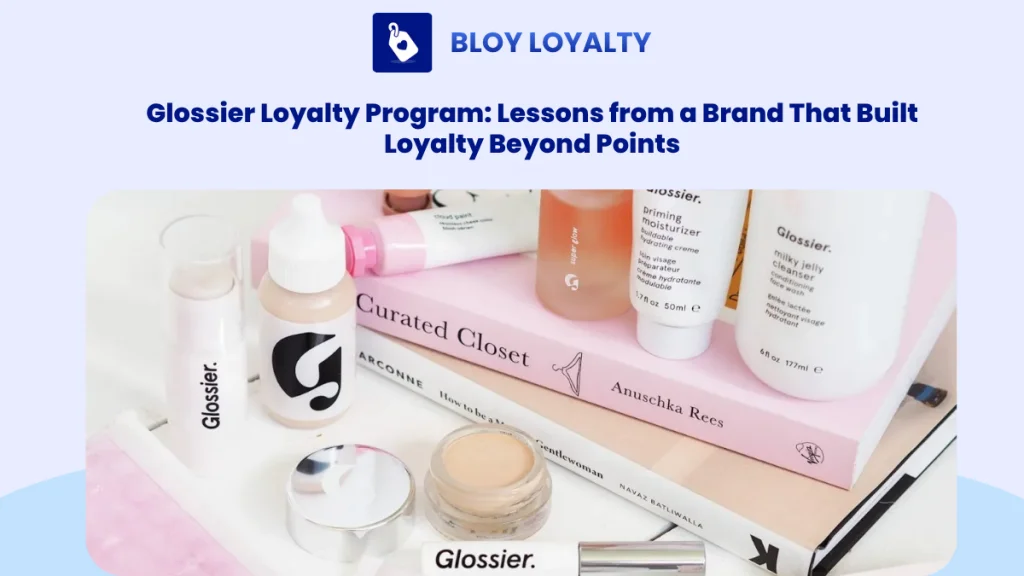
Most loyalty programs try to increase purchases through points. Glossier took a different path. Instead of building a complex rewards economy, the beauty brand gradually evolved from a referral-driven acquisition engine into a community-focused loyalty ecosystem built around membership, experiences, and emotional connection.
If you run a Shopify beauty or fashion store, the Glossier loyalty program is worth studying for one simple reason: it shows that loyalty does not have to mean discounts. This guide breaks down how the Glossier loyalty program evolved, what makes it different from traditional beauty loyalty programs, and how Shopify brands can apply the same principles without an enterprise budget.
Key Takeaways
- Glossier does not rely on a traditional points-based loyalty program.
- The brand evolved through three stages: referrals, experiential retail, and membership.
- Emotional rewards often create stronger loyalty than discounts.
- Shopify brands can replicate these strategies without enterprise resources.
- Simplicity is one of the biggest reasons the Glossier loyalty approach works.
Glossier Loyalty Program at a Glance
If you only have thirty seconds, here is the quick answer. The Glossier loyalty program is not a points scheme. It is a mix of referrals, a free membership, and in-store experiences designed to make customers feel like they belong to something.
| Loyalty Element | Available? |
| Membership Program | Yes |
| Referral Program | Yes |
| Points Program | No |
| VIP Tiers | No |
| Early Access | Yes |
| Exclusive Gifts | Yes |
| Physical Rewards | Yes |
| Omnichannel Experiences | Yes |
While many beauty brands rely on points and tiers, Glossier focuses on belonging, participation, and community. That choice reflects a deeper truth about the category, which is that in beauty, points alone rarely build real loyalty. Repeat purchases tend to be driven by identity, routine, and trust rather than by a points balance ticking upward.
The Evolution of Glossier’s Loyalty Strategy
The Glossier loyalty ecosystem was not built overnight. It evolved through several stages as the brand matured, and each stage solved a different business problem.
Phase 1: The Referral Engine
In its earlier years, the engine behind Glossier’s growth was word of mouth, formalized through a double-sided referral program. The structure was simple. An existing customer shares a personal referral link, a new customer clicks it, creates an account, and gets a discount on their first order, often around 10% off. In return, the referrer earns a promotional credit, reported at around 10 US dollars, toward a future purchase.
Why did this work so well? First, it reduced acquisition costs. A referred shopper arrives already warmed up by a friend. Shopify’s own analysis notes that retaining an existing customer can cost five to twenty-five times less than acquiring a new one, according to its overview of customer retention strategies for ecommerce, and a referral program acquires new customers through the people you have already retained. This is why referrals belong near the top of any early-stage plan, a point we explore in the loyalty program objectives every Shopify store should set first.
Second, it leveraged social proof. Nielsen found that 88% of consumers trust recommendations from people they know more than any other channel, according to Nielsen’s study on consumer trust. A referral program turns that trust into a measurable acquisition channel. Third, it turned customers into advocates, making each person feel like an insider sharing a secret rather than a salesperson pushing a pitch.
Phase 2: The Glossier Passport Book
In March 2025, Glossier introduced something unusual. The Glossier Passport Book is a collectible booklet that encourages shoppers to visit different Glossier stores across the US and the UK and collect exclusive stickers from each location, according to reporting from Cosmetics Business on the Passport Book launch. Shoppers can personalize their book with a polaroid photo taken in-store by a Glossier “Editor”. One expert quoted in that coverage described it as a modern beauty version of a coffee shop stamp card.
Why did it work? It encouraged store visits, because the passport only fills up when you show up. It created collectible experiences, tapping into the psychology that makes people chase stamps and limited editions. And it generated user-generated content naturally, because customers love to share their personalized books, giving Glossier authentic owned media without paying for ads.
The merchant takeaway: not every reward needs monetary value. A sticker costs almost nothing, yet collecting it can create more attachment than a 10% off coupon.
Phase 3: The Membership Program
The most recent stage is the Glossier Membership Program. According to Glossier’s own membership terms, membership is free for eligible US residents. You create an account, and your first qualifying purchase unlocks a free limited-edition keychain. From there, members get perks such as birthday gifts, early access to sales, and invitations to exclusive events.
What stands out is what is missing. No points to track, no tiers to climb, no redemption math. You join, you belong, and the perks arrive. It is low friction, easy to understand, and built for high participation, because the easier a program is to join, the more people actually join it.
The merchant takeaway: the easiest loyalty program to join is often the easiest loyalty program to scale. A program nobody understands is a program nobody uses, and Glossier removed almost every reason to hesitate at the front door.
Why Glossier Doesn’t Rely on Traditional Points Programs
The Glossier loyalty program reflects a broader shift toward emotional loyalty rather than purely transactional loyalty. McKinsey has argued that brands often over-index on rational point mechanics while underusing the emotional and experiential rewards that deepen connection, a theme explored in its analysis of why brands are missing the loyalty points.
In beauty, the product is rarely just a product. A foundation shade or a signature scent becomes tied to identity, so the decision is emotional before it is rational. Glossier built its brand on community-driven behavior, and that attachment is far stickier than a discount, because a competitor can undercut your price but cannot easily replicate the feeling of belonging.
Simplicity also increases participation. Points programs ask customers to do mental work: How many points do I have? When do they expire? Every question is a small barrier. By removing points, the Glossier loyalty program removes that cognitive load. This is the opposite philosophy from a classic earn-and-burn structure, and it is worth understanding how points-based loyalty programs actually work on Shopify so you can decide which model fits your store.
Finally, experiences create stronger brand affinity. Exclusive invitations, early access, and a membership status that feels special add up to a relationship. Harvard Business Review research found that fully connected customers are roughly 52% more valuable on average than merely satisfied ones, according to its study on the emotional connection that matters more than satisfaction.
What Glossier Gets Right (And Where Shopify Brands Can Improve It)
No loyalty program is perfect. Glossier nails several things many programs get wrong: enrollment is extremely low-friction, the emotional positioning is strong, the mindset is community-first, and the membership value is clear.
The same simplicity also creates gaps. There are limited progression mechanics, so customers do not feel like they are leveling up. There are fewer reasons for high-spending customers to stay deeply engaged, and less gamification than a tiered program offers. Referral rewards can also carry tight expiration windows that frustrate customers. For a smaller brand, these gaps are not weaknesses to fear but openings to improve on, since a thoughtful Shopify program can keep Glossier’s emotional core while adding the structure that keeps your best customers coming back.
The real lesson is not to copy Glossier exactly. It is to understand why each mechanism exists and adapt it to your business model. Glossier can afford a minimalist program because it already has a powerful brand. A newer Shopify brand may need more structure, such as a points layer or a light tier system. Studying brands that keep customers loyal for years is the fastest way to see which mechanics map to your situation.
Why This Approach Works So Well for Beauty Brands
The Glossier loyalty program is a near-perfect fit for beauty in ways that might not transfer to every industry. Beauty is one of the most personal categories in retail. The global beauty and personal care market was valued at well over 600 billion US dollars heading into 2025, according to Statista’s beauty and personal care market data, and much of that spending is tied to self-expression rather than utility. When a purchase is about identity, customers respond to programs that make them feel seen.
Beauty shoppers also learn from each other, watching tutorials and copying routines from people they trust. A community-first model turns customers into a source of discovery for other customers, which is exactly what referral and advocacy programs capture. User-generated content is the currency here: a customer posting their Passport Book is worth more than a discount code because it carries authenticity paid media cannot manufacture.
That emotional loyalty pays off in lifetime value, because connected customers buy more often, forgive the occasional misstep, and recommend the brand to others. Bain & Company found that increasing customer retention by just 5% can increase profits by 25% to 95%, as detailed in Bain & Company’s retention research. In other words, a loyalty program that deepens connection is a retention program with compounding returns. One caveat: a commodity category with thin margins and low emotional involvement might still need a more transactional structure. The principle holds, but the execution should match your audience.
How to Recreate Glossier’s Loyalty Strategy on Shopify
You do not need Glossier’s budget to apply these principles. Most of what makes the Glossier loyalty program effective can be assembled on Shopify with the right setup, built deliberately rather than turning every reward into a markdown. Our guide on how to set up a loyalty program that does not collapse into constant discounts is a useful companion to the steps below.
Step 1: Build a low-friction membership experience. Offer a welcome reward for creating an account and reserve a few benefits for members only. This is where a loyalty platform like BLOY earns its keep on Shopify, since you can stand up an account-based membership with welcome perks without writing custom code.
Step 2: Launch a double-sided referral program. Reward both sides: a clear first-order incentive for the new customer and a meaningful credit for the referrer once the order completes. One expert tip: use longer reward expiration windows than Glossier’s original setup. A tight seven-day window can leave value on the table, while thirty days or more keeps the program feeling generous.
Step 3: Reward community participation. Give points or perks for reviews, user-generated content, social shares, and engagement, not just purchases. Our deep dive on building a social media loyalty program that turns engagement into revenue covers which actions are worth rewarding.
Step 4: Offer physical rewards instead of more discounts. Branded merchandise, limited-edition gifts, and surprise rewards often create more memorable moments than another percentage off. Physical rewards feel like gifts, and gifts build relationships.
Step 5: Introduce VIP benefits only when needed. Glossier avoids tiers, and for its brand that works. But your store may benefit from a light VIP structure if you have a segment of high-spending customers who want recognition. Our guide on how to build a tiered VIP loyalty system covers when to add progression and when to keep things flat.
Key Lessons Shopify Brands Can Learn from Glossier
Referrals can be more powerful than points, because a referred customer arrives with built-in trust. Community is a loyalty asset that is harder to copy than any reward catalog. Physical rewards create memorable experiences that outperform discounts on emotional impact. Simplicity often beats complexity, since fewer hoops mean more participation. And loyalty should evolve as your brand grows, the way Glossier added layers as it matured.
Frequently Asked Questions
Does Glossier have a loyalty program?
Yes. The Glossier loyalty program centers on a free membership and a referral program rather than a points scheme, with perks like birthday gifts, early sale access, and event invitations.
Does Glossier use loyalty points?
No. Glossier does not run a traditional points-based program. Its strategy is built around membership, referrals, and experiences instead of accumulating and redeeming points.
What is the Glossier Membership Program?
It is a free program for eligible US customers. After creating an account and making a qualifying purchase, members receive a free limited-edition keychain and gain access to early access, gifts, and exclusive events.
How does the Glossier referral program work?
An existing customer shares a referral link. The new customer gets a discount on their first order, and the referrer earns a promotional credit toward a future purchase once the referred order is placed.
What is the Glossier Passport Book?
Launched in 2025, the Passport Book is a collectible booklet that rewards customers for visiting Glossier stores and collecting exclusive stickers, with the option to add a personalized in-store polaroid.
Can Shopify brands build a loyalty program like Glossier?
Absolutely. With a loyalty app, Shopify merchants can combine memberships, double-sided referrals, community rewards, and experiential perks without custom development. The key is to adapt the principles to your audience rather than copying the program exactly.
Conclusion
The story of the Glossier loyalty program is a story of evolution: from a referral engine that fueled early growth, to experiential loyalty through the Passport Book, to a membership ecosystem built on belonging. Each phase solved a different problem, and together they show that loyalty is not a single feature you bolt on, it is a strategy that matures with your brand.
Glossier proves that loyalty is not always about giving customers more points. Sometimes it is about giving them more reasons to feel connected. Discounts buy a transaction. Belonging buys a relationship. If you want to bring these ideas to your store, start small and layer up while designing your program around behavior rather than constant discounts. A platform like BLOY gives Shopify brands the building blocks to combine referrals, member experiences, community rewards, and optional VIP perks in one place, so you can launch an enterprise-style loyalty experience without an enterprise-style engineering team.

Yến Lê Hải
Content author at BLOY, focusing on product-led content, SEO, and educational resources to help merchants improve conversion and customer engagement.