Membership Acquisition Strategy for Shopify: How to Turn Shoppers Into Members
Most membership acquisition strategies still rely on signup forms, popups, and email capture before customers even experience value. But Shopify merchants already have a stronger acquisition moment: the purchase itself. The most effective membership acquisition strategies today do not interrupt the shopping experience. They use rewards, loyalty visibility, and post-purchase momentum to turn shoppers into members naturally. This guide shows how Shopify merchants can build a membership acquisition strategy that increases signups, reduces friction, and connects loyalty across online and offline touchpoints.
1. What Is a Membership Acquisition Strategy?
A membership acquisition strategy is a structured approach to converting website visitors or one-time buyers into enrolled loyalty members. The goal is not just collecting email addresses. It is building an ongoing customer relationship that increases repeat purchase rate, average order value, and lifetime value.
For Shopify merchants, this matters more than ever. Customer acquisition costs have risen by over 60% in the last five years, making it increasingly difficult to build a profitable store on first-time purchases alone. A well-designed membership acquisition strategy shifts the focus from constantly chasing new traffic to converting existing buyers into loyal members who return on their own.
There is a meaningful difference between traditional signup acquisition and loyalty-driven acquisition:
| Type | Traditional membership acquisition | Loyalty-driven membership acquisition |
|---|---|---|
| Main trigger | Popup, email signup | Purchase, rewards, loyalty visibility |
| Customer motivation | Get updates or a discount | Unlock rewards and benefits already earned |
| Main friction | Signup before value | Account creation after earning |
| Best use | Lead generation | Retention and repeat purchase |
In a Shopify context, membership acquisition is not just a form on your homepage. It is a layer of your shopping experience that gives customers a clear reason to create an account, come back, and spend more.
2. Why Traditional Membership Acquisition Strategies Are Losing Effectiveness
The classic playbook for membership acquisition involves a popup offering 10% off in exchange for an email address. While this approach still has a place in lead generation, it is becoming less effective as a loyalty acquisition channel for several reasons.
Customers have seen the popup thousands of times. They dismiss it without reading it, or they enter a throwaway email address to claim the discount and never return. The signup happens before the customer has experienced any real value from your store, which means there is no emotional reason to stay.
Guest checkout behavior compounds this problem. Over 83% of consumers say that loyalty membership influences their decision to buy again from a brand, but that influence only exists once they are actually in a program. Merchants who push signup too early, before the first purchase, miss the natural conversion window entirely.
Meanwhile, acquisition costs keep rising. Retention costs 5 to 7 times less than acquiring a new customer, which means every membership signup from an existing buyer is significantly more valuable than a cold email capture. Traditional acquisition strategies treat membership as a top-of-funnel marketing tactic. Loyalty-driven strategies treat it as a post-purchase retention system, and that shift changes everything.
3. Why “Earn Before Joining” Is Becoming the New Membership Model
3.1. The Psychology Behind Post-Purchase Momentum
After completing a purchase, customers are already invested in your brand. They have made a financial commitment. They feel a degree of ownership over the transaction. This is the most natural moment to introduce loyalty membership because the customer is already emotionally engaged.
Reward language at this stage carries more weight. “You just earned 100 points” creates a sense of ownership. The customer does not feel asked to sign up for something. They feel they already have something worth keeping. That shift from “please join” to “you’ve already earned” is what reduces friction and increases conversion.
3.2. Why Customers Respond Better to Earned Rewards Than Signup Requests
Most customers do not want another account. They already have dozens. But they do not want to lose rewards they have already earned. This asymmetry is what makes the earn-before-joining model work. The incentive to create an account is not a vague promise of future benefits. It is a specific balance sitting in their cart right now.
A post-purchase prompt like “You just earned 100 points. Create your account to save them” converts at a meaningfully higher rate than “Sign up for our rewards program.” The reward is real. The loss of walking away is concrete.
3.3. How Invisible Membership Acquisition Works on Shopify
Shopify’s native infrastructure supports this model directly. With the right loyalty app, points can be assigned to a transaction the moment it is completed, before the customer has even created an account. The post-purchase page then invites the customer to register and claim their balance. The membership acquisition flow is embedded inside the shopping experience rather than interrupting it.
For a practical walkthrough of how to build this kind of setup, see BLOY’s guide on how to set up a loyalty program on Shopify.
4. Five Membership Acquisition Strategies Shopify Brands Should Use
4.1. Reward Account Creation After Checkout
Guest checkout is one of the biggest membership acquisition leaks in Shopify. Customers complete a purchase without creating an account, which means no loyalty profile, no repeat purchase trigger, and no way to keep them engaged after delivery.
The fix is simple: connect reward points to the transaction and then invite the customer to create an account to access them. This turns a potential dead end into a natural onboarding moment. The reward earns the account creation. The customer does not feel like they are signing up for a marketing list. They feel like they are claiming something they already own.
Tactics that support this:
- Display a points balance on the order confirmation page with a clear call to action to register
- Use a post-purchase email triggered within minutes of checkout with the subject line focused on the reward earned
- Set a short expiry window on unclaimed points to create urgency without aggression
4.2. Show Loyalty Value Directly on Product Pages
Membership acquisition does not have to start after checkout. Showing customers what they will earn before they buy is one of the most effective ways to increase both conversion and signup intent.
A simple “Earn 45 points on this order” message on the product page gives customers a concrete reason to register before or during checkout. Member-only pricing previews work similarly. When a shopper sees that logged-in members get early access or a slightly better price, the value of joining becomes visible before any commitment is required.
Points-based loyalty programs for Shopify cover this in detail, including how to structure earning rates that feel meaningful without eroding margin.
4.3. Use Referral Loops as a Membership Acquisition Channel
Referral programs reduce customer acquisition cost by turning existing members into a recruitment channel. A referred customer arrives with a pre-existing level of trust because a friend recommended the brand. They tend to convert at higher rates and have better long-term retention profiles than cold paid traffic.
For membership acquisition, the referral mechanic works on both ends. The referring member gets a reward that reinforces their loyalty. The new customer receives an incentive that is tied to creating an account, which means referral traffic has a built-in membership acquisition trigger baked in.
According to Bond Brand Loyalty research, referred customers are significantly more likely to enroll in a loyalty program than customers who arrive from paid channels. This makes referral one of the highest-quality membership acquisition channels available to Shopify merchants.
For implementation guidance, see BLOY’s overview of subscription and referral loyalty programs for Shopify.
4.4. Create FOMO With Visible VIP Tiers
Nothing motivates a membership signup faster than showing someone what they are missing. VIP tier programs use visible status and locked benefits to create urgency around joining and progressing.
A message like “Spend $50 more to unlock Gold Member perks” gives a non-member a specific, achievable goal. It makes the cost of not joining tangible. When tier benefits include early access, exclusive products, or free shipping thresholds that non-members cannot access, the value of membership becomes undeniable rather than abstract.
BLOY’s guide on tiered loyalty programs for Shopify covers how to design tier thresholds that motivate progression without making the first level feel unreachable for new members.
4.5. Turn Offline Shoppers Into Online Members With Shopify POS
For merchants who operate both online and physical retail, in-store purchases represent a significant membership acquisition opportunity that most brands underutilize. A customer who buys in-store but never creates an online account is invisible to your retention systems.
Shopify POS makes it straightforward to capture this segment. Staff can look up a customer profile at the register, add points to their balance, and invite them to create an account to access their rewards. QR codes at the counter or on receipts give customers a frictionless path to register from their phone. For a complete guide to this model, see BLOY’s POS loyalty program guide for Shopify merchants.
5. Where Membership Prompts Should Appear on Shopify
Placement determines whether your membership acquisition strategy converts or goes unnoticed. Different touchpoints carry different levels of buying intent, and your loyalty prompts should be calibrated accordingly.
| Placement | Why it converts |
|---|---|
| Product page | Shows reward value before purchase decision |
| Cart drawer | Captures momentum at highest spend intent |
| Checkout | Reaches customers mid-transaction |
| Post-purchase page | Lowest signup friction of any touchpoint |
| Loyalty widget | Always-visible reminder for returning visitors |
5.1. Product Pages
Earned points previews, member-only pricing labels, and VIP tier teasers on product pages give visitors a reason to register before they even reach checkout. This is the earliest possible touchpoint and works best for merchants with a strong first-purchase average order value.
5.2. Cart Drawer
The cart drawer is one of the most overlooked placements for membership acquisition. A customer reviewing their cart is at peak buying intent. A short message showing points they will earn on this order or how close they are to a reward threshold can increase both conversion rate and signup intent simultaneously.
5.3. Checkout and Post-Purchase Pages
Shopify’s checkout extensibility allows loyalty apps to surface points balance and membership prompts inside the native checkout without disrupting the flow. The post-purchase page is the highest-converting placement for account creation because the customer has already committed financially. The decision is made. The friction is at its lowest.
5.4. Persistent Loyalty Widgets
A floating loyalty widget gives returning visitors an always-visible entry point to check their balance, see available rewards, and discover the program without navigating to a separate page. This is particularly effective for customers who earned points as guests and need a visible reminder to register and claim them.
6. Which Membership Acquisition Model Should You Choose?
Not every membership acquisition approach fits every store type. The right model depends on your product category, purchase frequency, and the primary behavior you want to drive.
| Store type | Best acquisition model | Why it works |
|---|---|---|
| Fashion and beauty | VIP tiers and rewards | Encourages status-seeking and repeat spend |
| Coffee and consumables | Points-based rewards | Supports high-frequency purchases |
| Supplements and wellness | Subscription and loyalty | Supports replenishment behavior |
| Lifestyle and gifts | Referral rewards | Encourages social sharing and advocacy |
| Retail and pop-up stores | POS and QR signup | Connects offline and online customer profiles |
For stores that are unsure where to start, BLOY’s guide on loyalty program objectives for Shopify offers a framework for choosing the right mechanics based on the specific behavior you are trying to change.
7. How AI Can Improve Your Membership Acquisition Strategy
AI is increasingly useful for reducing guesswork in loyalty program setup, particularly around reward structures and onboarding incentives.
Where AI adds real value for membership acquisition:
- Recommending reward point values based on your product margin and average order value
- Identifying signup incentives that are too weak to motivate action or too expensive to sustain
- Predicting which customer segments are most likely to convert to members based on purchase behavior
- Automating personalized post-purchase prompts that feel relevant rather than generic
The practical application for most Shopify merchants is using AI-assisted onboarding to move from a blank configuration to a working loyalty structure faster. Instead of spending weeks calibrating point values manually, AI tools can suggest a starting structure that fits the store’s margin profile and typical purchase cadence.
BLOY’s AI-assisted onboarding is designed for exactly this scenario, helping merchants configure a practical membership acquisition setup without needing to be loyalty program experts from day one.
8. Membership Acquisition Examples for Shopify Brands
8. Membership Acquisition Examples for Shopify Brands
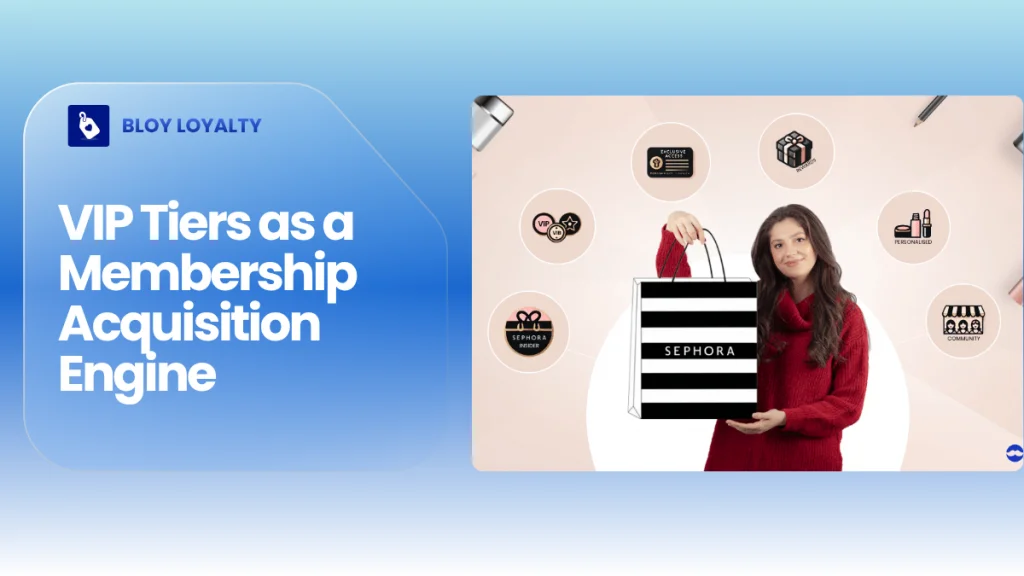
8.1. Sephora Beauty Insider: VIP Tiers as a Membership Acquisition Engine
Sephora’s Beauty Insider is one of the most studied loyalty programs in retail, and its membership acquisition model is built almost entirely around visible tier progression. The program has three tiers: Insider (free), VIB ($350 annual spend), and Rouge ($1,000 annual spend). Non-members and entry-level members can clearly see the benefits locked behind the higher tiers, including early access to product launches, exclusive Rouge Celebration events, and tier-specific discounts during seasonal sales.
The results are significant. The program now has over 34 million members globally and accounts for 80% of Sephora’s North American sales. The tiered structure is specifically what drives membership growth: customers who might otherwise stay as one-time buyers are motivated to create an account and begin working toward the next level because the benefits they are missing are visible at every touchpoint.
For Shopify brands in the beauty and fashion space, the key takeaway is that visible tier progression creates a stronger acquisition trigger than any signup form. The customer is not asked to join. They are shown what they are missing.
8.2. Death Wish Coffee
Death Wish Coffee, a Shopify brand known as the world’s strongest coffee, rebuilt its loyalty program in 2023 after noticing a drop in redemption rates. The refresh involved a rebrand from Reaper Rewards to Ritual Rewards, a gamification campaign called the Swig League, and tighter integration between Smile.io and Klaviyo for personalized post-purchase email flows.
The Swig League campaign encouraged subscribers to join one of two teams based on their coffee preference and earn points through referrals, SMS opt-ins, and challenges over nine weeks. This turned the referral mechanic into a community acquisition channel rather than a simple discount transaction.
The results: a 186% increase in loyalty-generated revenue, a 70% reward redemption rate, and a 4.8x higher average order value for repeat customers compared to one-time shoppers. For high-frequency consumable brands on Shopify, this case demonstrates how combining points, referrals, and post-purchase email flows into a unified membership acquisition system can dramatically outperform a standard signup-first approach.
8.3. Pacifica Beauty
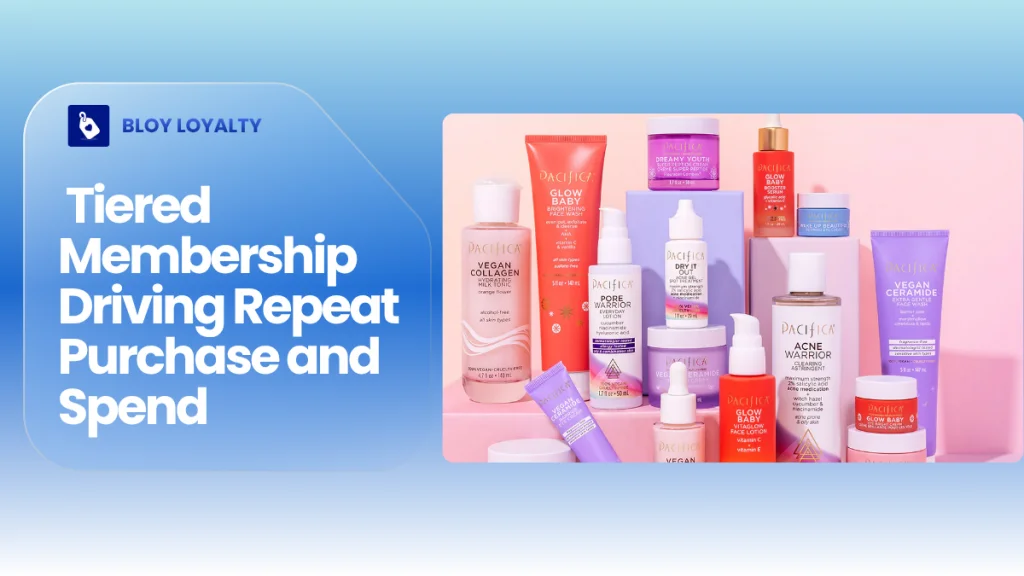
Pacifica Beauty, a vegan and cruelty-free cosmetics brand with nearly 30 years in the market, launched a tiered loyalty program with three levels named Friend Status, Girl Crush, and Bestie Forever. Rather than hiding the program behind a signup gate, Pacifica embedded loyalty visibility throughout the shopping journey, including a points balance preview in the cart drawer and in-cart reward redemption so customers could apply rewards without leaving checkout.
The program was integrated with Klaviyo to send reward reminder emails and referral prompts after each purchase, giving the brand a structured post-purchase membership acquisition flow for every new customer.
Outcome: a 47% improvement in repeat purchase rate, a 46% increase in customer spend, and 35% of total revenue now generated from loyalty program members. For beauty and personal care brands on Shopify, Pacifica’s approach shows that embedding loyalty visibility at the cart and checkout level, rather than relying on a homepage popup, is what converts one-time buyers into enrolled members at scale.
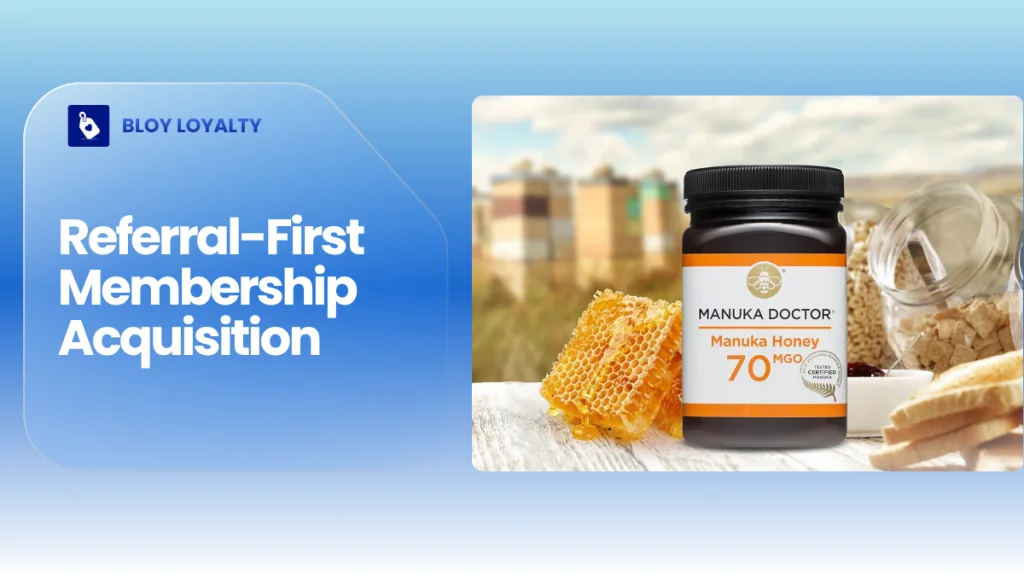
8.4. Manuka Doctor Referral-First Membership Acquisition
Manuka Doctor, a family-owned honey and skincare brand on Shopify, used referral rewards as their primary membership acquisition channel. The goal was to attract customers with a higher lifetime value rather than simply maximizing signup volume from paid traffic.
By building a referral offer that rewarded both the referrer and the incoming customer with account-tied incentives, Manuka Doctor created a natural pipeline where existing members actively recruited new members. The referred customer had a built-in reason to register an account and complete a purchase because their reward was tied to doing so.
The results: nearly 100% of referred visitors converted into customers, 47% of revenue is now generated by loyal members, and the brand achieved a 53% increase in repeat purchase rates. For supplement and wellness brands where trust is a major purchase barrier, referral-driven membership acquisition reduces that barrier significantly because the customer arrives pre-qualified through a recommendation rather than a cold ad. For more on building this kind of system, see BLOY’s B2C loyalty program guide.
9. Common Membership Acquisition Mistakes Shopify Brands Make
9.1. Asking Customers to Join Before Showing Value
The most common membership acquisition mistake is asking for a signup before the customer has any reason to commit. Popups that appear on the homepage before a shopper has browsed a single product create friction at the worst possible moment. Show value first. Ask for membership after the customer has experienced the store and ideally completed a purchase.
9.2. Hiding Loyalty Benefits Until After Signup
Some merchants build elaborate loyalty programs and then make them invisible until a customer registers. This creates a circular problem: customers do not know enough about the program to want to join, and they cannot see the program unless they join. Loyalty visibility on product pages, in the cart, and in checkout is what creates the motivation to sign up. The program needs to be discoverable before it becomes desirable.
9.3. Overcomplicating the Rewards Structure
A membership acquisition strategy fails when customers cannot understand how the program works in ten seconds or less. Too many earning categories, complex redemption rules, and hard-to-calculate point values all reduce participation. Start with one earning action and one redemption option. Complexity can be added later once the program is working and customers are actively engaged.
9.4. Treating Membership Acquisition as Email Collection Only
Membership acquisition that focuses purely on growing an email list misses the retention opportunity entirely. An email address without a loyalty relationship is just another contact in a database. The goal is not a list. It is a behavioral change: customers who return more often, spend more per visit, and refer others because they feel genuinely connected to the brand.
9.5. Ignoring Online and Offline Customer Sync
Merchants with both online and physical retail operations often run disconnected loyalty systems. A customer who earns points in-store cannot redeem them online, or vice versa. This inconsistency erodes trust and reduces the perceived value of membership. A unified Shopify POS and online loyalty setup ensures that every touchpoint contributes to the same membership profile, which makes the program feel cohesive rather than cobbled together.
10. Membership Acquisition Strategy Checklist for Shopify Merchants
Use this checklist before launching or auditing your membership acquisition approach:
- [ ] Define your primary goal: new signups, repeat purchases, referrals, or VIP tier growth
- [ ] Choose one simple onboarding incentive that is easy for customers to understand
- [ ] Make loyalty value visible on product pages and in the cart before asking customers to join
- [ ] Set up post-purchase reward prompts for guest checkout conversion
- [ ] Keep earning and redemption rules simple enough to explain in one sentence
- [ ] Sync online and offline customer data if you operate a physical location
- [ ] Test loyalty widget placement on product pages, cart, and post-purchase page
- [ ] Track signup conversion rate and repeat purchase rate as primary success metrics
- [ ] Review reward liability monthly to ensure the program is sustainable
- [ ] Use analytics or AI assistance to optimize reward values and signup incentives over time
Conclusion: Build a Membership Acquisition Strategy Around Customer Momentum
The best membership acquisition strategies no longer rely on interruptive signup forms or generic popups. They use customer momentum, reward visibility, and loyalty experiences to turn purchases into long-term relationships.
According to McKinsey, top-performing loyalty programs can boost revenue from customers by 15 to 25% annually by increasing purchase frequency or basket size, which means every customer who converts from a one-time buyer to an enrolled member has a measurable impact on store revenue over time. For Shopify merchants, the opportunity is not in acquiring more traffic. It is in converting more of the buyers you already have.
BLOY helps merchants build a flexible membership acquisition strategy with rewards, VIP tiers, referrals, Shopify POS sync, and AI-assisted onboarding designed for modern loyalty workflows. Whether you are starting a program from scratch or improving an existing setup, the right membership acquisition strategy begins with showing customers the value of joining before asking them to commit.

Yến Lê Hải
Content author at BLOY, focusing on product-led content, SEO, and educational resources to help merchants improve conversion and customer engagement.