7 B2B Referral Program Examples (+ How to Build Yours)
TL;DR
- B2B referral programs work because trust travels between businesses. Referred customers convert faster, churn less, and are worth more over time.
- Seven programs worth copying: Dropbox, DigitalOcean, HubSpot, PayPal, Salesforce, SmartBear, plus a Shopify-app angle most guides ignore.
- The winning formula: a double-sided reward, near-zero friction, fraud limits, and tracking the program like a sales campaign.
- To build your own on Shopify: pick a native incentive, embed the share button inside the merchant dashboard, block self-referrals, and automate payouts.
- Use the Referral Reward and ROI Estimator below to set the right reward for your own price point.
Ninety-two percent of buyers trust recommendations from people they know more than any other form of advertising, according to Nielsen’s Global Trust in Advertising study. In B2B, where deals are bigger and buying committees are more skeptical, that trust is worth even more, and it is exactly what a referral program turns into a repeatable growth channel.
Yet most articles on this topic either list famous programs without telling you how to copy them, or hand you a theoretical framework with no real examples. This guide does both. Below you will find seven B2B referral program examples with the exact reward mechanics behind them, the pattern that makes them work, a four-step way to launch your own, and an interactive calculator to size your reward. If you run a SaaS product or a Shopify app, the app-based tactics near the end will be especially useful.
What is a B2B referral program?
A B2B referral program is a structured system that rewards existing business customers or partners for introducing new companies to your product. In plain terms: a happy customer sends you a qualified lead, and you reward them for it. The reward can be account credit, a commission, a discount, cash, or a product perk.
It is worth separating B2B referrals from their B2C cousins, because the differences change how you design the program:
- Longer sales cycles. A B2B referral rarely converts the same day, so rewards often trigger on a paid milestone rather than a signup.
- Buying committees. Several people approve a purchase, so your advocate is vouching to a group, not one individual.
- Higher value per referral. A single referred account can be worth thousands, which justifies larger, tiered, or revenue-share rewards.
Why B2B referral programs work: the numbers
Referrals are not just cheaper leads; they are better ones. A landmark study of a bank’s referral program by Wharton researchers found referred customers had higher retention and were roughly 16% to 25% more valuable over their lifetime than non-referred customers. Industry data since then points the same direction:
| Metric | What the data shows | Source |
| Trust in recommendations | 92% trust peer recommendations over other advertising | Nielsen |
| Lifetime value | Referred customers 16% to 25% more valuable long-term | Wharton (Schmitt et al.) |
| Retention / churn | Referred customers churn less and retain longer | Wharton (Schmitt et al.) |
| Conversion vs paid | Referral leads convert several times higher than paid ads | Extole / Friendbuy |
| Cost per acquisition | Referral traffic carries a markedly lower CPA | Referral Factory |
Referrals compound: lower acquisition cost up front, higher value over time.
The takeaway for a founder: a referral program is one of the few channels that lowers your cost to acquire a customer while raising the quality of who you acquire. That is why it deserves a real system, not a forgotten link in a footer.
7 B2B referral program examples to learn from
Each example below follows the same lens: the context the company was in, the exact mechanic they used, why it worked at a deeper level, the results, and the specific lesson you can apply to your own program.
1. Dropbox: pay people in your own product
The context. In 2008 Dropbox was a small file-syncing tool fighting for attention against much larger players. The team has said that paid search was brutally expensive for them: acquiring a single customer through ads could cost several times the price of the product itself, which made paid channels a losing game for a low-priced subscription. They needed growth that did not scale with an ad budget.
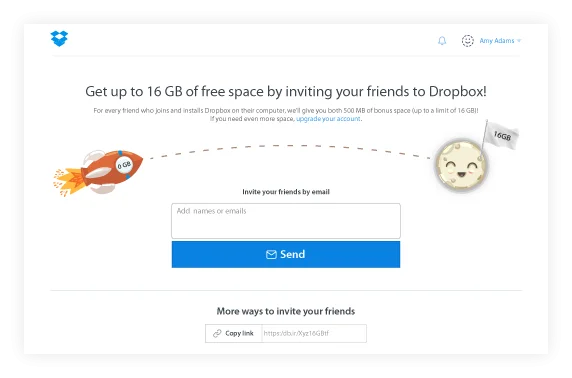
The mechanic. Dropbox launched a double-sided referral in which both people were rewarded with extra storage. Refer a friend, and both you and the friend received free space (roughly 500 MB per successful referral for free accounts, and more for paid Plus accounts), stackable up to a generous cap. Crucially, the invite flow was built into onboarding and offered several one-click sharing options (email, contacts, social), and a progress meter showed users how much space they had left to earn.
Why it worked. Three things compounded. First, the reward was the product, so each referral cost Dropbox almost nothing in cash while paid rivals were burning ad spend. Second, giving more storage actually deepened usage: the more space you had, the more files you moved in, and the harder it became to leave. The reward and the retention mechanic were the same lever. Third, the friction was close to zero, and the progress meter turned inviting friends into a small game.
The result. Dropbox grew from about 100,000 registered users to roughly 4 million in 15 months, a jump often cited as 3,900% growth, with referrals driving a large share of daily signups. See Prefinery’s growth study for the full breakdown.
Apply it. Ask whether you can reward people with your own product instead of cash. Extra seats, higher usage limits, premium features, or account credit all cost you less than a payout and pull the customer deeper into your product at the same time. If you can make the reward double as a retention hook, you get two wins from one incentive.
2. DigitalOcean: use a spend threshold to filter for real customers
The context. DigitalOcean sells cloud infrastructure to developers, an audience that is famously ad-resistant and instead trusts the opinions of other engineers. Word of mouth was already how many developers discovered the platform, so the job was to formalize it without attracting freeloaders who sign up, grab a credit, and never become paying customers.
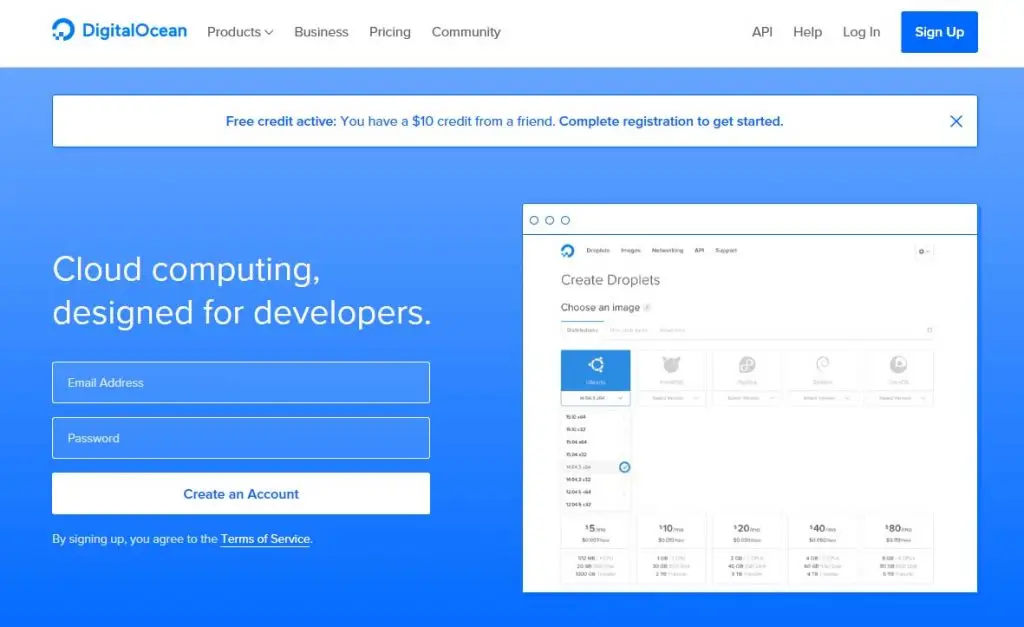
The mechanic. New customers who sign up through a referral link and add a valid payment method get a $200 credit valid for 60 days. The referrer earns a $25 credit, but only after the referred customer has spent their first $25 in real charges, and there is no cap on how much referral credit you can earn. DigitalOcean also offers a Powered by DigitalOcean badge so advocates can share links passively from their own sites.
Why it worked. The design solves the two hardest problems in a credit-based program at once. The generous $200 trial credit removes the risk of trying a technical product that requires real evaluation time, which raises conversion. Meanwhile the $25 real-spend threshold before the referrer is paid guarantees rewards flow only toward engaged, paying accounts, not tire-kickers. The badge turns satisfied developers into a passive, always-on distribution channel.
Apply it. Attach your payout to a meaningful milestone rather than a signup. A minimum spend, a completed onboarding, or a paid month all confirm the referred account is real before you release the reward. It costs you nothing extra and quietly protects your budget from low-quality signups.
3. HubSpot: segment your advocates instead of running one program
The context. HubSpot is referred by two very different groups. Agencies and consultants implement HubSpot for their clients and want a long-term commercial relationship. Content creators, bloggers, and publishers want to monetize an audience with affiliate links. Treating these groups the same would underserve both, because they sell in completely different ways and need different tools.
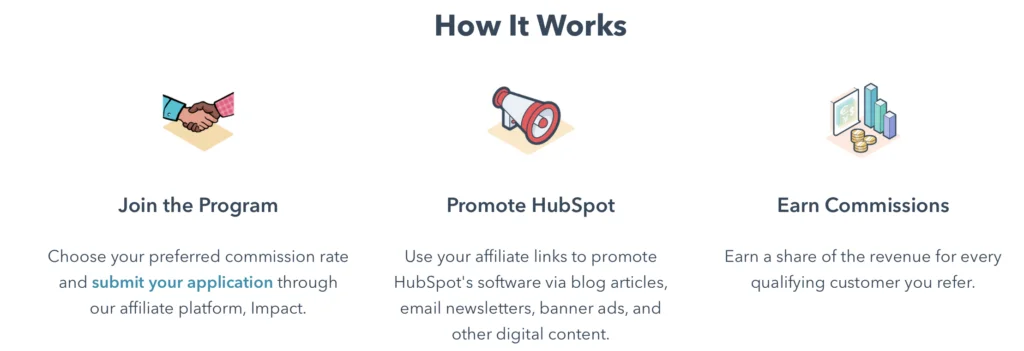
The mechanic. HubSpot runs two separate tracks. The Solutions Partner program gives agencies tiered benefits, co-marketing, and commissions tied to the business they bring and manage. The Affiliate program gives publishers a more self-serve setup with commission tiers and marketing assets designed for driving volume through content. Each track has its own onboarding, payout structure, and reporting.
Why it worked. Segmentation lets HubSpot match the incentive to the motivation. An agency cares about client retention and recurring value, so a partnership with ongoing rewards fits. A creator cares about clean tracking and fast payouts on volume, so a streamlined affiliate track fits. By refusing to force both into one generic program, HubSpot gets higher-quality participation from each and avoids the trap of an incentive that fits nobody well.
Apply it. List the different types of people who could refer you (customers, agencies, integration partners, influencers). If two of them refer in fundamentally different ways, give each a dedicated track with its own reward and tooling rather than one blended program. Start with your single biggest advocate type, prove it, then add a second track.
4. PayPal: scale the reward to the value of the referral
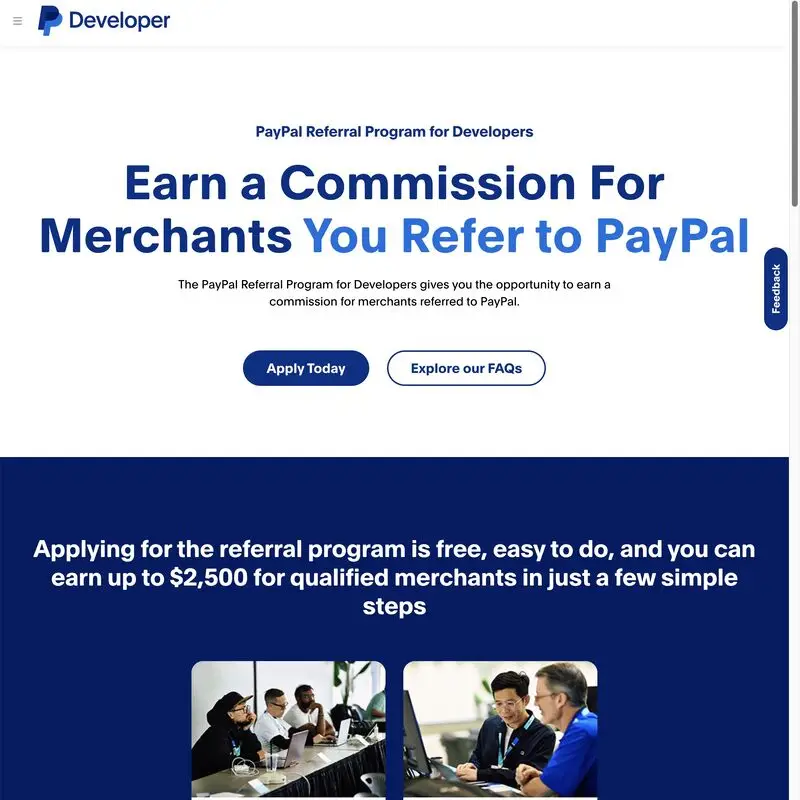
The context. PayPal is famous for its early consumer growth hack of literally paying people to sign up, but its B2B motion is different. On the developer and merchant side, a single referred business can process large transaction volumes and stay for years, so the value of one good referral is far higher than a consumer signup. A flat bounty would either overpay for small merchants or underpay for large ones.
The mechanic. PayPal’s developer referral program has paid in the range of $500 to $2,500 per merchant referral, with the exact amount tied to transaction-volume thresholds the referred merchant hits within a set window (commonly 60 days). Bigger, more active merchants trigger bigger rewards.
Why it worked. Tiering the reward to transaction volume aligns what PayPal pays with what it actually earns. A high-volume merchant is worth a $2,500 reward because the lifetime processing revenue dwarfs it, while a smaller merchant still earns the referrer a fair amount. The time window also concentrates effort: referrers are motivated to introduce merchants who will activate quickly, not just sign a form.
Apply it. If your customers vary widely in value, do not pay one flat reward. Tie the payout to a proxy for value, such as plan level, seats, or usage in the first 60 days. You will spend more on the referrals that deserve it and protect your margins on the ones that do not.
5. Salesforce: use revenue-share to align a partner ecosystem
The context. Salesforce grows through a large ecosystem of consultancies, resellers, and technology partners. In enterprise sales, deals are large, cycles are long, and partners invest real effort to bring and close a lead. A one-time bounty would not be worth their time, and it would not reward the partners who bring the biggest accounts.
The mechanic. Partners who register and refer a qualified lead can earn a percentage of the revenue that lead generates in its first year, commonly reported in the 5% to 20% range depending on partner tier and involvement. Deal registration formalizes who gets credit and prevents two partners from claiming the same lead.
Why it worked. Revenue-share ties the partner’s payout directly to outcomes and to deal size, so partners are motivated to bring larger accounts and to help them close, not just to drop a name. Deal registration removes channel conflict, which is the fastest way to lose partner trust. The first-year window keeps the cost predictable while still feeling generous. Together these turn partners into an extension of the sales team.
Apply it. For a sales-led or high-ticket product, offer ongoing revenue-share rather than a flat fee, and add a simple deal-registration step so credit is never disputed. Partners will happily do more selling when their reward grows with the account they bring.
6. SmartBear: ask only your happiest customers, at the right moment
The context. SmartBear sells software-testing and development tools into technical, often enterprise, buyers. Rather than blasting every customer with a referral ask, the company wanted to invite the customers most likely to advocate, at the moment they were most enthusiastic, so the ask would land as a natural recommendation instead of a spammy request.
The mechanic. SmartBear connected its referral program to customer-experience data, using Net Promoter Score (NPS) signals to identify promoters, then triggered referral invitations to those happy customers at the right time. According to CustomerGauge’s breakdown, this approach was tied to roughly $6 million in referral-influenced revenue in a single year.
Why it worked. Timing and targeting beat volume. A referral request sent to a customer who just rated you a 9 or 10 converts far better than the same message sent to everyone, including detractors who might spread the opposite of a recommendation. By wiring the ask to a satisfaction signal, SmartBear made every invitation land when goodwill was highest and pointed only at the people willing to vouch.
Apply it. Do not ask your whole list to refer you on the same day. Trigger the referral prompt off a positive signal: a high NPS or CSAT score, a renewal, a milestone reached, or a five-star support interaction. You will get more referrals from fewer, better-timed asks, and you will avoid burning goodwill with unhappy customers.
7. The Shopify-app angle: build a merchant-to-merchant loop
The context. Most B2B referral guides stop at enterprise tools like Marketo or Salesforce. But if you build a Shopify app, you sit on top of a platform with two things those guides ignore: merchants who already talk to and trust each other, and a shared billing system (Shopify billing) that every merchant checks. That combination unlocks a referral mechanic the big enterprise playbooks cannot use.
The mechanic. Run a merchant-to-merchant loop with a double-sided, native reward. A merchant refers another merchant to your app; the new merchant gets, for example, 20% off their monthly app bill, and the referrer gets $50 in app credit applied directly to their Shopify billing account. The share button lives inside the app dashboard, and the reward is applied automatically through the billing system rather than paid out by hand.
Why it works. The reward lands in the exact account merchants already watch every month, so it feels instant and real with no invoices, gift cards, or payout delays. Because the prompt sits inside the product a merchant uses daily, the ask appears where attention already is. And since Shopify merchants often belong to the same communities and agencies, one happy merchant can introduce several others, creating a compounding loop. This is precisely the kind of program apps like BLOY can automate on Shopify without custom code.
Apply it. Reward people using the payment rails they already use. The closer the reward is to a customer’s existing account (app credit, billing discount, plan upgrade), the higher the take-up and the lower your friction and cost. Then put the ask inside the product, not in an email, so it is seen the moment a merchant is getting value.
At a glance: how the seven compare
| Program | Reward model | Double-sided? | Standout idea |
| Dropbox | Free storage (product) | Yes | Reward that deepens usage |
| DigitalOcean | $25 credit / $200 to new user | Yes | Spend threshold filters tire-kickers |
| HubSpot | Tiered commission | Partial | Separate tracks per advocate type |
| PayPal | $500 to $2,500 bounty | No | Reward scales with account value |
| Salesforce | 5% to 20% revenue-share | No | Ongoing share aligns partners |
| SmartBear | Varies (NPS-triggered) | No | Ask only your happiest customers |
| Shopify app loop | App credit + billing discount | Yes | Reward inside existing billing |
What the best B2B referral programs have in common
Strip away the industries and the reward amounts, and the same four traits show up again and again:
- A double-sided reward. Rewarding both the advocate and the new customer removes friction on both ends of the introduction.
- Near-zero friction. The fewer steps to share and to redeem, the more referrals you get. One-click sharing beats a form every time.
- A quality gate. A spend threshold, transaction minimum, or qualified-lead check keeps rewards flowing to real customers.
- Sales-grade tracking. The best programs measure shares, conversions, and downstream retention, and iterate like any other growth channel.
How to build your own B2B referral program (4 steps)
Here is a practical way to launch, framed for a SaaS or Shopify app team. Each step exists to remove a specific reason referrals fail.
Step 1: Choose a native, double-sided incentive
Decide between a recurring app discount, billing credit, or cash, and make sure both sides win. Native rewards (credit toward the bill your customer already pays) usually beat cash because they cost you less and keep the customer inside your product. This step exists because a one-sided reward stalls at the moment of acceptance: the new customer has no reason to say yes.
Step 2: Embed the referral trigger in the dashboard
Do not bury the program in a cold email. Place a Refer a merchant widget directly on the home screen of your app, where active users see it every day. This step exists because referrals are a habit: the ask has to appear where attention already is, not in an inbox that gets ignored.
Step 3: Set fraud and self-referral limits
Prevent people from referring their own secondary or test stores by adding guardrails: IP checks, domain matching, and a minimum number of active days before a reward unlocks. This step exists because any program with real rewards will be gamed if you let it, and unchecked fraud quietly drains your budget.
Step 4: Automate the payout loop
Connect your referral triggers to your billing system (for example, the Shopify Billing API or Stripe) so credits apply automatically once conditions are met. This step exists because manual payouts do not scale and introduce delays that erode advocate trust. Automation is where an app-based program pulls ahead of a spreadsheet.
Interactive: Referral Reward and ROI Estimator
How much should you actually reward per referral? Rather than guess, use the calculator below. Enter your monthly price and average customer lifetime, and it suggests a reward and shows your return.
Referral Reward & ROI Estimator
Enter your numbers to see a recommended referral reward and your return.
LTV = price x lifetime. Reward = a share of LTV. Cost per referral = reward + operating cost. Net ROI = (LTV minus cost) / cost. Payback = cost / monthly price.
The logic is simple, and it matters that the math is right:
- Customer LTV = Monthly Price x Customer Lifetime (months). Example: $49 x 27 = $1,323.
- Recommended Reward = 10% to 20% of LTV (15% by default). Example: 15% of $1,323 is about $198.
- Net ROI = (LTV minus Reward minus CPA) divided by (Reward plus CPA), times 100%. Keep your total cost per referred customer well below LTV and the program pays for itself many times over.
As a rule of thumb, if a referred customer is worth $1,300 and costs you $200 to reward, you are buying long-term revenue at a fraction of what paid channels charge.
Common mistakes to avoid
- One-sided rewards. Rewarding only the referrer ignores the person who has to say yes.
- Hiding the program. If customers cannot find it in two clicks, it does not exist.
- No fraud controls. Self-referrals and fake stores will erode your budget without limits.
- Flat rewards on unequal deals. Paying the same for a $10 and a $1,000 account misallocates your spend.
- No measurement. If you do not track shares, conversions, and retention, you cannot improve.
Frequently asked questions
How much should a B2B referral reward be?
A common starting point is 10% to 20% of a customer’s lifetime value. Tie it to LTV rather than a flat figure so high-value referrals earn proportionally more, and use the calculator above to model your own number.
Do B2B referral programs actually work?
Yes. Referred customers tend to convert at higher rates, churn less, and deliver more lifetime value than customers from paid channels, which is why referrals often carry a lower cost per acquisition.
What is the difference between a referral and an affiliate program?
Referrals usually come from existing customers rewarded for introducing peers, often with product credit. Affiliates are typically external partners or publishers paid a commission to drive volume. Some companies, like HubSpot, run both.
How do I prevent referral fraud?
Add a quality gate: verify unique domains, check IP addresses, require a minimum active period, and release rewards only after the referred account hits a real spend or usage milestone.
Turn happy customers into your best growth channel
The seven B2B referral program examples above share one truth: a referral program is not a coupon, it is a system that turns trust into predictable, low-cost growth. Pick a double-sided reward, put the ask where your users already are, guard against fraud, and automate the payout.
If you run on Shopify, you do not have to build that system from scratch. BLOY lets you launch a referral loop right inside your store: one-click sharing, automatic reward payouts, and built-in fraud controls, so you can go from idea to live program without writing code. Try the reward calculator above to size your offer, then set it live in minutes.

Yến Lê Hải
Content author at BLOY, focusing on product-led content, SEO, and educational resources to help merchants improve conversion and customer engagement.