B2B Referral Program for Shopify & E-Commerce Merchants: The 2026 Playbook
TL;DR
- A B2B referral program rewards existing business customers for bringing in new ones, and referred B2B accounts convert faster and are worth more over time.
- Cash and gift cards work for SaaS; wholesale buyers respond better to store credit, volume discounts, invoice credits, and tier upgrades.
- Use the E-Commerce Reward Matrix to match incentives to each buyer’s order profile.
- Track referrals in private communities (dark social) with custom codes and landing pages.
- Follow the 6-step Shopify setup, then measure participation, conversion, CAC, and referred LTV.
If you sell wholesale or run a B2B store on Shopify, a B2B referral program is one of the cheapest, fastest ways to win new accounts. Your best retail buyers, distributors, and purchasing managers already talk to each other. A referral program simply turns those private conversations into trackable, rewarded revenue.
Here is the problem. Search for a guide today and you will find advice written for enterprise SaaS: 18-month sales cycles, buying committees of 13, and cash rewards worth thousands of dollars. None of that fits a wholesale referral program where the buyer is a single shop owner and the next order might ship in a week.
This playbook fixes that. You will get a reward model built for e-commerce, a way to track referrals in “dark social” channels, a 6-step setup you can launch on Shopify without code, copy-paste templates, and the KPIs that prove it works.
What Is a B2B Referral Program? (And Why E-Commerce Is Different)
A B2B referral program is a structured, trackable system that rewards your existing business customers for recommending your products to other businesses. Instead of hoping for word-of-mouth, you invite specific buyers to refer, give them a simple way to do it, and reward them when a referral becomes a paying customer.
This matters because referrals already drive an enormous share of B2B sales. Harvard Business Review reports that as much as 84% of B2B sales begin with a referral (cited by CustomerGauge). Yet only around 10% of B2B companies run a formal program, so the channel is wide open.
B2B vs B2C referral: the real differences
A B2B referral is not just a bigger version of a B2C “Give $10, Get $10” link. The stakes, the buyer, and the reward are all different.
| Factor | B2C referral | B2B / wholesale referral |
| Who refers | A consumer telling a friend | A shop owner, buyer, or distributor putting their reputation on the line |
| Motivation | Low-stakes, casual, personal perk | Professional credibility + business value |
| Best reward | Small cash / personal discount | Store credit, volume discount, invoice credit, tier upgrade |
| Order value | Low | High and often recurring |
| Sales cycle | Instant | Days to weeks (not the 9-18 months of enterprise SaaS) |
Why enterprise-SaaS advice fails for merchants
Most “B2B referral” content assumes you sell software to a committee. For a referral program for distributors and retailers, the reality is simpler and faster: the buyer is usually one person, often a store owner or purchasing manager, who can say yes this week. That single difference changes the reward you offer, how you trigger the ask, and how you measure results. The rest of this guide is built for that reality.
Why B2B Referral Programs Matter More in 2026
Two things are happening at once. Shopify’s native B2B and wholesale features are pushing more merchants into B2B selling, while the old acquisition channels are getting more expensive and less reliable.
- Referred customers are simply better. A Wharton study (cited by Cello) found referred users show 25% higher spending, 18% lower churn, and 16% higher lifetime value.
- Referred deals close faster. CustomerGauge reports referred deals close roughly 5x faster and at about 13% higher value, because trust is already built in.
- Legacy channels are fading. Cello notes that pages ranking first on Google can lose up to 79% of clicks to AI overviews, while paid CPMs keep climbing. Trusted recommendations are now the most efficient channel.
For a merchant, the takeaway is clear: your happiest wholesale accounts are an under-used acquisition engine. A referral program turns them on.
The E-Commerce Reward Matrix: Incentives That Actually Work
This is where most guides fail merchants. They push cash, PayPal, or gift cards. But a wholesale buyer spending $8,000 a month rarely gets excited about a $50 gift card, and often can’t even accept personal cash rewards on behalf of their company.
Store credit, wholesale invoice discounts & tier upgrades
The best B2B rewards keep value inside the buying relationship. A store credit referral reward is powerful because it goes straight onto the referrer’s next order. That is real money against real inventory. Other high-performing options:
- Wholesale invoice discount: a percentage off their next bulk order or applied directly to their next invoice.
- Tier upgrade: bump the referrer into a higher wholesale tier with better pricing or perks. It is a status reward that keeps giving.
- Free freight shipping: waive shipping on a large or heavy order, which can be worth far more than a gift card.
- Double-sided offer: give the referred business a first-order discount too, so the referrer looks generous, not salesy.
The reward matrix by merchant size & order profile
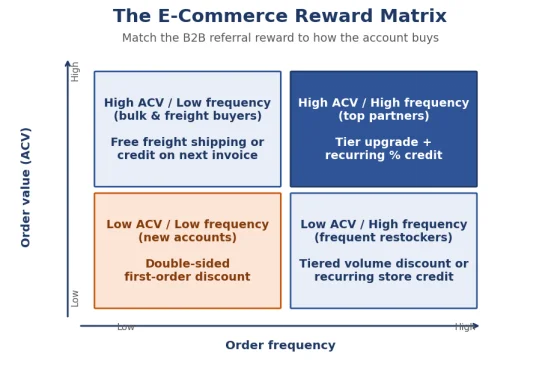
Match the reward to how the account actually buys:
| Buyer profile | What they value | Best reward |
| Low ACV / high order frequency (frequent restockers) | Ongoing savings on regular orders | Tiered volume discount or recurring store credit |
| High ACV / low frequency (bulk & freight buyers) | Big-ticket value per order | Free freight shipping or credit applied to next invoice |
| Recurring / subscription B2B | Predictable, compounding value | Recurring % credit or a permanent tier upgrade |
| New or growing accounts | Momentum and recognition | Double-sided: referred gets first-order discount, referrer gets credit |
How much should a B2B referral reward be?
Keep the reward a small fraction of the revenue a new account generates. Tremendous frames it well: if your average contract is worth $20,000 over three years, a $200 reward is easily justified against what paid acquisition would cost. Start from the lifetime value of a wholesale account, then work backward to a reward that feels generous but still profitable.
With a Shopify loyalty & referral app like BLOY, store credit, discounts, and tier upgrades are built-in reward types, with no custom development required.
Solving “Dark Social”: Tracking Referrals in Private B2B Communities
Here is a truth every merchant knows but few guides mention. Your buyers don’t recommend you on public, trackable channels. They do it in private WhatsApp threads, closed Facebook groups, niche subreddits, trade-show group chats, and LinkedIn DMs. Cello calls this “dark social,” meaning recommendations that are invisible to your analytics.
If you can’t see the referral, you can’t reward it, and the buyer stops bothering. The fix is to give advocates something concrete to drop into those private spaces.
Custom codes & memorable landing pages
- Personal referral codes: give each advocate a short, memorable code (e.g., their store name) they can paste into any chat. When it’s used at checkout, attribution is automatic.
- Custom landing pages: a simple, trackable page the advocate can share, pre-loaded with the referred-buyer offer.
- Trackable links in signatures & bios: let advocates add a referral link to their email signature or community profile.
This is exactly the gap a loyalty app fills: it issues the codes, tracks redemptions across channels, and pays the reward automatically, which solves the attribution problem that kills most manual programs.
How to Set Up a B2B Referral Program on Shopify (Step-by-Step)
Here is a practical blueprint you can launch on a Shopify B2B referral program without writing a line of code. For the consumer-side version, see our guide on how to set up a referral program on Shopify.
- Identify your top 10% of wholesale buyers. Sort accounts by lifetime value and order frequency. These loyal, high-value buyers are your natural advocates.
- Segment them in your loyalty dashboard. Create a “wholesale advocates” segment so you can target only accounts that have earned trust. Never ask on a support or complaint touchpoint.
- Automate the trigger. Prompt the referral ask at a moment of peak satisfaction. For example, right after a buyer’s 3rd successful bulk order is fulfilled.
- Pick the right reward. Use the Reward Matrix in Section 3 to match the incentive to the account’s order profile.
- Promote it through the right channels. Brief account managers to mention it, add it to order-confirmation emails, and surface it in the customer account portal.
- Measure and optimize. Track the KPIs in Section 7, then A/B test reward size and messaging.
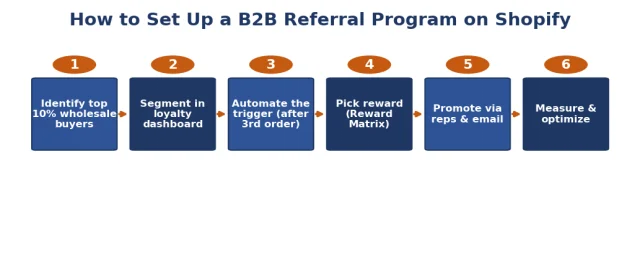
The 6-step setup for a B2B referral program on Shopify.
Copy-Paste Templates & UI Examples
None of the top-ranking guides give you something to ship today. Here are two you can adapt in minutes.
Referral invite email (send after a successful bulk order)
| Email templateSubject: You’ve earned $250 in store credit to share, [First name]Hi [First name],Thanks for another great order for [Store name]. Because you’re one of our top wholesale partners, we’d love your help.Know another shop or buyer who’d stock [Product/Brand]? Share your code [CODE] with them.When they place their first wholesale order, they get 10% off, and you get $250 in store credit toward your next invoice.Share your code → [button/link]Thanks for helping us grow, [Your name] |
Referral widget UI (in the customer account portal)
- Headline stating the two-sided reward: “Give 10%, get $250 credit.”
- The advocate’s personal code with a one-click copy button.
- Share buttons for email, WhatsApp, and copy-link (the dark-social channels).
- A simple tracker: invites sent, signups, rewards earned.
B2B Referral KPIs You Should Track
A referral program without metrics is just goodwill with a price tag. Track these five.
| Metric | What it tells you | Benchmark to aim for |
| Participation rate | % of active buyers who shared at least one referral | 5-15% (Cello) |
| Invites per referrer | How far each advocate spreads the word | 2-5 invites (Cello) |
| Conversion rate | % of invited businesses that become customers | 25%+ for referrals, vs ~6.6% for low-funnel channels |
| CAC (referral vs other) | Cost efficiency of the channel | Lower: referral CAC ~$150 vs $200-500 elsewhere (Tremendous) |
| Referred revenue & LTV | The real value the program creates | Referred accounts ~16% higher LTV |
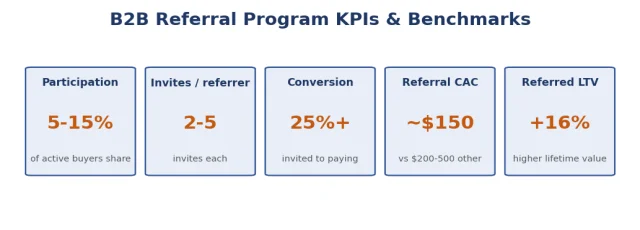
Key B2B referral program KPIs and the benchmarks to aim for.
Common Mistakes to Avoid
- Copying a B2C “Give $10, Get $10” link. Wholesale buyers aren’t moved by small personal cash, so match the reward to business value.
- Asking at the wrong moment. Never request a referral during a complaint or before you’ve delivered value.
- Ignoring dark social. If you only track on-site sharing, you’ll miss where B2B recommendations actually happen.
- Forgetting the account manager. In B2B, a personal nudge from a rep often outperforms any automated email.
- Not measuring. Without attribution and KPIs, you can’t prove ROI or improve.
Choosing a B2B Referral & Loyalty App for Shopify
You can run a small program manually, but it breaks the moment you scale, because tracking codes in a spreadsheet and paying rewards by hand don’t last. When you evaluate a B2B loyalty and referral program app that plugs into your existing Shopify loyalty program, look for:
- Automatic segmentation of high-value wholesale accounts.
- Behavior-based triggers (e.g., after the Nth fulfilled order).
- E-commerce-native rewards: store credit, discounts, tier upgrades, not just cash.
- Custom codes and landing pages to capture dark-social referrals.
- Integration with your Shopify store, email tool, and B2B/wholesale setup.
BLOY is a Shopify loyalty & referral app built for exactly this. It lets you segment top wholesale buyers, automate referral triggers, and reward with store credit or tier upgrades. Explore BLOY to launch your B2B referral program.
Frequently Asked Questions
What is a B2B referral program?
A structured, trackable system that rewards existing business customers for recommending your products or services to other businesses, usually in exchange for a reward like store credit or a discount.
Do B2B referral programs work for wholesale and e-commerce?
Yes. Wholesale buyers trust peers, and referred accounts tend to convert faster and spend more. The key is offering business-relevant rewards (store credit, invoice discounts, tier upgrades) rather than small consumer-style cash incentives.
What is the best referral reward for B2B buyers?
Rewards that keep value inside the buying relationship: store credit, wholesale invoice discounts, free freight shipping, or a tier upgrade. Match the reward to how the account buys using the Reward Matrix.
How is a B2B referral program different from B2C?
B2C referrals are casual and low-stakes with small personal perks. B2B referrals carry professional reputation, involve higher and often recurring order values, and work best with business-value rewards.
How much should a B2B referral reward be?
A small fraction of the revenue a new account generates. Start from the lifetime value of a wholesale account and work backward. For example, a $200 reward against a $20,000 multi-year account.
How do you track referrals in private communities (dark social)?
Give each advocate a personal referral code or trackable landing page they can paste into WhatsApp, Slack, or private groups. When it’s redeemed at checkout, attribution is automatic.
Can I run a B2B referral program on Shopify?
Yes. With a Shopify loyalty and referral app you can segment top wholesale buyers, automate the referral ask, issue codes, and reward with store credit or tier upgrades, with no custom code required.
What KPIs measure a B2B referral program?
Participation rate, invites per referrer, conversion rate, customer acquisition cost versus other channels, and referred revenue and lifetime value.
Conclusion
Your best wholesale accounts already recommend you, and a B2B referral program just makes it trackable and rewarding. The winning approach for merchants isn’t the enterprise-SaaS playbook. It’s e-commerce-native rewards, dark-social tracking, a simple Shopify setup, and clear KPIs.
Pick your top 10% of buyers, choose a reward from the matrix, automate the ask, and measure what comes back. Start small, then scale what works.
Ready to turn your top wholesale buyers into a growth engine? Launch your B2B referral program with BLOY on Shopify.

Yến Lê Hải
Content author at BLOY, focusing on product-led content, SEO, and educational resources to help merchants improve conversion and customer engagement.