Gymshark Loyalty Program: Why It Feels Different From Most Loyalty Programs
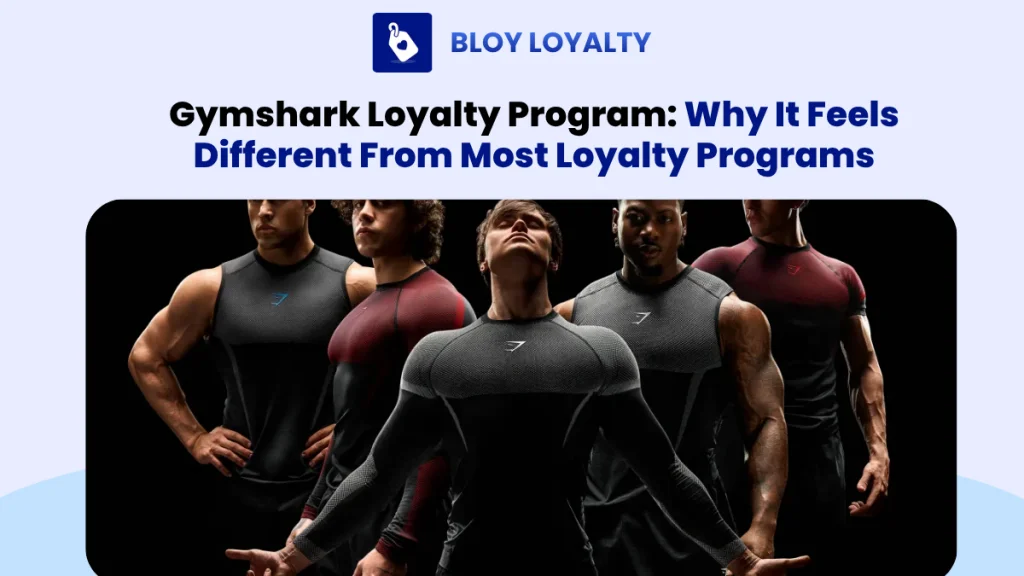
The Gymshark loyalty program is not built around discounts. It is built around participation. While many loyalty programs focus on rewarding purchases, Gymshark rewards behaviors that make the brand more visible: joining challenges, referring friends, engaging with the community, and earning access to exclusive experiences.
Since its founding in 2012 by Ben Francis, Gymshark grew from a screen-printing operation in a garage to a fitness apparel brand with £607.3 million in revenue for FY2024 (year ending July 2024). The Gymshark loyalty program, launched officially in May 2025, is the formalization of a retention and acquisition engine that the brand has been running in different forms for years through community challenges, referral mechanics, ambassador tiers, and VIP product drops.
What makes Gymshark worth studying is not the loyalty program itself. It is how loyalty connects to acquisition, advocacy, and long-term brand equity in a way most DTC brands never achieve.
What Is the Gymshark Loyalty Program?
Overview of Gymshark Rewards
The Gymshark loyalty program rewards members for shopping, working out, and staying connected with the brand. The core philosophy, as stated by Chief Digital Officer Carly Natalizia at launch, is to reward customers for showing up, not just spending. In her words: “It basically comes down to getting paid for sharing, shopping, and, most importantly, showing up.”
Members earn experience points (XP) across multiple touchpoints and progress through a four-tier structure that unlocks increasingly valuable benefits at each level.
How Members Earn XP
XP accumulates through purchases made online or through the Gymshark app, as well as through completing workouts on the Gymshark Training app, subscribing to emails, and other engagement actions. Early joiners who signed up before May 31, 2025 also received legacy XP credit for purchases made throughout 2024, which gave the program an immediate head start in member engagement.
One structural detail worth noting: XP expires on a rolling 12-month basis from the date earned. This keeps the program active rather than allowing points to sit dormant indefinitely, which is a common failure mode in loyalty programs where members earn but never engage.
Loyalty Tiers Explained
The program runs across four tiers, with each tier unlocking a set of exclusive rewards. At Tier 2, members receive a discount reward redeemable on their next purchase. Higher tiers unlock early access to events, product drops, partnership discounts, and event invitations. Once a member reaches a tier, that status is held for 12 months, meaning a single qualifying period protects their benefits.
The tier-down mechanic is noteworthy: if a member does not earn enough XP to maintain their tier over the 12-month window, they move down one level rather than falling to the bottom. This preserves perceived progress and reduces the frustration that tier resets typically create.
Referral Benefits and Community Rewards
Gymshark’s referral structure runs separately from the XP system but feeds the same acquisition loop. The give-and-get model (offer a discount to a new customer while the referrer earns a reward) mirrors what high-performing referral programs have used to drive acquisition at scale. For Shopify brands studying referral mechanics, this is the part of Gymshark’s approach with the most direct replication potential. You can read more about how referral structures work within gym membership referral programs in a related BLOY guide.
How the Gymshark Loyalty Program Works
XP-Based Engagement System
Most loyalty programs tie points directly to dollars spent. Gymshark’s XP system is spend-weighted but not spend-exclusive. Members earn more XP per interaction when they complete workouts on the Training app or share content, which means the program naturally rewards the behaviors that build community. A customer who only shops earns XP. A customer who shops, trains, and shares earns significantly more, and progresses faster.
This structure matters because it makes the loyalty program a product engagement driver, not just a purchase driver. The Training app becomes stickier. Social sharing becomes incentivized. Every brand touchpoint has a loyalty payoff.
Tier Progression and Status Retention
The four-tier structure creates goal gradient motivation. When a member can see they are close to the next tier, behavioral economics research consistently shows they increase purchase and engagement frequency to close the gap. This effect is well-documented across loyalty programs and was applied deliberately in Gymshark’s architecture.
The status protection mechanic (you do not lose tier status just because a return reduces your XP balance) reduces one of the most common sources of loyalty program frustration: members feeling penalized for ordinary shopping behavior like returns.
VIP Product Drops and Early Access
Tier-based early access to product drops is where Gymshark’s loyalty program connects directly to its core commercial model. Collections like the Onyx range generate demand through scarcity and community anticipation. Higher-tier members receive access before the general public, which turns tier status into something fans actively pursue, not just track.
This is the FOMO mechanic made structural. It works because the access is real and the products are desirable. When early access is just a marketing talking point with no actual scarcity, it loses its pull.
Gymshark66 Community Challenge
While technically predating the formal loyalty program, the Gymshark66 challenge is the clearest example of Gymshark turning community behavior into brand equity. The 66-day fitness challenge has generated over 1.9 million likes, more than 12,500 comments, and 45.5 million views on the #gymshark66 hashtag as of 2024, according to Marketing Week. It is one of the most successful branded community campaigns in fitness ecommerce.
Insight: Gymshark rewards behavior, not just purchases. The XP system formalizes what the brand has been doing informally for years: treating every brand interaction as a loyalty signal.
Lesson 1: Turn Challenges Into Customer Acquisition Loops
What Gymshark Did
The 66 Days Challenge was not a giveaway. It was a structured community behavior loop. Participants chose a personal fitness goal, posted a starting photo or video, then returned 66 days later to post their result using #gymshark66. Winners received a year’s supply of Gymshark product, but the real engine was the UGC volume.
Every participant who posted was doing three things simultaneously: creating content that promoted Gymshark, signaling brand identity to their own audience, and building a personal accountability loop that kept them engaged with the brand for 66 consecutive days.
Why It Generated Massive UGC
The mechanism is simple. A branded challenge with a tangible reward and a clear community identity is something people want to participate in publicly. UGC drives 29% higher conversions than non-UGC formats, according to eMarketer data, and 77% of consumers say they would submit UGC in exchange for a reward (Bazaarvoice). Gymshark understood this before it was a widely cited statistic.
The challenge did not feel like advertising. It felt like belonging.
How Shopify Brands Can Replicate It
You do not need a fitness app or 80 influencers to run a behavior-based challenge. What you need is a reward structure that incentivizes a specific repeatable action over a defined period, a community hashtag that creates a visible participation signal, and a follow-up mechanism that brings participants back to your store.
For a Shopify brand, this might look like a 30-day recipe challenge for a food brand, a 21-day outfit posting challenge for an apparel brand, or a 14-day training streak challenge for a supplement brand. The action length matters less than the community loop. The goal is repeated brand exposure during the challenge window and a return trigger at the end.
Pairing challenge participation with your gamified loyalty program gives each step double value: customers earn points for participating AND they become part of your UGC library.
Lesson 2: Build Referral Programs That Reward Both Sides
The Give-and-Get Model
Gymshark’s referral structure follows the double-sided reward model, where the referrer receives a benefit and the new customer receives an incentive to make their first purchase. This is not a new idea, but Gymshark executes it within a brand context that makes the referral feel like a gift rather than a transaction.
When a loyal customer refers a friend to Gymshark, they are not just sharing a discount code. They are sharing their identity as a Gymshark member. That social framing matters enormously for how referrals convert.
Why Referrals Outperform Paid Acquisition
The data is clear on this. Referral programs deliver 4x higher ROI than digital advertising, according to Harvard Business Review data. Referred customers spend 25% more on their initial purchase compared to non-referred customers, and they have a 25% higher lifetime value over time. According to a Wharton Business School study, the customer acquisition cost for referred customers was $23.12 lower than for non-referred customers.
For Shopify brands where paid social CAC has continued to climb, a well-designed referral program is one of the most reliable ways to reduce dependence on Meta and Google spend. Companies with referral programs see up to 24% lower customer acquisition costs overall, per Deloitte research.
How Referral Loops Lower CAC
The math works in a compounding way. A referred customer who is also enrolled in your loyalty program is more likely to refer their own network because they already have a reason to stay engaged. That second-generation referral does not cost you any additional acquisition spend.
This is the loop that Gymshark builds structurally: loyal customer refers a friend, friend joins the loyalty program, friend becomes a loyal customer who refers their own network. The program self-perpetuates.
For Shopify merchants ready to build this kind of double-sided referral system natively within a loyalty program, the BLOY points-based loyalty program guide covers how to structure referral earning alongside purchase rewards.
Lesson 3: Use VIP Access to Create FOMO Without Creating Friction
The Onyx Drop Example
The Gymshark Onyx collection is one of the brand’s most anticipated regular drops. Higher loyalty tier members receive early access before general release, meaning tier status translates into a concrete commercial advantage. You get the product you want before it sells out.
This is a well-executed scarcity mechanic. The tier benefit is real, not symbolic. Members are genuinely advantaged compared to non-members, which creates a visible reason to pursue tier progression.
The Psychology Behind Tier-Based Scarcity
Exclusive access leverages two psychological levers simultaneously: loss aversion (the fear of missing out on a limited product) and status signaling (the visibility of being a higher-tier member who got in early). For brands with genuinely desirable products, this combination is powerful.
The tier model also mirrors what travel loyalty programs have done for decades. Business class upgrades, lounge access, and priority boarding are all status-tier benefits that create strong retention without requiring constant discounting. Tiered loyalty programs for Shopify stores follow the same psychology applied to ecommerce.
What Shopify Merchants Should Watch For
Gymshark’s rollout of VIP access has not been without friction. Community feedback has surfaced issues around unclear queue systems during drops, limited communication about when tier access windows open versus general access, and confusion about expiring rewards that members felt they lost without adequate notice.
These are execution problems, not structural problems. The lesson for Shopify merchants is that VIP access only works as a retention tool if the communication layer is reliable. Members need to know when their access window is, what they can access, and how long they have. Ambiguity around exclusive access creates frustration faster than it creates loyalty.
Simple rules help here: clear email notifications when access windows open, countdown timers visible in the loyalty account dashboard, and consistent messaging about reward expiry dates well in advance.
Lesson 4: Turn Loyal Customers Into Micro-Influencers
The Gymshark Athlete Program Architecture
While Gymshark’s formal loyalty program launched in 2025, the brand has operated an informal tier-based advocate structure for much longer. The Seeding-Ambassador-Athlete pipeline runs from product gifting at the entry level through formal ambassador relationships to full Gymshark Athlete status, where creators receive creative input on product lines and exclusive collection collaborations.
As Gymshark’s PR head Stephanie O’Neill has noted publicly, the brand prioritizes engagement quality and audience trust over follower count. This is a deliberate decision: a creator with 50,000 highly engaged fitness followers is more valuable than a creator with 500,000 passive followers who barely interact with content.
The Seeding-Ambassador-Athlete pipeline creates deepening relationships over time, as detailed by Rivo’s breakdown of Gymshark’s retention strategy. Rather than spreading budget across hundreds of one-off activations, Gymshark invests in fewer, longer-term partnerships that compound in trust and reach.
How Loyalty Members Can Become Brand Advocates
Most Shopify brands will not build a formal athlete program. But the underlying structure is replicable at any scale. The key insight is that your most engaged loyalty members are already functioning as micro-influencers for your brand, whether or not you have formalized that relationship.
A member who posts about your product, tags your brand, and refers three friends is generating measurable acquisition value. Rewarding those behaviors through your loyalty program, giving them early access to new products, and occasionally featuring their content creates a genuine advocate relationship without requiring influencer marketing spend.
The social media layer matters here. According to Bazaarvoice, 77% of consumers would submit UGC in exchange for a reward. Your loyalty program is the mechanism that activates that willingness. For brands looking to connect social engagement to loyalty earning, social media loyalty programs for Shopify break down exactly how to structure UGC rewards within a points system.
Lesson 5: Reward Engagement, Not Just Spending
Why Purchase-Only Loyalty Programs Fall Short
A loyalty program that only rewards purchases is a discount program with extra steps. It reduces margin, trains customers to expect price incentives, and provides no competitive differentiation. Any brand can offer a discount. Not every brand can offer recognition, community, and status.
Gymshark’s XP system explicitly rewards behaviors beyond purchasing: completing workouts, sharing content, engaging with the Training app. Each of these behaviors deepens brand attachment in ways that purchase discounts never can.
The loyalty program objectives guide from BLOY identifies advocacy as one of the most overlooked loyalty objectives for Shopify merchants. The brands that build it into their program structure from the start tend to outperform those that retrofit it later.
What Community Actions Actually Drive
When a customer completes a workout using your branded app, they associate the feeling of achievement with your brand. Then when they share a transformation using your hashtag, they publicly align their identity with your product. When they refer a friend and both get rewarded, they have created a social proof event with downstream retention value.
These are not soft metrics. Repeat purchase rates among Gymshark’s community members rose 30%, and community engagement rates doubled over two years, according to Rivo’s breakdown of the brand’s retention data. The community behaviors are doing measurable commercial work.
Building an Engagement-Based Program on Shopify
For a Shopify brand, building an engagement-based loyalty system means defining which non-purchase actions you want to reward, assigning point values proportional to the effort and value of each action, and connecting those actions to tier progression so engagement accelerates status growth.
Common engagement earning actions that work well: leaving a product review (high social proof value), referring a friend (direct acquisition value), sharing a post or tagging the brand (content value), completing a brand challenge (community and UGC value), and subscribing to a newsletter or following on social (audience building value).
The how to set up a loyalty program guide from BLOY walks through the earning rule structure in practical detail, including how to weight engagement actions relative to purchase rewards without creating margin risk.
What Shopify Merchants Can Learn From the Gymshark Loyalty Program
What Gymshark Gets Right
Community first. Gymshark does not treat loyalty as a retention tool bolted onto a transactional model. It treats community as the core product and uses loyalty mechanics to formalize and reward the behaviors that build it. Every XP-earning action reinforces a brand behavior, not just a purchase decision.
UGC as acquisition. The Gymshark66 challenge, athlete seeding, and social sharing rewards all produce content that functions as organic acquisition. The #gymshark hashtag has 11.5 billion views on TikTok alone, according to The Scaleup Collective. Most of that content was created by customers, not the brand.
Referrals within a loyalty framework. The double-sided referral model connects to tier progression, meaning a member who refers a friend is simultaneously growing their own loyalty status and adding a new member to the program. The loop is self-reinforcing.
Status as a product. Tier benefits like early access to Onyx drops make tier status commercially meaningful, not just symbolically satisfying. Members pursue tier progression because it gives them real advantages, not because they enjoy the label.
What Gymshark Gets Wrong
No loyalty program at scale runs perfectly. Gymshark’s execution has surfaced a few patterns that Shopify merchants should specifically avoid.
Tier transition communication gaps. When members move up a tier or are close to losing status, the notification system needs to be precise and timely. Community feedback indicates Gymshark has had gaps here, leaving members uncertain about their standing.
Reward expiry without adequate notice. XP expiry on a 12-month rolling basis is a reasonable structural choice, but members who lose points they forgot about feel cheated rather than motivated. A reminder email 30 days before expiry is a minimal fix that most programs do not implement.
Queue confusion during product drops. When VIP early access windows are not clearly communicated, members who believe they should have access but cannot get in generate disproportionate frustration. Early access only works as a benefit if the access experience is frictionless.
These are solvable operational problems, not program design failures. But they are the kind of friction that erodes trust faster than it erodes revenue, which is why Shopify merchants building VIP tier access should invest in the communication layer before they invest in the tier benefit.
The Takeaway
The biggest structural lesson from Gymshark is this: loyalty should not be designed to keep existing customers from leaving. It should be designed to turn existing customers into the primary mechanism for brand growth. Retention, acquisition, and advocacy should all flow from the same system.
Keep it simple enough to use, but design it deliberately enough to create advocacy.
Conclusion
The Gymshark loyalty program is not remarkable because of its mechanics. XP systems, four-tier structures, and double-sided referral rewards are not new ideas. What makes it worth studying is the way Gymshark has consistently connected loyalty to community, community to content, and content to acquisition in a compounding loop that most DTC brands have not replicated.
The five lessons distill to one underlying principle: loyalty should not only increase retention. It should create visibility, advocacy, and customer acquisition at the same time.
For Shopify brands at any stage, the question is not whether to build a loyalty program. The question is whether to build one that only rewards purchases or one that rewards the full range of behaviors that make customers valuable.
If you want to launch points, VIP tiers, referrals, and engagement rewards without engineering a complex system from scratch, BLOY is built specifically for Shopify stores that want to start simple and scale with purpose.

Yến Lê Hải
Content author at BLOY, focusing on product-led content, SEO, and educational resources to help merchants improve conversion and customer engagement.