POS Loyalty Program for Shopify: Setup, Rewards & ROI
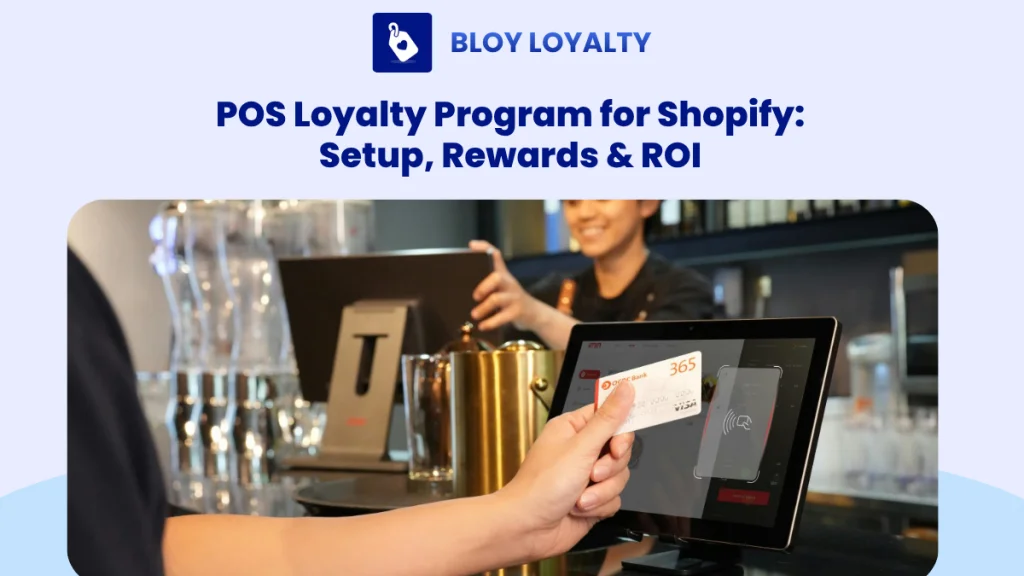
Most Shopify merchants think a POS loyalty program simply means giving points at checkout. But the real value is not the points. It is the ability to connect in-store purchases, online customer accounts, VIP tiers, and rewards into one retention system. This guide shows how Shopify merchants can build a POS loyalty program that is easy to launch, profitable to run, and scalable across online and offline sales.
1. What Is a POS Loyalty Program?
A POS loyalty program is a structured reward system that tracks and incentivizes customer purchases made at a physical point of sale. When a customer buys in-store, the program identifies them, credits points or rewards to their account, and allows them to redeem those rewards either at checkout or on a future visit.
The key difference between a POS loyalty program and an online-only loyalty program lies in the touchpoint and the data layer behind it. An online loyalty program operates within a website, cart, or checkout flow. A POS loyalty program operates at a retail counter, requires real-time customer lookup, and must sync data back to the customer’s account so that nothing is lost between channels.
For Shopify merchants who sell both online and in-store, the loyalty program must work across both environments. A customer who earns points online should be able to redeem them in-store, and vice versa. Without that sync, the program creates data silos and missed opportunities.
| Type | Online loyalty | POS loyalty |
|---|---|---|
| Main touchpoint | Website, cart, checkout | Retail store, checkout counter |
| Customer action | Online purchase, account signup | In-store purchase, QR/customer lookup |
| Main risk | Low visibility | Data silo, missed points |
| Best use | Ecommerce retention | Omnichannel retention |
2. Why Shopify Merchants Need POS Loyalty Beyond Punch Cards
Physical punch cards are still common in small retail. They are easy to hand out and require no software. But they do not store customer behavior, cannot sync with an online store, and disappear the moment a customer forgets to bring them.
The gap goes deeper than lost cards. When a customer buys in-store but has no link to their online account, the merchant loses the ability to track repeat purchase rate, measure AOV growth, identify VIP customers, or trigger post-purchase campaigns. The offline sale happens, but it contributes nothing to the retention system.
Research on omnichannel retail consistently shows that businesses with comprehensive omnichannel customer engagement strategies retain up to 89% of their customers, compared to just 33% for those with weak omnichannel approaches. A POS loyalty program is one of the most practical ways to close that gap for merchants running both online and in-store channels.
Generic POS reward tools often make this worse by operating as standalone systems that never communicate with Shopify’s customer data. A customer who has Gold status online walks into the store and is treated like a stranger. That is not a loyalty program. It is two separate programs pretending to be one.
With BLOY, merchants can maintain consistent points, rewards, and VIP tier experiences across both online and in-store touchpoints, turning every in-store checkout into a contribution to the same retention system.
3. How a Shopify POS Loyalty Program Works
Understanding the mechanics helps merchants set up a program that actually functions at the counter without slowing down checkout.
3.1. Customer Identification at POS
The first step in any in-store loyalty interaction is identifying the customer. This typically happens through email lookup, phone number, or a QR code linked to the customer’s loyalty account. The faster this step is, the smoother checkout becomes.
For Shopify merchants, loyalty accounts should be tied directly to Shopify customer profiles. When a staff member looks up a customer by phone number and finds their profile, the loyalty data, points balance, VIP tier, and reward history should all be visible in the same view.
3.2. Earning Points from In-Store Purchases
Once the customer is identified, in-store purchases earn points exactly as online purchases do. The earning rule can be as simple as one point per dollar spent, or it can be product-specific or campaign-based during promotional periods.
The simplicity of the earning rule matters at the counter. If a cashier needs to explain a complex structure to every customer, the program creates friction instead of loyalty. Starting with a flat rule and expanding later is a more practical approach for most merchants.
3.3. Redeeming Rewards at Checkout
Redemption at POS must be fast. Customers who want to use a reward should be able to do so without requiring a manager, a workaround, or a lengthy lookup process. Common redemption options include amount discounts, percentage discounts, free products, and custom rewards.
The checkout should clearly show the customer’s current balance and available rewards before confirming the transaction, so staff can offer the option proactively rather than waiting for the customer to ask.
3.4. Syncing VIP Tiers Across Online and Offline
This is the part that separates a real omnichannel POS loyalty program from a basic stamp card. Points earned in-store should contribute to VIP tier progression, and tier status should be visible and consistent whether the customer shops online or walks into the store.
A customer who reaches Gold tier through a combination of online and in-store purchases should be recognized as a Gold member at POS. This recognition, whether it means an extra discount, early access, or simply being addressed by tier status, is what makes the loyalty program feel real rather than transactional.
4. Which POS Loyalty Model Should You Choose?
Not every store needs the same structure. The right POS loyalty model depends on purchase frequency, average order value, and customer behavior.
| Store type | Best POS loyalty model | Why it works |
|---|---|---|
| Coffee, bakery, small F&B | Stamp-style points | Frequent purchases, low AOV |
| Fashion, beauty, skincare | VIP tiers + points | Encourages repeat spend and status |
| Supplements, consumables | Points + subscription perks | Supports replenishment behavior |
| Gift, lifestyle, accessories | Referrals + rewards | Encourages word-of-mouth |
| Pop-up / event retail | Limited-time bonus points | Creates urgency and first-party data |
For a deeper look at how to choose between these structures, the BLOY guide on points-based loyalty programs for Shopify stores and tiered loyalty programs for Shopify stores both cover the mechanics and decision logic in detail.
BLOY supports flexible program setups where merchants can combine points, VIP tiers, referrals, and custom rewards based on their store model, without needing to rebuild the program from scratch as the business grows.
5. How to Calculate If Your POS Loyalty Program Is Profitable
Most merchants who struggle with POS loyalty ROI are asking the wrong question. They focus on the value of a point rather than the cost of a reward. Those are not the same thing.
5.1. Start with Reward Cost, Not Point Value
A point value tells you how much a customer earns per dollar. A reward cost tells you how much the merchant pays when that reward is redeemed. The second number is what determines profitability.
Before launching a POS loyalty program, calculate whether your gross margin can absorb the reward at your expected redemption rate. A 50% margin store offering a $10 reward at 30% redemption has a different financial reality than a 20% margin store offering the same reward.
5.2. Simple POS Loyalty ROI Formula
Reward Cost = Reward Value x Redemption Rate

Incremental Revenue = Repeat Orders x Average Order Value

POS Loyalty ROI = (Incremental Revenue - Reward Cost) / Reward Cost
This framework gives merchants a starting point for evaluating whether their program is generating incremental revenue or simply subsidizing purchases that would have happened anyway.
5.3. Example Calculation
To make this concrete, consider a merchant with the following baseline:
- AOV: $50
- Gross margin: 50%
- Reward: $5 off per redemption
- Redemption rate: 30%
- Active loyalty members: 100
Reward cost across 100 members at 30% redemption: $150
If the loyalty program drives 40 additional repeat orders that would not otherwise have occurred, incremental revenue equals $2,000. After subtracting reward cost, the margin retained on those additional orders is the program’s profit contribution.
The key question is always whether the repeat purchases are truly incremental. A well-designed loyalty program business model separates retention-driven purchases from discount-seeking behavior, and that distinction determines whether the program is a profit center or a cost center.
6. How to Set Up a POS Loyalty Program on Shopify with BLOY
The setup process does not need to be complex. Most merchants can have a functional POS loyalty program running within a day.
6.1. Install BLOY from the Shopify App Store
Install the BLOY loyalty app from the Shopify App Store, connect it to the store, and select the initial program type. For most merchants starting with POS loyalty, a points-based structure is the fastest to launch and easiest for staff to explain at the counter.
For a full walkthrough of the setup logic, the BLOY guide on how to set up a loyalty program covers the sequence from goal-setting through to launch.
6.2. Create Earning Rules for POS Purchases
Set the points-per-purchase rule, decide whether all products or a selected range earn points, and define the order status that triggers the point credit. Keeping this simple at launch reduces staff training time and customer confusion.
6.3. Create Redemption Rules
Configure the redemption options that will appear at POS checkout. Common starting options are a fixed amount discount or a free product. Percentage discounts can be added once the baseline is working. Avoid stacking too many redemption options at launch, as this slows down the checkout conversation.
6.4. Add BLOY to the Shopify POS Smart Grid
In Shopify POS, navigate to the Smart Grid customization screen and add the BLOY tile or app extension. This gives staff direct access to customer lookup, points balance, and reward redemption without leaving the POS interface.
Test the tile with a real or test customer before going live. Confirm that customer lookup works by phone and email, that points are credited immediately after a transaction, and that redemption applies the correct discount at checkout.
6.5. Test the Full Customer Journey
Before launch, run through the complete flow:
- Customer makes an in-store purchase
- Points are credited to their account
- Customer checks their balance (via staff lookup or account page)
- Customer redeems a reward at POS
- VIP tier progress updates correctly
- Online account reflects the same loyalty status
Any gaps in this chain, particularly between step 5 and step 6, are worth resolving before the program goes live to customers.
7. How AI Can Make POS Loyalty Easier to Launch and Optimize
One of the common barriers to launching a POS loyalty program is the blank-screen problem. Merchants know they want a program, but they are uncertain how many points to offer, which rewards to start with, or whether their proposed structure is margin-safe.
AI-assisted onboarding addresses this by helping merchants move from uncertainty to a working setup faster. Rather than guessing a point value or copying a competitor’s structure, merchants can receive suggestions based on store type, AOV, product category, and expected purchase frequency.
AI can also flag reward rules that are likely to be too costly given the store’s margin, or too weak to drive the behavior change the merchant is trying to create. This reduces the guesswork that causes many merchants to either set rewards too high (reducing profit) or too low (reducing engagement).
Loyalty program trends heading into 2026 point to AI-powered personalization becoming a baseline expectation rather than a premium feature. For POS loyalty specifically, this means smarter customer segmentation, reward timing based on purchase cycles, and proactive suggestions for when to adjust program structure.
BLOY’s AI-assisted onboarding helps merchants move from a blank setup screen to a practical loyalty structure faster, reducing the guesswork that often delays program launches or leads to miscalibrated reward economics.
8. POS Loyalty Program Examples for Shopify Merchants
Seeing how different store types apply POS loyalty in practice makes the mechanics easier to translate to a specific business.
8.1. Coffee Shop: Simple Points for Frequent Visits
A coffee or bakery with high purchase frequency and low AOV benefits most from a stamp-style or flat-rate points structure. Customers earn points per order and redeem them for a free drink or a fixed discount after a set number of visits. The program needs to be explainable in one sentence at the counter and visible enough that customers remember it exists between visits.
8.2. Fashion Store: VIP Tiers for High-Value Customers
A fashion or lifestyle store with a higher AOV benefits from a tiered structure where in-store and online purchases combine toward tier progression. Gold or VIP members unlock early access to new collections, exclusive styling appointments, or free alterations. The in-store touchpoint becomes a recognition moment rather than just a transaction. For more on building a tier structure that motivates this behavior, see the BLOY guide on membership tiers for Shopify.
8.3. Supplement Store: Rewards for Replenishment
Supplement and consumable stores have a predictable repurchase cycle. A POS loyalty program can reinforce that cycle by triggering bonus point events near the expected replenishment date, rewarding bundle purchases, and offering birthday rewards that keep the brand front of mind. Points earned in-store contribute to the same replenishment-focused program as online purchases.
8.4. Beauty Store: Referrals After In-Store Purchase
A beauty store can use the in-store purchase moment as a referral trigger. After checkout, a customer receives a referral link or a printed card that rewards them for introducing a friend. The offline purchase becomes the starting point for an online advocacy loop, turning an in-store buyer into a channel for new customer acquisition. This is covered in more depth in the BLOY guide on how to set up a loyalty program.
9. BLOY vs Built-In POS Loyalty: What Is the Difference?
Shopify includes basic customer profile functionality at POS, but the native tools are not designed to run a structured loyalty program with points, tiers, and cross-channel sync.
| Criteria | Built-in POS loyalty | BLOY Loyalty |
|---|---|---|
| Points program | Basic or limited | Flexible earning and redemption rules |
| VIP tiers | Often limited | Supports tier-based loyalty strategy |
| Referrals | Usually separate | Can connect referrals with loyalty |
| Shopify online sync | Depends on system | Designed for Shopify loyalty workflows |
| Branding | Limited | Customizable loyalty experience |
| Scaling | Suited for simple programs | Better suited for growing Shopify merchants |
The distinction is not about one being superior in all cases. It is about fit. For merchants who want a points program that works only at POS and does not need to connect with online purchases, a simpler setup may be enough. For merchants running both channels and wanting VIP progression, referral mechanics, and consistent customer recognition across touchpoints, a dedicated loyalty platform is better suited for the job.
10. Common Mistakes to Avoid When Launching a POS Loyalty Program
Most POS loyalty programs that fail do not fail because of the technology. They fail because of avoidable setup decisions that create friction, reduce margin, or make the program invisible to customers.
10.1. Making the Reward Too Hard to Understand
If a cashier needs more than one sentence to explain the program, it will not be explained consistently. Keep the initial earning rule and redemption option simple enough that staff can communicate them during a normal checkout without slowing the line.
10.2. Not Syncing Online and Offline Customer Data
A customer who buys across both channels should have one loyalty account, one points balance, and one VIP status. Running two separate systems that do not sync creates frustrated customers who feel penalized for shopping across channels.
10.3. Offering Rewards Without Checking Margin
A reward that drives repeat purchases but erodes the margin on each transaction is not a loyalty program. It is a discount campaign with extra steps. Check reward cost against gross margin before launch, and review it monthly as redemption rate becomes clearer.
10.4. Hiding Loyalty Value After Checkout
Customers who do not see their points balance, reward progress, or next reward milestone will not be motivated by the program. Visibility is not a design preference. It is a conversion requirement. The balance should be visible in the customer’s account, in post-purchase communication, and at the POS counter during their next visit.
10.5. Setting Up Once and Never Optimizing
A POS loyalty program is not a launch-and-forget system. Redemption rate, repeat purchase rate, AOV among loyalty members versus non-members, and active member rate are the metrics that tell a merchant whether the program is changing behavior. Review these monthly and adjust earning rules, reward values, or tier thresholds when the data suggests they are not working.
11. POS Loyalty Program Checklist for Shopify Merchants
Before launching, use this checklist to confirm the program is ready to run:
- Define the main goal: repeat purchase, VIP retention, referrals, or AOV growth
- Choose one simple earning rule to start (for example: $1 spent earns 1 point)
- Choose one easy redemption option ($5 off, free product, or percentage discount)
- Confirm customer lookup works at POS by phone and email
- Test online-to-offline point sync with a real transaction
- Train staff to explain the program in one sentence
- Set up post-purchase communication that shows the customer their points balance
- Track redemption rate and repeat purchase rate from week one
- Review reward cost against margin every month
- Add VIP tiers only after customers understand the base points system
For a broader framework on setting loyalty program goals before configuring any mechanics, the BLOY guide on loyalty program objectives is a useful reference before finalizing the setup.
Conclusion: Build a POS Loyalty Program That Connects Every Purchase
A POS loyalty program that works is not just a rewards tool at the checkout counter. It is the connective layer between offline purchases and online customer data, between a single transaction and a long-term retention system, and between a one-time in-store visit and a returning customer who knows their loyalty is recognized wherever they shop.
Omnichannel data shows that customers who engage across multiple channels spend 30% more than single-channel shoppers. A well-configured POS loyalty program is one of the most direct ways for Shopify merchants to capture that additional spend by making the in-store channel a full participant in the retention system rather than an isolated touchpoint.
BLOY helps merchants launch a flexible POS loyalty program with points, rewards, VIP tiers, and AI-assisted setup, so loyalty can work across both online and in-store journeys without requiring two separate systems or two separate customer databases.
For merchants who want to go deeper on the loyalty program types that work best alongside a POS setup, the following BLOY guides cover the relevant structures in detail:

Yến Lê Hải
Content author at BLOY, focusing on product-led content, SEO, and educational resources to help merchants improve conversion and customer engagement.