Why Points-Based Loyalty Programs Outperform Generic Rewards for Shopify Stores?
Running a Shopify store is one thing, keeping your customers coming back is another. That’s where points-based loyalty and rewards programs come in. Unlike generic discounts, these programs tap into customer psychology, turning every purchase, referral, or engagement into meaningful points that drive repeat purchases, higher engagement, and long-term loyalty. In this guide, we’ll show why points-based programs outperform generic rewards and how you can set up a system that keeps your shoppers coming back for more.
1. What Is a Points-Based Loyalty Program?
Loyalty programs are more than simple discounts. They are a powerful way to turn one-time buyers into loyal customers. Among these, the points-based loyalty program stands out for its ability to boost engagement, increase repeat purchases, and strengthen long-term brand loyalty for Shopify stores. But why do points-based programs work so effectively?
1.1. Psychology Behind Points-Based Loyalty Programs
A points-based loyalty program gives every customer interaction perceived value. Unlike one-off discounts, points create a sense of progress and achievement, motivating shoppers to engage repeatedly. This gamification taps into basic human psychology: people enjoy tracking progress and earning rewards, and they are more likely to return to your store to accumulate and redeem points than to chase occasional coupons.
1.2. How Points-Based Loyalty Programs Differ from Generic Rewards
Generic rewards, such as a flat 10% off for all customers, often fail because they feel impersonal and lack long-term incentive. In contrast, a points-based loyalty program rewards specific actions, including purchases, referrals, social engagement, and reviews. By tying rewards to customer behavior, Shopify merchants can encourage repeat buying, create a stronger emotional connection, and make each interaction feel meaningful.
1.3. Why This Matters for Shopify Stores
For Shopify merchants, a points-based loyalty program can seamlessly integrate with POS systems, checkout flows, and membership modules, creating a unified experience for shoppers. Beyond motivating purchases, it collects actionable data on customer behavior, allowing merchants to run personalized campaigns, targeted offers, and smarter marketing strategies.
2. How Points-Based Loyalty Programs Work for Shopify Stores
- Sign-Up / Onboarding: Customers join the program by registering with basic information such as their name, email, and birthday. This registration creates a personalized account that tracks all earned points and rewards, setting the foundation for their loyalty journey.
- Earning Points: Customers earn points by completing key actions, including making purchases, writing product reviews, referring friends, or engaging on social media. Integration with Shopify POS, online store, checkout, and membership modules ensures that points are accurately tracked across every channel.
- Points Accumulation & Tracking: As customers continue to engage, points accumulate in their accounts and can be viewed through a mobile app, online account, or physical loyalty card. This visible tracking not only helps customers monitor their progress but also encourages ongoing participation.
- Redeeming Rewards: Customers can redeem their points for discounts, free products, free shipping, or exclusive perks. Keeping the redemption rules simple and clear increases participation, makes the program easy to understand, and enhances customer satisfaction.
- Repeat & Engagement Loop: The program establishes a continuous cycle of earning, tracking, and redeeming points. This engagement loop keeps customers motivated, drives repeat purchases, and strengthens long-term brand loyalty.
3. Types of Points-Based Loyalty Programs
Points-based loyalty programs can drive repeat purchases and engagement. Let’s take a look at the main types you can implement to make your Shopify store’s rewards program more effective.
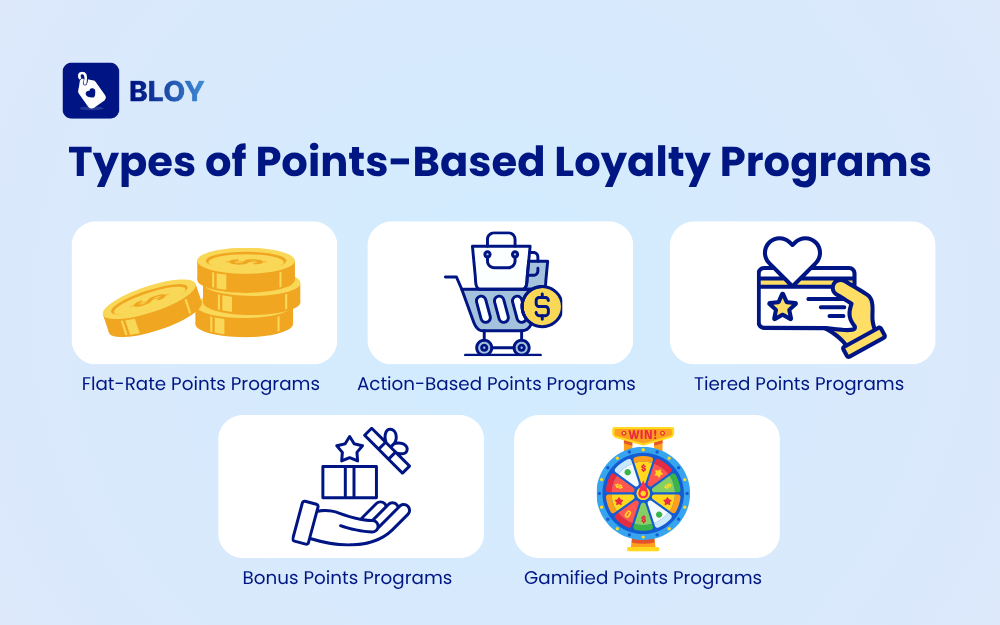
- Flat-Rate Points Programs: In a flat-rate points program, customers earn a fixed number of points for every dollar they spend, such as 1 point per $1. This type of program is simple, easy to understand, and works well for small stores with straightforward pricing structures.
- Action-Based Points Programs: Action-based points programs reward customers for completing specific actions, including making purchases, writing product reviews, referring friends, or engaging on social media. This approach encourages customers to interact with the brand in multiple ways and increases overall engagement.
- Tiered Points Programs: Tiered points programs allow customers to unlock higher points earning rates or exclusive rewards after reaching certain spending or engagement milestones. This type is effective for medium to large stores that want to motivate repeat purchases and reward their most loyal customers.
- Bonus Points Programs: Bonus points programs offer extra points for specific events, promotions, or product launches. By providing additional incentives during key moments, these programs drive short-term engagement and increase sales during targeted campaigns.
- Gamified Points Programs: Gamified points programs incorporate game-like elements such as challenges, mini-games, or spinning wheels to earn points. These programs boost engagement and make the loyalty experience fun, particularly for mobile-first brands and highly engaged audiences.
4. Points-Based Loyalty Program vs Other Loyalty Models
For Shopify merchants, choosing the right loyalty model can directly impact repeat purchases, engagement, and overall revenue. Points-based loyalty programs are particularly effective, but other models can complement them depending on your goals. Below is a comparison to help you decide.
| Loyalty Model | Key Focus | Main Benefit | Shopify Merchant Insight | Recommendation |
|---|---|---|---|---|
| Points-Based Loyalty Program | Reward actions (purchases, reviews, referrals, social engagement) | Continuous engagement, higher repeat purchase | Works across all customer types; easy integration with POS, checkout, membership | Ideal for merchants focusing on retention and repeat sales; forms the foundation of your loyalty strategy |
| Tiered Loyalty Program | Milestone rewards | Drives higher spending for loyal customers | Motivates top spenders but slower engagement for new/occasional shoppers | Best as a complement to points-based for high-value customers |
| Referral Loyalty Program | Customer acquisition | Attracts new customers via existing ones | Great for growing customer base but does not retain existing customers | Use alongside points-based to balance acquisition and retention |
| Subscription Loyalty Programs | Recurring revenue | Predictable income from repeat subscriptions | Engages only recurring buyers; limited effect on casual shoppers | Combine with points-based for broader engagement |
| Gamified Loyalty Program | Challenges, mini-games | Increases engagement through fun | Can drive social sharing and excitement but complex to manage | Points-based can incorporate gamification elements without added complexity |
| Event-Based Loyalty Program | Special campaigns or holidays | Boosts short-term sales | Engagement spikes only during events; no consistent behavior | Points-based ensures year-round motivation, complement event-based promotions |
| Social Media Engagement Loyalty Programs | Likes, shares, follows | Builds brand awareness | Drives traffic but has limited impact on repeat purchases | Points-based can include social actions while rewarding revenue-driving behaviors |
For a deeper understanding of all types of loyalty programs, including tiered, referral, subscription, and gamified models, check out our types of loyalty program guide.
5. Real-World Examples of Points-Based Loyalty Programs
5.1. Mila & Co.
Mila & Co. is a Canadian family-run brand offering organic clothing for babies, kids, and moms. The brand launched its points-based loyalty program to strengthen engagement with eco-conscious customers.
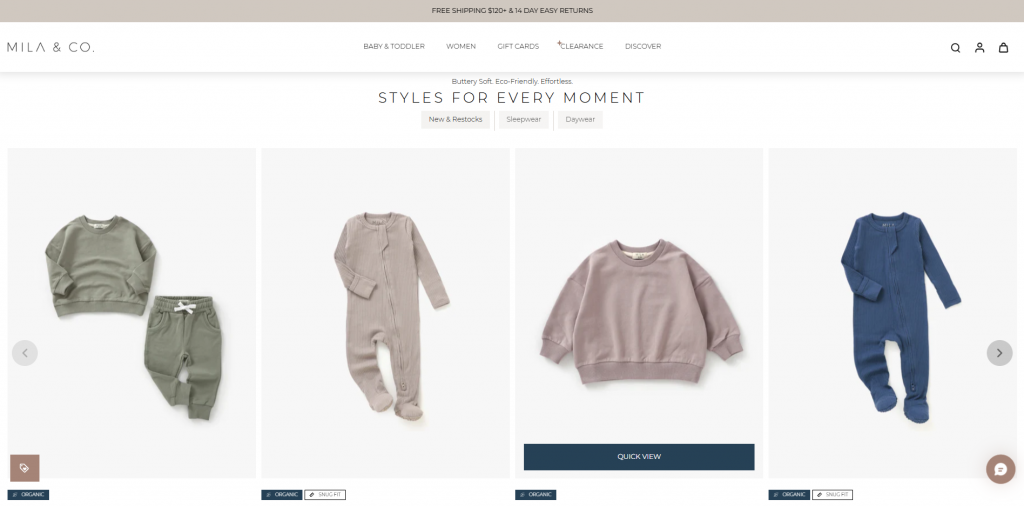
By rewarding both purchases and interactions, the program motivates repeat buying and social connection. Members earn 5 points per $1 spent and additional points for actions such as creating an account, celebrating birthdays, or following on social media. Points can be redeemed for discounts ranging from $5 to $20.
Results: After launching with BLOY, Mila & Co. saw a 12% increase in repeat purchases, 15% higher engagement, and 8% growth in average order value.
5.2. Supra Protein
Supra Protein, a direct-to-consumer supplement brand, uses its loyalty program to make health and wellness more rewarding. Customers earn 1 point for every 1 TL spent and up to 1500 points for birthdays or 1000 points for signing up.
Rewards include gift certificates and free products such as Collagen, Omega-3, and Vitamin C, making customers feel appreciated and motivated to stay consistent.
Results: Since switching to BLOY, Supra Protein achieved a 10% increase in total orders, 17% growth in returning customers, and 8% higher average order value.
5.3. Le Sens des Choses
Le Sens des Choses is a French eco-boutique that promotes slow living and mindful consumption. Its minimalist points program rewards customers with 2 points per €1 spent and bonus points for actions like sign-ups, birthdays, or newsletter subscriptions.
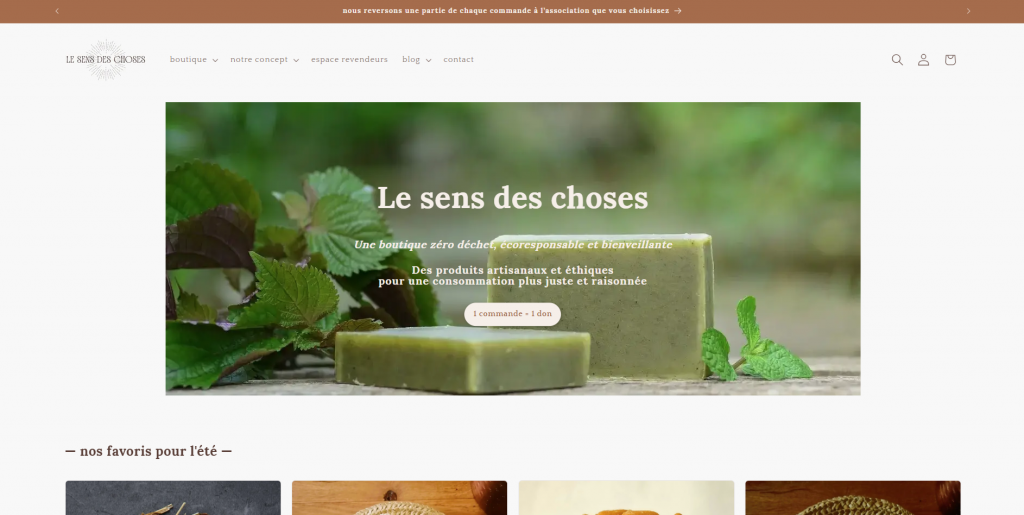
With a simple €1 = 100 points system, the brand encourages repeat purchases without unnecessary complexity. The program also replaced manual coupon codes, improving customer retention and experience.
Result: Although newly launched, returning customers have already shown strong appreciation for the seamless and thoughtful system.
5.4. The Gentlemen’s Vault
The Gentlemen’s Vault is a Dutch menswear brand that uses a branded points program to build community among fashion-conscious men. Customers earn 5 points per €1 spent and 200 points for engagement actions such as following on social media or joining the newsletter.
Points can be redeemed for €10 off per 500 points, with reward visibility embedded across product pages, checkout, and the customer account.
Results: One in five orders now comes from loyalty members, with improved conversion rates and repeat visits. The program strengthens brand identity while rewarding loyal customers.
5.5. Rugged Pirate Beard Co.
Rugged Pirate Beard Co. is a U.S.-based grooming brand that launched Rugged Rewards to boost customer retention and reviews. Members earn 5 points per $1 spent and bonus points for actions such as leaving reviews, following on social media, and celebrating birthdays.
Points can be redeemed for discounts between $10 and $20 or for free grooming products, creating a fun and valuable customer experience.
Results: After implementing BLOY, the brand achieved a 20% increase in total sales and a sharp rise in verified product reviews, thanks to automation and customer engagement.
Inspired by these real-world examples? Start your own points-based loyalty program today with BLOY and see how it can boost repeat purchases, engagement, and revenue.
6. How to Set up a Loyalty Points Program for Your Shopify Store?
Step 1: Understand Your Customers and Define Your Goals
Before setting up a points-based loyalty program, it is essential to have a clear understanding of your customers and what drives their loyalty. Start by gathering insights about your audience:
Customer insights:
- Identify your audience: Determine whether your customers are repeat buyers, budget-conscious shoppers, or new visitors exploring your store.
- Understand motivations: Find out if they are more likely to respond to discounts, exclusive perks, or special rewards.
- Analyze shopping behavior: Review their purchase frequency, preferred channels, and average order value to understand how they engage with your store.
Once you have a clear picture of your customers, define the goals of your loyalty program:
- Increase repeat purchases by incentivizing ongoing engagement.
- Boost customer interaction and brand connection through meaningful rewards.
- Encourage referrals or social sharing to expand your reach.
Finally, determine the metrics that will help you track success, such as customer retention rate, lifetime value, and referral conversions. These will allow you to measure the effectiveness of your program and make informed adjustments.
Step 2: Select the Right Loyalty App for Your Shopify Store
When choosing a loyalty app for your Shopify store, not all options are equally suited for points-based programs. Here’s a quick comparison:
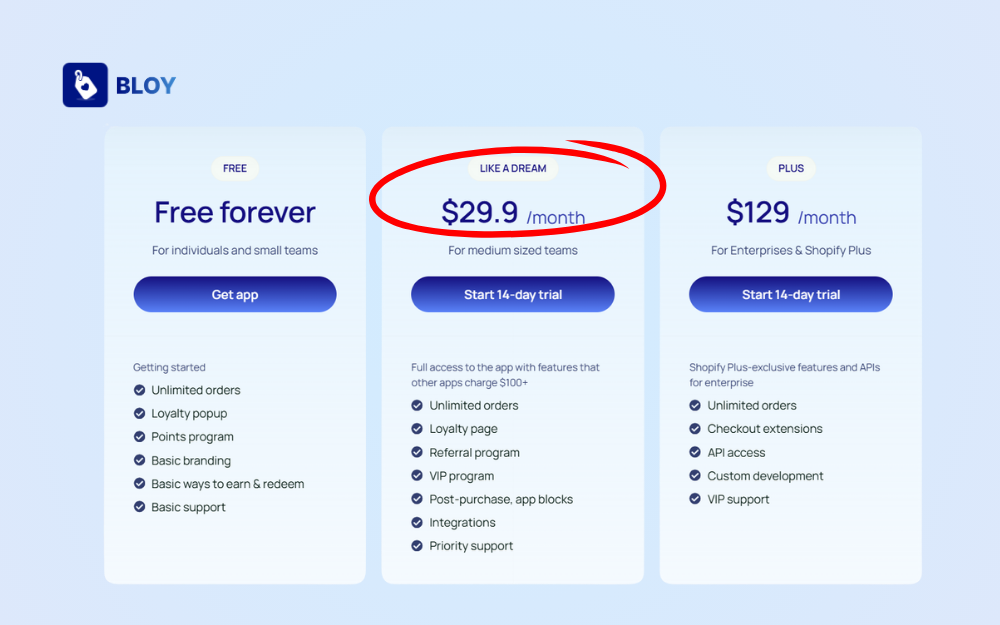
BLOY is the standout choice for points-based loyalty programs. You can set up a full program in just a few minutes without any coding. Its Like a Dream plan at $29.9/month includes everything you need: VIP tiers, branded widgets, points earning and redemption rules, and more. Compared with competitors, this plan offers full functionality at a fraction of the cost, making it ideal for small to medium DTC stores. BLOY also offers plans for all store sizes, from a free basic points program to advanced options for growing businesses.
Smile.io is known for tiered programs and gamification features. Many advanced functionalities are locked behind higher-tier plans, which can be costly for smaller stores.
Joy Rewards & Loyalty Program is simple to set up and customizable. It works for a range of store sizes, but some features require higher plans to unlock.
For merchants focused on points-based loyalty, BLOY delivers unmatched ease, flexibility, and value, making it highly effective for driving repeat purchases and engagement.
Step 3: Define Earning and Redemption Rules
The core of any points-based loyalty program lies in its earning and redemption rules. Clear guidelines for how customers accumulate and redeem points are essential for driving engagement and repeat purchases.
The following demonstrates how to set up these rules using the BLOY app, taking advantage of its full feature set for an effective Shopify loyalty program.
Access the Rewards program > choose Points
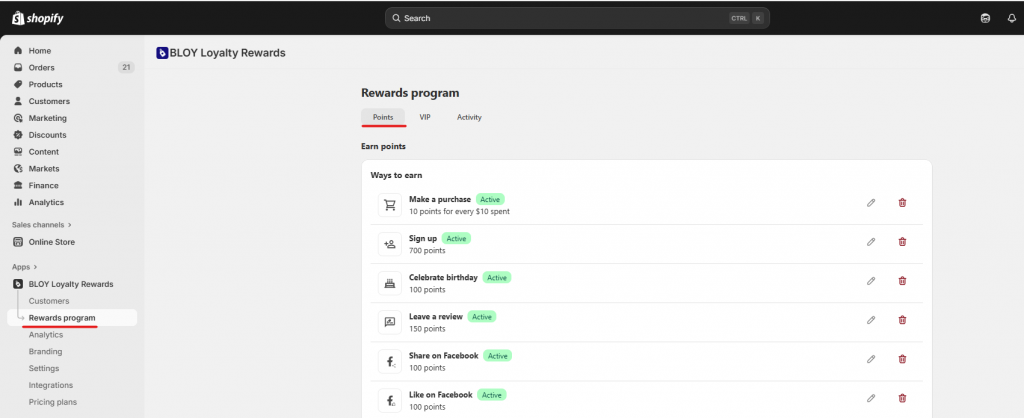
On the Points page, it’s possible to set up how customers can earn points. For example, to reward 10 points for every $10 spent, simply select the Make a purchase option and edit it accordingly.
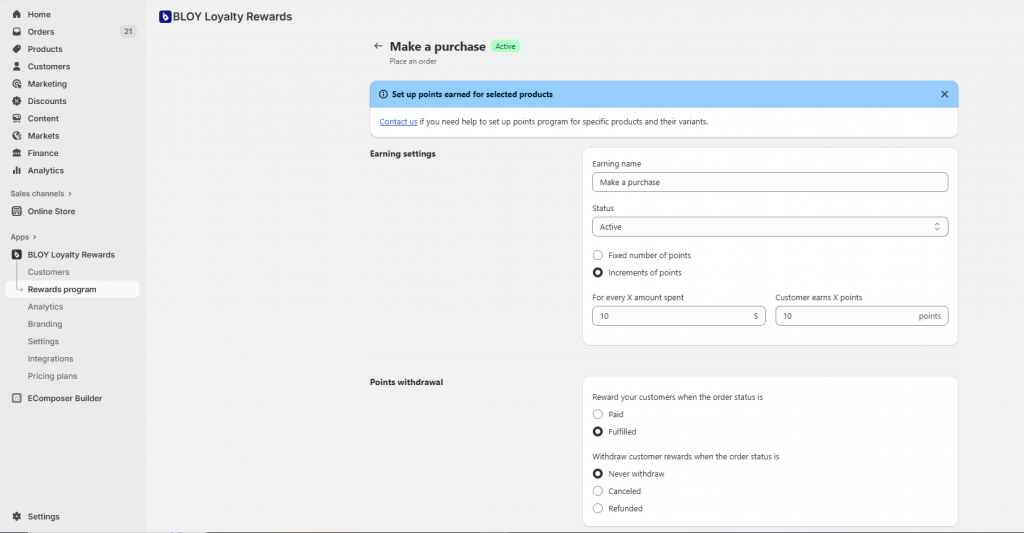
Once on the Make a Purchase settings page, configure the points program as follows:
- Set the earning method
Choose Fixed number of points or Increments of points. For example, you can set 10 points for every $10 spent to reward proportional to purchase value. - Select products
If you want to assign points to specific products or variants, use Set up points earned for selected products. For more complex setups, contact support for guidance. - Adjust order conditions
Decide when customers actually receive points:- Reward points when order status is: Paid / Fulfilled
- Withdraw points when order status is: Never / Canceled / Refunded
- Activate the rule
Make sure the Status is set to Active so points are applied automatically when customers make purchases.
Other ways to earn points can be set up in the same way by clicking the pencil icon. It’s quite simple, just select the appropriate options. For a detailed step-by-step guide, see How to create a way to earn on BLOY.
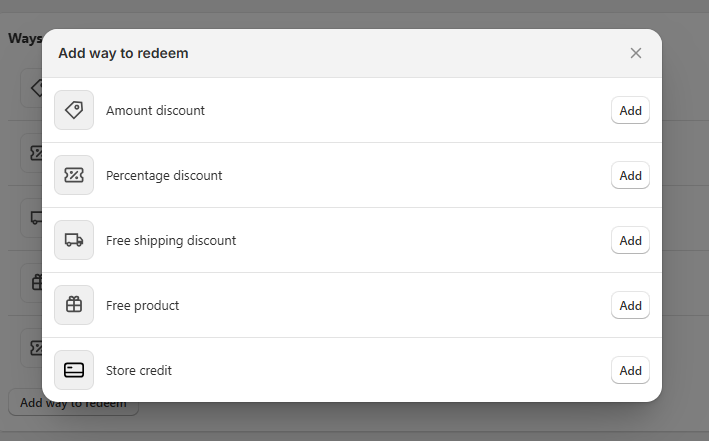
For redemption rules, you can set up amount or percentage discounts, free shipping, free products, or store credit. Detailed instructions for setting up these redemption rules can be found on BLOY here: How to create a way to redeem on BLOY.
For merchants who want to align the points system with their brand identity, the points currency can be customized to a different unit such as “Stars” or another creative name. This change can be made directly on the Points page, allowing the loyalty program to feel more unique and consistent with the store’s branding. For detailed instructions, see How to change point currency.
Step 4: Visual & Branding Considerations
A points-based loyalty program should not only function smoothly but also look appealing. Customize your loyalty page and widgets to match your store’s colors, fonts, and overall style. Display points clearly on product pages, carts, post-purchase pages, and account dashboards so customers can easily track and redeem them. For more guidance, see BLOY Branding & Customization.
Step 5: Monitor & Optimize
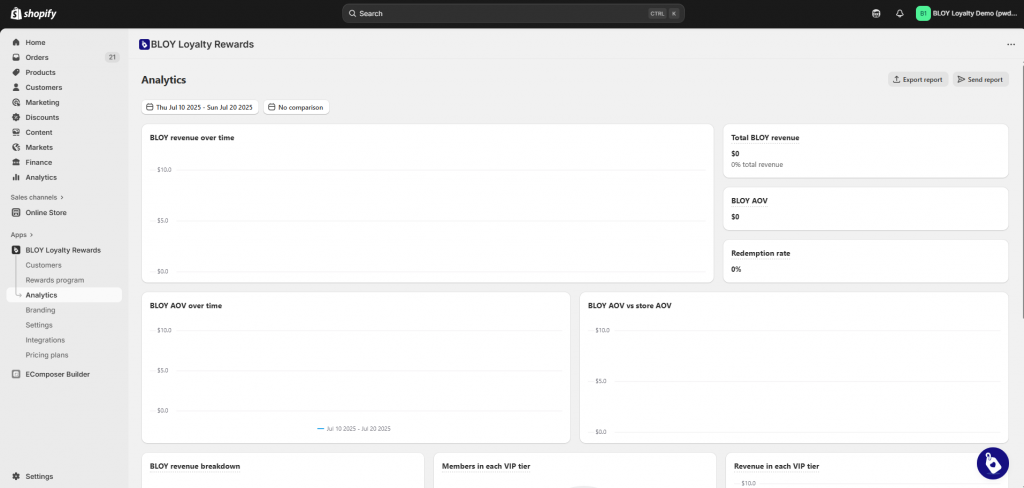
After launching, regularly monitor your program’s performance. Key metrics include enrollment, points earned versus redeemed, repeat purchases, and average order value. Collect customer feedback to spot friction points and adjust rewards as needed. Visuals from BLOY’s analytics dashboard can help illustrate engagement trends and inform program improvements.
7. Common Mistakes When Launching Points-Based Loyalty Program
Even the best-planned points-based loyalty programs can stumble if key pitfalls are overlooked. Here are common mistakes Shopify stores should avoid:
- Overly Complex Earning or Redemption Rules: If customers find it confusing to earn or redeem points, adoption will drop. Keep rules simple, clear, and easy to understand. Use visual cues like progress bars or simple tables to guide them.
- Low Perceived Value of Rewards: Points mean little if the rewards don’t feel worth it. Offer meaningful rewards that customers actually want to redeem, such as discounts, exclusive products, or free shipping.
- Points Expire Too Soon: Short expiration periods can frustrate customers. Give enough time to redeem points while maintaining urgency to engage.
- Lack of Personalization: Treating all customers the same weakens emotional connection. Use behavioral data to tailor rewards, birthday bonuses, or exclusive perks for VIPs.
8. Conclusion
Points-based loyalty programs are more than just a tool. They help increase repeat purchases, boost engagement, and build lasting customer relationships. By offering meaningful rewards and personalized experiences, Shopify stores can turn casual shoppers into loyal advocates. Getting started is easy: choose the right program, select a loyalty app like BLOY, and set up points, rewards, and branding in just a few clicks, seeing real improvements in retention, average order value, and satisfaction.
Try the BLOY free trial to launch a points-based loyalty program that truly works for your store.

Zoe Pham
Zoe Pham is a content strategist at BLOY, specializing in customer retention and loyalty marketing. She writes about practical ways Shopify brands can boost lifetime value and grow sustainably.