How to Build a Loyalty Rewards Program for Restaurants in 7 Days
Most restaurants think loyalty starts with a card or an app. But guests don’t come back because they collected points. They come back because the experience felt worth repeating.
A real loyalty rewards program for restaurants is not about issuing rewards; it’s about shaping behavior: visiting one more time this month, adding a drink to the order, or choosing your place over the café next door. Research shows that turning first-time diners into regulars is critical for profitability, and restaurant repeat customer statistics reveal that many restaurants struggle to maintain consistent repeat visits over time.
Whether you use digital or physical restaurant loyalty cards, the goal is the same: create small, repeatable reasons for guests to return. This guide shows how to build that system in 7 days, without discounting your margins away.
1. Start with behavior, not software
Most loyalty programs fail before a single point is earned.
Not because the software is wrong, but because the logic is backward. Restaurants choose tools first and only later ask what behavior they want to change.
A working loyalty rewards program for restaurants must influence at least one of these three actions:
- Come back sooner
Shorten the gap between visits, not just reward long-term accumulation. - Spend slightly more
One extra drink, side, or dessert matters more than a higher bill total. - Choose you by default
Even when competitors are closer, cheaper, or more convenient.
If your program doesn’t move one of these levers, it isn’t loyalty, it’s just another discount channel.
Why points alone don’t change behavior
Traditional restaurant loyalty cards assume a simple equation: more points = more loyalty.
Reality is messier. Guests often collect points across multiple restaurants at once. The card becomes something they own, not something that influences today’s decision.
Behavior only changes when rewards connect to real dining moments:
- “I’ll add dessert, I’m close to a reward”
- “Let’s eat here, I have a member perk”
- “It’s a slow Tuesday, they offer bonus points”
Points work only when they are tied to timing, context and choice, not accumulation for its own sake.
The margin rule for restaurants
Loyalty has one job in a restaurant environment:
increase lifetime value without training guests to wait for discounts.
That means:
- Rewarding frequency over price cuts
- Small, relevant perks over blanket coupons
- Experience-based rewards over percentages
Think of loyalty as an extension of hospitality, not a replacement for it. When designed this way, staff can promote it naturally, guests don’t feel “sold to”, and margins stay protected.
2. Restaurant loyalty cards – Physical vs Digital
Before choosing tools, restaurants need to decide what kind of loyalty experience they want to run on the floor. Most programs still fall into two camps: physical loyalty cards and digital loyalty cards. They may look similar on the surface, but they behave very differently in practice.
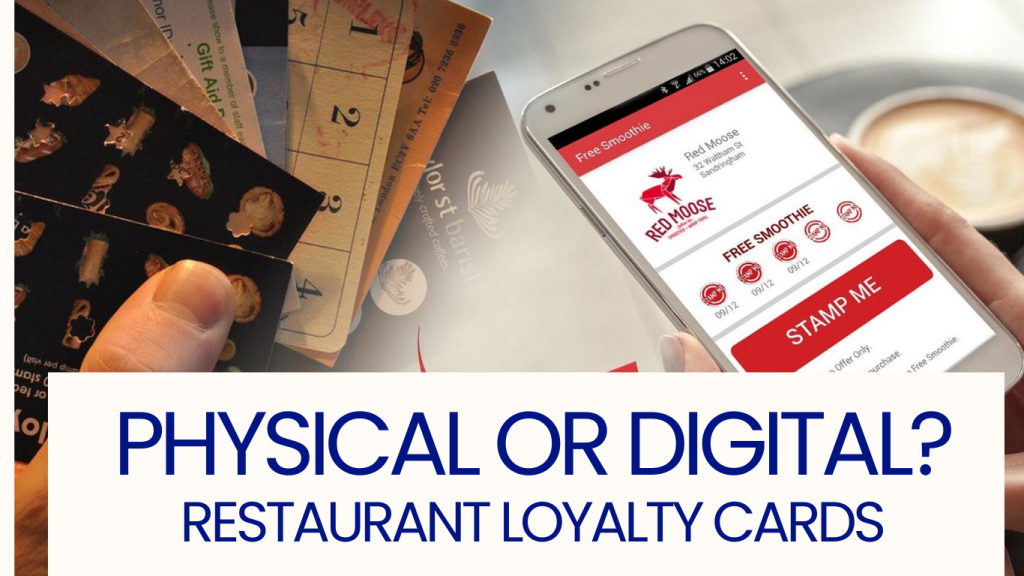
Physical loyalty cards (stamp cards, punch cards) feel simple and familiar. They work best in very small setups where staff know regulars by name and visit frequency is high. The problem appears as soon as volume increases. Cards get lost, stamps are easy to game, and there’s no visibility into who your loyal customers actually are. You reward visits, but you don’t learn from them.
That lack of data becomes a ceiling. You can’t segment guests, trigger follow-ups, or connect rewards to timing. Every customer gets the same experience, regardless of how often they visit or how much they spend.
Digital restaurant loyalty cards change the equation. Instead of relying on a piece of paper, loyalty is tied to a phone number, QR code, or digital wallet pass. This removes friction at signup and eliminates fraud. More importantly, it turns loyalty into a system, not just a counter.
With digital loyalty, restaurants can:
- Track visit frequency instead of just stamp counts
- Reward off-peak visits or specific menu items
- Identify regulars and treat them differently over time
The key difference isn’t technology, it’s control. Digital loyalty cards give restaurants the ability to design behavior, not just record it. And once behavior is clear, rewards, VIP tiers, and referrals become much easier to layer on without confusing staff or guests.
3. Day 1–2 – Design rewards people actually redeem
The fastest way to kill a loyalty rewards program for restaurants is to design rewards that look good on paper but never get used. If guests don’t redeem rewards, nothing changes: no extra visits, no higher spend, no habit formation.
In restaurants, redeemable beats impress every time.
The best-performing rewards share three traits: they’re easy to understand, easy to redeem, and tied to real dining moments. Free add-ons (a drink, side, or dessert) consistently outperform percentage discounts because they feel like a treat, not a transaction. Guests don’t calculate margins, they remember experiences.
This is also where many restaurant loyalty cards go wrong. When rewards require too many points or only apply to the full bill, guests mentally push redemption into “someday.” Someday never comes.
💡 A simple rule to design your reward mix is 70/20/10:
- 70% instant or near-instant rewards (Free drink after 2 visits, free add-on after a spend threshold)
- 20% experiential perks (Birthday rewards, members-only combos, priority seating)
- 10% aspirational rewards (Higher-value perks that give regulars something to work toward)
Avoid blanket discounts on the entire bill. They train guests to wait, not return. Instead, use rewards to guide behavior: redeemable on weekdays, tied to specific menu items, or unlocked after a short visit gap.
By the end of Day 2, your goal isn’t a perfect reward catalog. It’s clear. When staff can explain rewards in one sentence and guests can imagine using them on their next visit, you’ve designed something that will actually move behavior, not just track it.
4. Day 3 – Set earn rules that protect margin
By Day 3, most restaurants feel tempted to keep the earn rules simple: “1 point for every dollar spent”.
It’s easy to explain and just as easy to waste margin.
A strong loyalty rewards program for restaurants uses earn rules to shape behavior, not just count spending. The question isn’t how many points guests earn, but when and why they earn them.
Per visit vs per spend
- Points per visit work best for cafés, casual dining, and places that win on frequency. They encourage repeat visits without pushing discounts.
- Points per spend make sense when average ticket size varies widely, but they should be capped or tiered to avoid rewarding one-off splurges over loyal behavior.
Many restaurants combine both: a base reward per visit, with small bonuses tied to spend thresholds.
Bonus actions that move the needle
This is where digital restaurant loyalty cards outperform paper programs. You can reward actions that matter operationally:
- bonus points for off-peak visits
- points for adding a specific menu item
- points for returning within a set number of days
These rules don’t increase discounts, they redirect demand.
Anti-gaming rules
Every program needs guardrails. Without them, loyalty becomes a loophole.
- Limit points per day
- Exclude refunded orders
- Cap rewards tied to promotions
The goal isn’t complexity. It’s predictable.
By the end of Day 3, you should be able to answer one question clearly: Which customer behavior is this rule encouraging?
If an earn rule doesn’t have a behavior attached, it’s noise. When rules are intentional, loyalty stops leaking margin and starts reinforcing habits.
6. Day 5 – Launch restaurant loyalty cards to staff & guests
By Day 5, the program is designed but adoption is where most restaurant loyalty initiatives stall. The issue is rarely the rewards. It’s how the program is introduced on the floor.
A loyalty rewards program for restaurants only works if staff can explain it quickly and guests understand it instantly.
The 15-second staff script
If it takes longer than one sentence, it won’t get said during service. A simple script works best: “Scan this QR to collect points, you’ll get a free drink after a couple of visits.”
No features, no tiers, no explanations. Curiosity does the rest.
Place the cue where decisions happen
Guests don’t sign up for loyalty while waiting for the check, they do it while deciding where to eat again. That’s why visibility matters more than persuasion.
Effective placements include:
- Table tents with a single benefit highlighted
- Receipt CTAs reminding guests of an upcoming reward
- Counter signage for quick-service and cafés
Each touchpoint should point to one action, not explain the whole program.
Keep POS flow frictionless
Staff shouldn’t hunt for buttons or break their rhythm. Enrollment must fit naturally into payment or order confirmation. If staff feel loyalty slows them down, they’ll quietly stop mentioning it.
Digital restaurant loyalty cards help here by removing manual steps. A scan, a phone number, or a tap is enough. No cards to stamp. No rules to remember.
The Day 5 goal
You’re not trying to enroll everyone. You’re testing clarity.
If staff feel comfortable mentioning it and guests understand the value without asking questions, the program is ready to scale.
7. Day 6 – Referral & re-activation
By Day 6, your loyalty rewards program for restaurants should already be driving repeat behavior from existing members. Now it’s time to extend that momentum outward and pull inactive guests back in.
Referral: keep it social, not transactional
Referrals work best in restaurants because dining is rarely solo. The key is to reward shared experiences, not just sign-ups.
Effective referral mechanics are simple:
- Bring-a-friend rewards that unlock only when both guests visit
- First-visit hooks for the new guest (free add-on, drink, or upgrade)
- Return incentive for the referrer on the next visit, not immediately
This avoids abuse and ensures referrals create two future visits, not one discounted meal.
Reactivation after 30 days
Most restaurants lose guests quietly. They don’t churn loudly, they just stop coming. A well-timed re-activation closes that gap.
The 30-day mark is a natural trigger. It’s long enough to signal inactivity, short enough to still feel relevant. Instead of pushing discounts, re-frame the message around value:
- “We saved a reward for you”
- “Your member perk is waiting”
- “You’re one visit away from your next reward”
Digital restaurant loyalty cards make this easy by tying outreach to actual visit gaps, not assumptions.
Birthday & calendar moments
Birthdays remain one of the highest-redeemed loyalty triggers in hospitality. Keep the reward modest but personal: a free drink, dessert, or members-only perk. The goal is emotional recall, not margin sacrifice.
The Day 6 goal
You’re not maximizing reach. You’re restoring rhythm.
If referrals bring in guests who actually return and inactive members re-engage without heavy discounts, your program is no longer reactive. It’s self-reinforcing.
8. Day 7 – Metrics that actually tell you if loyalty is working
By Day 7, your loyalty rewards program for restaurants is live. The final step isn’t optimization, it’s measurement. And this is where many restaurants get misled by the wrong numbers.
Sign-ups and total points issued feel good, but they don’t explain behavior. What matters is whether loyalty is changing how guests act between visits.
When evaluating performance, behavior tells the real story. Industry data shows that loyalty program members visit more often and spend more than non-members, making repeat visit rate and AOV lift far more meaningful than raw enrollment numbers.
The 5 metrics that matter
You don’t need a complex dashboard. Start with these:
- Repeat visit rate
Are members coming back more often than non-members? This is the clearest signal that loyalty is influencing habit. - Redemption rate
If rewards aren’t redeemed, they’re not motivating behavior. Low redemption usually means rewards are too hard, too boring, or poorly timed. - Member activation rate
How many enrolled guests actually earn or redeem something within their first few visits? Early activation predicts long-term engagement. - Average order value (AOV) lift
Look for small, consistent increases, especially tied to add-ons and specific rewards, not spikes caused by discounts. - Visit frequency gap
Measure the number of days between visits before vs after joining the program. Shorter gaps mean loyalty is working.
What to ignore (at least for now)
- Total points issued
- Total members enrolled
- One-time spikes from promotions
These numbers describe activity, not impact.
The Day 7 mindset
Metrics aren’t for reporting, they’re for decisions.
When you track the right signals, it becomes clear which rewards drive return visits, which earn rules protect margin, and which restaurant loyalty cards are actually influencing choice. From here on, optimization becomes incremental instead of guesswork.
Maybe you want to read: How a Restaurant Loyalty App Drives Repeat Visits in Real Operations
9. Common restaurant loyalty failures (and how to avoid them)
Most restaurant loyalty programs don’t fail loudly. They don’t break. They simply stop influencing behavior. Points keep issuing, cards keep circulating but nothing actually changes.
Here are the failures that show up most often in restaurants.
1. Rewards that take too long to reach
If guests need 8–10 visits before seeing value, redemption drops fast. The program becomes background noise. A loyalty rewards program for restaurants should deliver a win early, ideally within the first 2–3 visits or guests mentally disengage.
Fix: Design at least one fast, low-cost reward that feels achievable.
2. Over-reliance on discounts
Discount-heavy programs train guests to wait. They don’t build preference; they create price sensitivity. Over time, margins shrink while visit patterns stay flat.
Fix: Shift rewards toward add-ons, experiences, and timing-based perks instead of % off the bill.
3. Loyalty cards without differentiation
When everyone gets the same reward at the same pace, loyalty feels generic. Regulars don’t feel recognized and casual guests don’t feel motivated.
Fix: Use tiers or progress-based perks so behavior unlocks different treatment over time.
4. Staff don’t believe in the program
If staff don’t understand the value, they won’t mention it. No signage or automation can fix that.
Fix: Keep the pitch short, the rewards clear, and the flow frictionless. If staff can’t explain it in one sentence, redesign it.
5. Tracking activity instead of impact
Enrollments and points issued look impressive, but they don’t explain whether guests are coming back more often.
Fix: Track repeat visits, redemption rate, and visit gaps, not vanity metrics.
Avoiding these failures doesn’t require better software. It requires better intent. When loyalty is designed around real restaurant behavior, it stops being a “program” and starts becoming a habit.
Conclusion
A loyalty rewards program for restaurants doesn’t succeed because it exists. It works because it changes behavior, shorter gaps between visits, slightly higher spend, and a clear reason to choose you again. Cards, points, and tiers are tools. The outcome is habit.
If you’ve followed the 7-day framework, you now have a program designed for real restaurant operations: rewards people actually redeem, earn rules that protect margin, staff-friendly rollout, and metrics that reveal what’s working. From here, optimization is incremental: adjust timing, tweak rewards, and double down on what moves visits.
Start small. Keep it simple. And remember: the best restaurant loyalty programs don’t feel like programs at all, they feel like recognition.

Yến Lê Hải
Content author at BLOY, focusing on product-led content, SEO, and educational resources to help merchants improve conversion and customer engagement.