Google’s Universal Cart Signals the Rise of Agentic Shopping. Is Your Loyalty Program Ready?
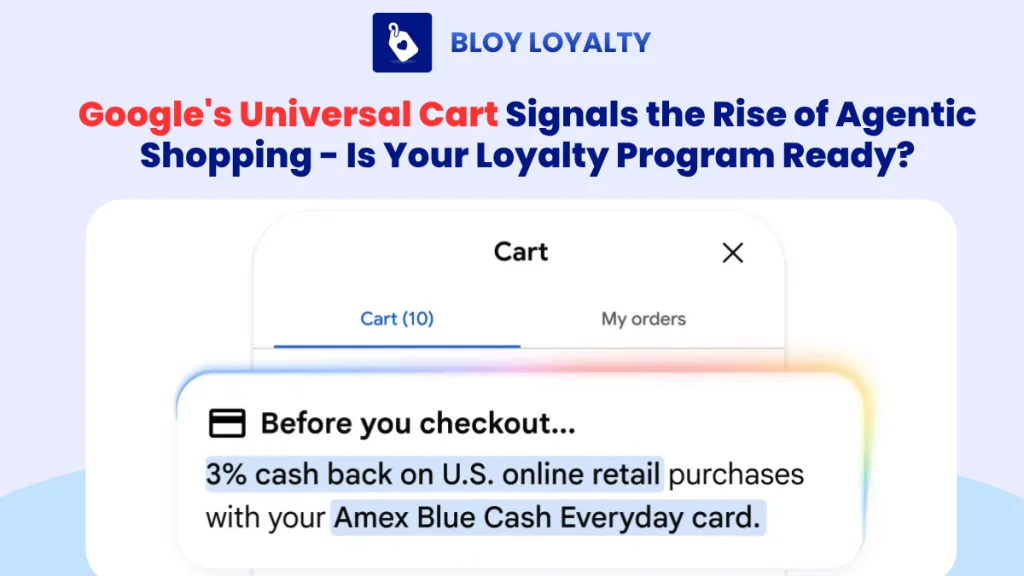
Google recently introduced Universal Cart at Google I/O 2026, a new shopping experience that allows consumers to add products from Search, Gemini, YouTube, and Gmail into a single AI-assisted cart. But Universal Cart is only the most visible sign of a much larger shift already underway.
The bigger story is the emergence of agentic shopping, a model where AI systems no longer just answer questions. They actively help consumers discover, compare, evaluate, and purchase products. For Shopify merchants, this creates an urgent question: if AI starts doing the shopping, what happens to customer loyalty?
This article explores what agentic shopping is, why Google Universal Cart matters, how the shift changes the role of loyalty programs, and what merchants can do right now to stay ahead.
What Is Agentic Shopping?
Agentic shopping is a shopping experience where AI systems actively assist consumers throughout the purchasing journey, going far beyond search results and product recommendations.
Instead of only answering questions, AI agents can:
- Discover products across multiple retailers simultaneously
- Compare alternatives by price, reviews, and availability
- Track pricing changes and alert shoppers to drops
- Monitor inventory and flag restocks
- Build and manage shopping carts
- Assist with or fully complete checkout
In other words, consumers increasingly delegate shopping tasks to AI. The consumer still holds the final decision, but AI increasingly handles the research, comparison, and logistics that used to require active browsing.
This is a meaningful departure from the ecommerce model most merchants have built their businesses around.
Traditional ecommerce journey: Customer searches, visits product page, browses, adds to cart, checks out.
Agentic shopping journey: Customer states a goal, AI evaluates options across retailers, presents a recommendation, completes the purchase.
The customer’s role shifts from active participant to final approver, while AI handles the work in between.
According to McKinsey, at the most advanced level, AI agents operate against standing goals rather than one-off transactions, for example “keep household essentials under $300 per month” or “maintain my airline loyalty status at the lowest total cost.” The agent continuously monitors needs, compares options across merchants, and handles the operational follow-through, including changes, returns, and replacements.
Why Agentic Shopping Is Already Here, Not Just on the Horizon
It is tempting to treat agentic shopping as a future scenario to prepare for. The data suggests it is already commercially relevant today.
According to Delight.ai, traffic to US retail sites from generative AI browsers surged 4,700% year-over-year in mid-2025. These AI-driven visitors also spent 32% more time on-site and bounced 27% less than traditional visitors.
TrueLoyal notes that Walmart and Sam’s Club went live on Google Gemini in January 2026, allowing customers to shop via natural language through Google’s Universal Commerce Protocol (UCP). Instacart became the first grocery partner for ChatGPT Instant Checkout in December 2025, enabling users to order groceries without leaving the conversation.
Meanwhile, daily shopping-related queries on ChatGPT now sit at around 50 million, according to Modern Retail. While most of these interactions remain informational rather than transactional, the volume of commerce-oriented intent flowing through conversational AI interfaces is already commercially meaningful.
The direction of travel is clear.
What Google Universal Cart Reveals About the Future of Shopping
Universal Cart is Google’s most concrete signal yet of where agentic shopping is heading at scale.
Announced at Google I/O 2026, Universal Cart is built on Google’s Universal Commerce Protocol (UCP), which enables AI agents to communicate with payments infrastructure across ecommerce transactions. Google co-developed UCP with Shopify, and retail partners including Nike, Target, Walmart, Wayfair, Sephora, and Ulta Beauty are already participating.
What makes Universal Cart different from a standard shopping cart:
- It works across Google Search, Gemini, YouTube, and Gmail in one persistent experience
- Once items are added, it actively monitors price drops, tracks inventory, and surfaces deal alerts in the background
- It can analyze cart compatibility, for example flagging incompatible computer parts and suggesting alternatives
- It can identify relevant loyalty perks and credit card benefits to help shoppers decide
- Checkout can happen via Google Pay inside the Universal Cart interface, or shoppers can transfer the cart to a merchant’s site
As Search Engine Journal noted, Google is “moving beyond AI-enhanced product discovery and deeper into the shopping journey itself.” Universal Cart is a step toward turning AI from a passive recommendation tool into an active participant in transactions.
TechCrunch also reported that Google teased its Agent Payments Protocol (AP2), a system that will allow users to authorize AI agents to make payments on their behalf, with strict guardrails and transparent, verifiable payment records.
For merchants, this signals something significant: parts of the shopping journey are increasingly moving outside the merchant’s own storefront.
What Agentic Shopping Means for Shopify Merchants
Product discovery may no longer start on your website
Historically, merchants controlled most of the shopping experience. Customers visited the website, browsed products, discovered promotions, and completed purchases on the merchant’s terms.
Agentic shopping introduces a layer between the customer and the merchant. AI platforms increasingly influence which products are even considered, which brands are recommended, which promotions are surfaced, and which purchases are completed.
The merchant still owns the product and fulfillment. But they may no longer control every customer interaction.
Competition intensifies around the factors AI evaluates
As AI systems become better at comparing alternatives across retailers instantly, brands face greater competition around price, reviews, shipping speed, product quality, return policies, and customer trust signals. Simply being visible in search results may no longer be sufficient.
SAP reported that 58% of Gen Z and millennials say they would trust an AI agent to compare prices and recommend the best option, which represents a structural shift in how purchase decisions get made.
Retention becomes the most defensible competitive advantage
If AI helps customers discover dozens of competing brands instantly, acquiring new customers becomes harder and more expensive. Retaining existing customers becomes one of the few truly defensible strategies available.
This is precisely where loyalty programs become more important, not less.
What Happens to Loyalty Programs in an Agentic Shopping World?
Traditional loyalty programs were built for human attention
Most loyalty experiences rely on customers actively engaging with storefront touchpoints: rewards widgets, loyalty launchers, referral pages, discount codes, promotional emails, and membership landing pages.
These experiences assume the customer is browsing the website, seeing the prompts, and consciously participating.
AI agents interact with loyalty differently
AI agents do not click popups. They do not browse rewards dashboards. They do not manually copy discount codes.
This does not mean loyalty programs become less important. It means the form of loyalty needs to evolve alongside how shopping happens.
As eMarketer noted, Google’s Universal Cart can already identify relevant loyalty perks and surface them during the shopping journey. Benefits such as member discounts or free shipping may appear directly inside AI-powered shopping experiences rather than only at checkout.
This creates a new challenge for merchants. Rewards that exist only within storefront widgets or loyalty dashboards are difficult for AI systems to recognize. By contrast, clearly defined and accessible benefits have a greater chance of influencing purchase decisions earlier in the customer journey.
Could Loyalty Become an AI Recommendation Signal?
This is one of the most strategically important questions merchants should be thinking about now.
To recommend products effectively, AI systems rely on signals that indicate quality, reliability, and customer preference. These signals include reviews, ratings, repeat purchase rates, engagement metrics, and brand reputation.
Effective loyalty programs naturally generate many of these signals. Higher retention rates indicate customer satisfaction. Repeat purchase behavior demonstrates genuine preference over alternatives. Strong first-party customer data enables more personalized, relevant experiences. Community engagement and referral behavior signal brand trust.
McKinsey’s analysis is direct on this point: as agentic commerce matures, competition shifts from winning a single purchase to earning a place in the agent’s ongoing plan. Merchants need deeper integration around loyalty, eligibility, and customer history so that AI agents can reason about trade-offs and execute reliably.
Put simply: a strong loyalty program is increasingly a signal of brand value that AI systems can use when making recommendations. Brands that build genuine, long-term customer relationships will have an advantage that brands competing on price alone cannot easily replicate.
A Real Example of Agentic Shopping in Action
Imagine a customer asks Google Gemini:
“Find me the best organic skincare moisturizer under $40 with free shipping, strong reviews, and available for delivery by Friday.”
An AI shopping agent can search multiple retailers simultaneously, compare products on price, review scores, ingredient quality, shipping availability, and delivery speed, and then present two or three recommendations, with the option to add directly to Universal Cart for checkout.
The customer may never visit a single product page manually.
For the brand that does not appear in those recommendations, the sale is effectively invisible. For the brand that does appear, the customer arrives already pre-sold. And for the brand whose loyalty program data tells a story of repeat purchases, strong reviews, and engaged members, that story can become part of why the AI makes that recommendation in the first place.
This is why loyalty strategy needs to evolve now, not after agentic shopping becomes mainstream.
Why Loyalty Benefits Must Become More Accessible
Loyalty needs to exist wherever shopping happens
As shopping expands across AI-powered channels, loyalty programs need to expose benefits more consistently across the full customer journey, not just on the storefront.
The benefits most likely to influence an AI-assisted decision include member-exclusive pricing, VIP tier perks and privileges, free shipping eligibility, reward balances and redemption thresholds, and personalized offers tied to purchase history.
The easier these benefits are to understand, apply, and verify, the more useful they become regardless of where the customer encounters the brand.
Loyalty becomes a customer preference system, not just a rewards mechanism
The future role of loyalty extends beyond points and discounts. Loyalty programs help establish brand familiarity, purchase history, membership status, and long-term customer relationships. These are the signals that help customers (and increasingly, their AI agents) repeatedly choose the same brand even when alternatives are immediately available.
According to Bloomreach, the old loyalty playbook no longer builds lasting relationships. Customers can switch brands in seconds, compare endless alternatives, and engage with competitors at any moment. Successful loyalty now requires an approach that aims the entire retention strategy at meeting customers where they are, not just where the storefront is.
5 Steps Shopify Merchants Can Take Right Now
1. Strengthen first-party customer relationships
First-party data, the information customers voluntarily share through accounts, loyalty memberships, and purchase history, is becoming one of the most valuable assets a merchant can hold. It enables personalization that third-party platforms cannot replicate and provides the behavioral signals AI systems increasingly use to assess brand preference.
Invest in customer loyalty reward programs that create genuine reasons for customers to engage directly with your brand.
2. Build loyalty beyond discounts
Discount-based loyalty is easy to replicate and easy for an AI agent to override with a lower price from a competitor. Benefits that create emotional connection or exclusive access are much harder to commoditize.
Consider VIP access to new products before public launch, exclusive products or limited editions only available to members, early access to sales and seasonal events, community experiences and direct brand engagement, and personalized rewards tied to individual purchase patterns.
Review how VIP loyalty programs can structure benefits that are meaningful beyond price matching. The brands that succeed at loyalty in an agentic world will offer things an AI cannot simply find cheaper elsewhere.
3. Improve product and customer data quality
In agentic shopping, structured and accurate product data is how your products get found, evaluated, and recommended. Incomplete product descriptions, missing specifications, and inconsistent data make your products harder for AI systems to assess and surface.
Similarly, structured loyalty data, including member tiers, eligibility rules, and benefit structures, needs to be machine-readable and consistently maintained.
4. Invest in customer retention metrics
Retention metrics are the clearest evidence of loyalty program performance and brand health. The ones worth tracking most closely are repeat purchase rate, customer lifetime value (CLV), loyalty program participation rate, referral performance, and member versus non-member purchase frequency.
Understanding loyalty program ROI requires looking beyond vanity metrics like enrolled member counts and focusing on behavioral indicators that reflect genuine customer preference.
5. Think about how your loyalty benefits appear in AI-driven discovery
Consider how a customer encountering your brand through an AI-assisted search or recommendation would understand your loyalty program. Are the benefits clear and accessible without requiring a visit to a dedicated loyalty page? Is member-exclusive pricing surfaced at relevant moments? Is free shipping eligibility easy to verify?
Understanding loyalty program trends in 2026 can help merchants identify where existing programs have gaps that may become more costly as agentic shopping grows.
The Future of Loyalty in an AI Shopping World
Google Universal Cart is not an isolated product launch. It is part of a broader infrastructure build, alongside Universal Commerce Protocol, Agent Payments Protocol, and growing retail partnerships, that is moving agentic shopping from experiment to mainstream channel.
As SAP noted, agentic AI represents a fundamental change in how commerce works, reshaping discovery, payments, fulfillment, and long-term customer loyalty. The brands that treat readiness as a strategic investment now will be the ones best positioned when the shift accelerates.
None of this eliminates the need for customer loyalty. If anything, it makes loyalty more valuable.
As AI helps consumers evaluate more options than ever before, with greater speed and less friction, the brands that maintain genuine customer preference will have an advantage that is difficult to reverse-engineer. Price can always be matched. Convenience can always be replicated. A real relationship, built through meaningful rewards, consistent experiences, and genuine value, is the hardest thing for a competitor or an algorithm to displace.
The merchants who succeed in an agentic shopping world will not simply optimize for AI visibility. They will build customer relationships that remain valuable regardless of where shopping happens.
FAQ
What is agentic shopping? Agentic shopping is a model where AI systems actively assist consumers throughout the purchasing journey, including discovering products, comparing alternatives, tracking prices, and completing purchases, rather than simply responding to questions.
How is agentic shopping different from traditional ecommerce? In traditional ecommerce, customers navigate the journey themselves: searching, browsing, and checking out manually. In agentic shopping, AI handles much of that process on the customer’s behalf, with the customer stepping in primarily to approve final decisions.
What is Google Universal Cart? Google Universal Cart is an AI-powered shopping cart announced at Google I/O 2026 that works across Google Search, Gemini, YouTube, and Gmail. It monitors prices, tracks inventory, surfaces deals and loyalty perks, and enables checkout via Google Pay or transfer to a merchant’s site.
How does agentic shopping affect loyalty programs? Traditional loyalty touchpoints like on-site widgets and discount codes rely on customers actively browsing the storefront. AI agents do not interact with these the same way humans do. Loyalty programs need to surface benefits through structured, accessible data so that they can influence AI-assisted decisions earlier in the journey.
Can loyalty programs influence AI recommendations? Yes. AI systems evaluate trust signals including repeat purchase rates, customer engagement, reviews, and brand preference. Strong loyalty programs generate many of these signals, which can influence how AI agents assess and recommend brands.
How can Shopify merchants prepare for agentic shopping? Merchants should invest in first-party data collection, build loyalty programs with benefits that go beyond discounts, improve product and customer data quality, track retention metrics closely, and evaluate how their loyalty benefits appear in AI-driven discovery channels.
Agentic shopping may change how customers discover products, but customer loyalty remains one of the few competitive advantages merchants truly own.
Explore how BLOY helps Shopify merchants build stronger retention through rewards, VIP tiers, referrals, and customer loyalty experiences designed for long-term growth.

Yến Lê Hải
Content author at BLOY, focusing on product-led content, SEO, and educational resources to help merchants improve conversion and customer engagement.