Costco Loyalty Program: Why Paying $130 Creates 90%+ Retention
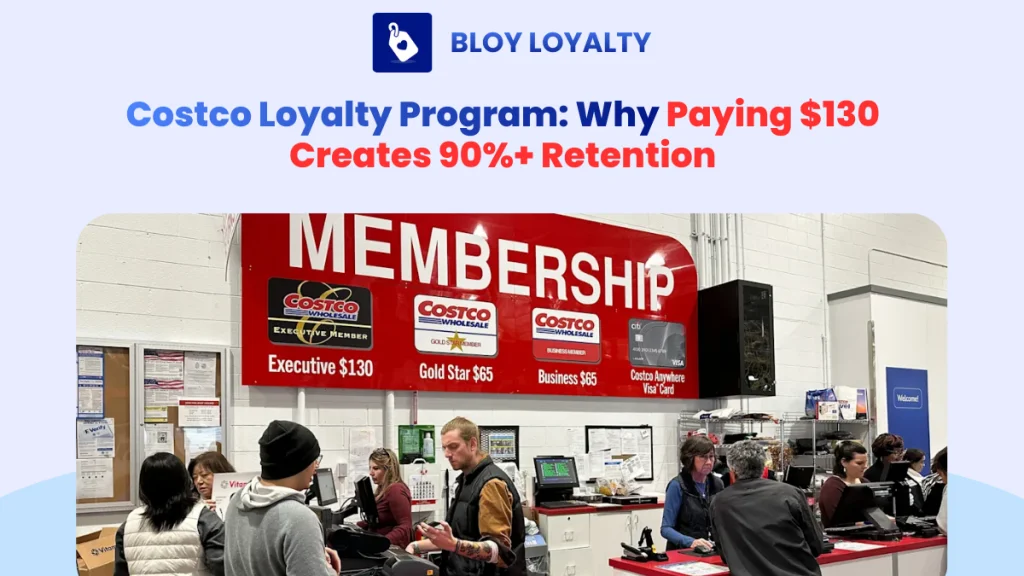
The Costco loyalty program is one of the most studied retention systems in retail. With a membership renewal rate exceeding 92% in the U.S. and Canada, it consistently outperforms nearly every loyalty model in existence.
Unlike most brands that reward repeat purchases with points or discounts, Costco takes a counterintuitive approach: it asks customers to pay upfront for the privilege of shopping. And rather than weakening commitment, this model appears to strengthen it year after year.
For Shopify merchants and ecommerce founders grappling with rising customer acquisition costs and low retention, the Costco model offers a roadmap worth studying. This guide breaks down how the Costco loyalty program works, the psychology behind its results, and how ecommerce brands can apply its core mechanics.
TL;DR
- Costco loyalty is built on a paid membership model, not traditional points
- Two membership tiers: Gold Star ($65/year) and Executive ($130/year)
- Executive members earn 2% cashback rewards on most purchases
- Membership fees represent less than 2% of total revenue but contribute over half of operating profit
- Renewal rates: 92.3% in the U.S. and Canada, 89.8% worldwide
What Is the Costco Loyalty Program?
The Costco loyalty program is not a traditional points-based system. There are no swipe cards, no reward tiers based on spending history, and no birthday coupons. Instead, Costco’s entire loyalty architecture is built on a single mechanism: a paid annual membership.
To shop at any Costco warehouse, customers must first pay a membership fee. This access-based model positions Costco in a category often called the access economy. The membership fee does not just unlock shopping privileges; it creates a psychological and financial commitment that drives long-term loyalty.
According to Costco’s fiscal 2024 annual report, the company had over 137 million cardholders worldwide by the end of fiscal 2024, with membership fee revenue reaching $4.8 billion, a figure that grew 5% year-over-year.
| Membership Tier | Annual Fee | Key Benefit | Best For |
| Gold Star | $65 | Full warehouse access | Occasional shoppers |
| Executive | $130 | 2% cashback + early access | Frequent/high-spend shoppers |
| Business | $65 | Wholesale purchasing rights | Small business owners |
How Costco’s Membership Model Works
Gold Star vs. Executive Membership
Costco offers two primary membership tiers for individual consumers.
The Gold Star membership costs $65 per year (raised from $60 in September 2024) and provides full access to all Costco warehouses and the online store. It is designed for households that shop at Costco periodically throughout the year.
The Executive membership costs $130 per year and includes everything in Gold Star, plus a 2% annual reward on most Costco purchases (capped at $1,000 per year), early warehouse access, and additional savings on Costco services such as travel and auto programs. According to The Street, Executive members now account for 47.7% of all paid members but drive 74.2% of worldwide sales, making them disproportionately valuable to the business.
The Executive Reward Loop
The 2% cashback reward on Executive memberships creates a self-reinforcing spending loop. The more a member spends, the more they earn back, which is often enough to offset or exceed the $65 premium over the Gold Star tier.
| Annual Spend at Costco | 2% Cashback Reward | Net Cost After Reward |
| $3,250 | $65 | Executive fee fully offset |
| $5,000 | $100 | $100 net reward after fee |
| $6,500 | $130 | Full membership cost recovered |
| $10,000 | $200 | $70 net gain above fee cost |
This dynamic encourages members to concentrate more of their household spending at Costco rather than splitting it across competitors. The reward loop does not just incentivize individual transactions; it shapes an entire household’s shopping behavior.
The Loyalty Economics Behind Costco’s Business Model
One of the most counterintuitive facts about Costco is that the company barely profits from selling merchandise. According to analysis from The Motley Fool, Costco generated $9.3 billion in total operating income in fiscal 2024 on $254 billion in total revenue. The $249.6 billion in merchandise sales carried a net profit margin of roughly 2.96%. The $4.8 billion in membership fees, meanwhile, contributed over half of that operating profit.
This structure is not accidental. Costco intentionally caps markups at 14% for branded products and 15% for its Kirkland Signature private label, far below the 25% to 50% margins common in traditional retail. The low merchandise margin is the product’s value proposition: members pay an upfront fee to access prices unavailable elsewhere.
The result is a business model that looks like retail on the surface but functions more like a subscription service underneath. Membership fees are collected with near-zero marginal cost, making them exceptionally high-margin revenue. As noted by 24/7 Wall St., membership fees account for 66% of Costco’s net bottom line.
For ecommerce brands, this raises a useful question: what would happen if loyalty stopped being a cost center and became a revenue stream?
The Psychology Behind Costco’s 90%+ Retention Rate
Costco’s renewal rates are not simply a reflection of product quality or pricing. They are the result of a carefully structured psychological architecture that makes cancellation feel irrational to the average member.
The Sunk Cost Effect
When a customer pays $65 or $130 for a membership at the start of the year, they have made a tangible financial commitment. Behavioral economists refer to the tendency to continue an activity because of prior investment as the sunk cost effect.
In practice, this means Costco members are motivated to shop at Costco frequently enough to justify the annual fee they have already paid. They are not choosing between Costco and a competitor on a per-trip basis; they are defending an investment already made. This drives store visit frequency and increases overall spend per member in ways that discount-based loyalty programs rarely replicate.
Commitment-Based Loyalty vs. Incentive-Based Loyalty
Most loyalty programs operate on incentive-based mechanics: earn points, redeem rewards, repeat. The problem with this model is that loyalty disappears the moment a competitor offers a better incentive. Points are fundamentally transactional.
Costco’s loyalty program operates on commitment. When someone pays for access, they are not responding to an incentive to continue shopping. They have already made a decision. This distinction matters enormously in practice. Incentive-based loyalty is rented; commitment-based loyalty tends to compound.
The Access Economy and Perceived Exclusivity
Beyond pricing, the Costco membership grants access to services that extend well outside the warehouse: gas stations with consistently lower fuel prices, in-house pharmacies, optical centers, a travel program, and early morning shopping hours for Executive members.
Each of these access points reinforces the perception that membership has value beyond any individual shopping trip. Members are not just buying bulk goods; they are maintaining access to an ecosystem of savings. This makes the membership feel essential rather than optional, which is why the majority of members renew without hesitation.
Costco vs. Traditional Loyalty Programs
To understand what makes the Costco loyalty program structurally distinct, it helps to compare it directly to the models used by other major brands.
| Loyalty Model | Example | Mechanism | Retention Driver | Weakness |
| Points program | Sephora Beauty Insider | Earn points per purchase | Reward accumulation | Easy to switch if competitor offers more points |
| Paid membership | Costco | Annual fee for access | Upfront commitment + sunk cost | High barrier to join initially |
| Hybrid (subscription + rewards) | Amazon Prime | Annual fee + perks + cashback | Ecosystem lock-in | Cost sensitivity at renewal |
| Cashback / discount | Target Circle | % back on purchases | Savings per transaction | Purely transactional, low emotional loyalty |
The key differentiator for Costco is that the commitment is made before any shopping occurs. Points programs reward past behavior. Paid memberships shape future behavior from day one.
What Shopify Merchants Can Learn from Costco
Paid Membership Can Increase Customer Lifetime Value
Amazon Prime is the most obvious modern analog to Costco’s membership model. According to research from Consumer Intelligence Research Partners, Amazon Prime members spend significantly more per year than non-Prime customers and renew at high rates. The upfront commitment changes how they shop.
For Shopify merchants, a paid VIP tier does not need to replicate Costco’s scale. Even a modest annual membership that unlocks free shipping, early access to new products, or exclusive pricing can shift the psychology from transactional to relational. The goal is to move customers from asking “why should I buy here?” to “I already paid to be here.”
Tiered Rewards Drive Higher Per-Member Revenue
Costco’s data makes the case for tiered structures clearly. Executive members represent 47.7% of paid members but account for 74.2% of worldwide sales. That disproportion is not coincidence; it is the result of a tier designed to encourage heavier spending through a reward loop.
Ecommerce brands can replicate this with tiered reward structures where spending thresholds unlock better cashback rates, exclusive products, or priority service. The principle is that a loyalty tier should change spending behavior, not just recognize it after the fact.
Loyalty Works Best When It Creates Behavioral Commitment
The most durable lesson from Costco is that the strongest loyalty programs change behavior at the point of joining, not at the point of purchase. When a customer commits to a membership, they restructure how they think about where to spend.
For brands with repeat-purchase categories (supplements, pet food, skincare, consumables), a subscription or membership model that creates upfront commitment is likely to outperform any points accumulation system over a 12-month period.
How to Build a Costco-Style Loyalty Program on Shopify
Adapting Costco’s membership mechanics to a Shopify store requires translating the warehouse model into a digital-first loyalty architecture. The core mechanics to consider:
| Mechanic | Costco Version | Shopify Equivalent |
| Paid VIP tier | Gold Star ($65) / Executive ($130) | Annual membership with perks ($15-$99/year depending on AOV) |
| Cashback reward loop | 2% Executive reward on purchases | Store credit earned as % of spend, redeemable on next order |
| Access-based perks | Early store hours, gas, pharmacy | Early product drops, members-only pricing, free shipping |
| Renewal incentive | Value reinforced by ecosystem | Annual loyalty summary email showing savings earned |
| Tier upgrade trigger | Spend enough to justify Executive upgrade | Automated upgrade when member crosses spend threshold |
The critical implementation principle is that the paid tier must deliver demonstrable value within the first 60 to 90 days. If a new member cannot clearly identify savings or benefits in their first few orders, they will not renew. Costco earns its renewal rate by consistently delivering on its core promise: lower prices than anywhere else.
For a Shopify merchant, the equivalent commitment is delivering exclusive savings, priority fulfillment, or product access that a non-member simply cannot get. The loyalty program must feel like a genuine advantage, not a marketing layer.
>> You may find this useful: Membership Tiers for Shopify (2026): Structures, Naming Ideas & Strategies to Boost CLV
Key Lessons from Costco’s Loyalty Strategy
Costco’s retention performance is the result of specific structural decisions, not luck or brand heritage. The key takeaways for brands building loyalty systems:
- Loyalty begins with commitment, not reward. Asking customers to invest upfront creates a fundamentally different relationship than offering points after the fact.
- Membership fees create a flywheel, not just revenue. At Costco, the fee enables lower prices, which justifies renewal, which funds more fee revenue. The structure compounds.
- Tiered reward loops change spending patterns. Executive members drive a disproportionate share of Costco’s revenue because the tier is designed to encourage higher spend, not just recognize it.
- Perceived value across touchpoints sustains renewal. Costco’s ecosystem of perks (gas, travel, pharmacy, early access) ensures members encounter value far beyond bulk groceries.
- Renewal rates are a metric worth obsessing over. According to
FAQs About the Costco Loyalty Program
Is Costco a loyalty program?
Costco’s membership model functions as a loyalty program, but it operates differently from conventional points-based systems. Rather than rewarding purchases after the fact, it requires an upfront annual fee that creates customer commitment from the moment of joining. The result is a retention system that consistently outperforms industry benchmarks.
Why does Costco charge membership fees?
Membership fees are Costco’s primary profit source. With merchandise margins capped below 15%, the company would be marginally profitable on product sales alone. The annual fee revenue, which cost nearly nothing to collect, contributes over half of Costco’s operating income and funds its ability to maintain lower prices than competitors.
What is Costco’s membership renewal rate?
As of fiscal year 2025, Costco reported a renewal rate of 92.3% in the U.S. and Canada, and 89.8% worldwide. These figures reflect a slight moderation from historical highs, attributed largely to a growing share of digitally acquired members who renew at slightly lower initial rates.
Is the Executive membership worth it?
The Executive membership ($130/year) pays for its $65 premium over the Gold Star tier once a member spends approximately $3,250 per year at Costco (since 2% of $3,250 = $65). For households that do a meaningful share of their grocery and household shopping at Costco, the Executive tier typically delivers a net return above the fee cost.
Can ecommerce brands replicate Costco’s loyalty model?
Yes, though the mechanics need to adapt to a digital context. The core principles: charge for a VIP tier that delivers demonstrable value (free shipping, exclusive pricing, cashback), make the value tangible within the first 90 days, and design the tier so that heavier shoppers benefit most. Platforms like Shopify support the infrastructure for paid membership programs with the right loyalty app integrations.
Conclusion
The Costco loyalty program demonstrates that retention does not require complexity. A membership model with a clear value exchange, a cashback loop that rewards heavier spending, and an ecosystem of perks that reinforces perceived value across multiple touchpoints can sustain renewal rates above 90% for decades.
The principle at work is not unique to warehouse retail. Any brand that sells repeat-purchase products can structure a loyalty program around upfront commitment rather than accumulated points. When customers invest in access, they change how they shop. That behavioral shift is ultimately what separates a loyalty program that drives real retention from one that simply tracks transactions.
For ecommerce brands ready to move beyond discount-driven retention, the Costco model offers a practical blueprint: build a paid tier, deliver real value, design a reward loop, and let the renewal rate tell you how well it’s working.

Yến Lê Hải
Content author at BLOY, focusing on product-led content, SEO, and educational resources to help merchants improve conversion and customer engagement.