Membership Loyalty Programs: What Shopify Brands Can Learn from Chime+
Customer acquisition costs keep rising while customer attention keeps shrinking. According to Shopify research, acquiring a new customer can cost five times more than retaining an existing one. As a result, many companies are shifting from traditional reward systems to membership loyalty programs designed to increase retention and long-term engagement.
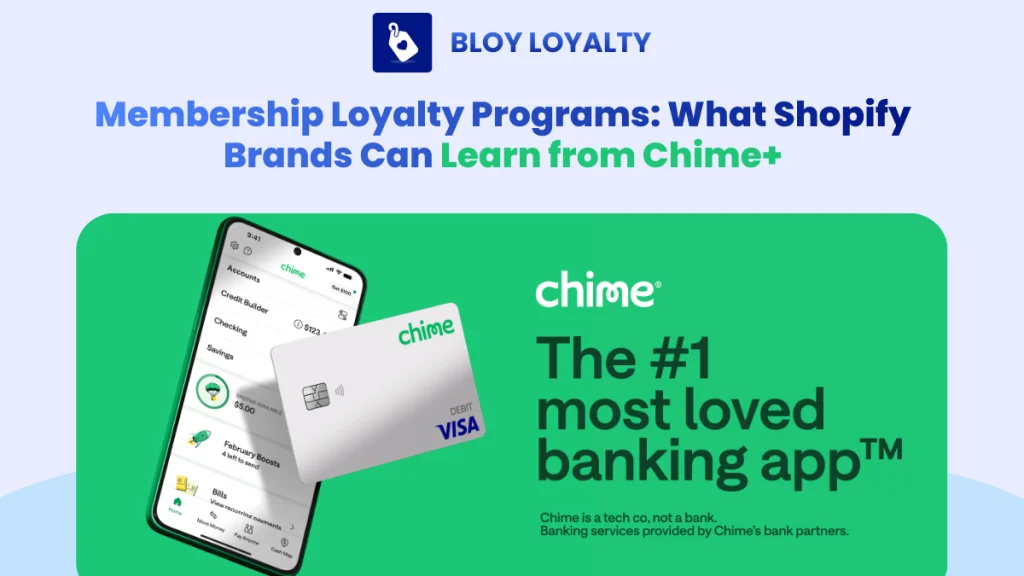
One recent example is Chime+, a premium membership tier unlocked through user behavior rather than a paid subscription. This model signals a broader industry shift: loyalty is evolving from simple reward points into full membership ecosystems that drive deeper customer relationships.
In this article, we break down what membership loyalty programs are, why they work, and how Shopify brands can adapt the same mechanics to grow retention and lifetime value.
What Are Membership Loyalty Programs?
A membership loyalty program is a structured system that rewards customers not just for individual purchases, but for their ongoing relationship with a brand. Unlike traditional loyalty programs that hand out points per transaction, membership loyalty programs create tiered access to exclusive benefits, status, and personalized perks.
The core distinction comes down to what drives participation:
| Traditional Loyalty | Membership Loyalty |
|---|---|
| Points per purchase | Tiered membership access |
| Discount-driven rewards | Status, perks, and recognition |
| Short-term purchase incentives | Long-term relationship building |
| Transactional engagement | Behavioral and emotional engagement |
Traditional loyalty programs treat every customer the same. Membership loyalty programs, on the other hand, reward commitment rather than just transactions. The result is a more engaged customer base with higher lifetime value and lower churn.
According to McKinsey & Company, companies that excel at personalization within loyalty programs generate 40% more revenue from those activities than average players. This underscores why membership models are outperforming legacy point systems.
Why Fintech Apps Are Launching Premium Membership Loyalty Programs
The fintech industry was one of the first sectors to recognize the competitive advantage of premium loyalty tiers. With low switching costs and a crowded market, fintech companies needed mechanisms to lock in users and increase engagement frequency. Membership loyalty programs answered that need.
Rising Customer Acquisition Costs
Digital advertising costs have surged across every industry. In fintech, the average cost to acquire a new user has climbed significantly year over year, driven by competition from neobanks, challenger apps, and traditional banks going digital. Statista data shows fintech consistently ranks among the highest-CAC industries, making retention a critical growth lever.
When the math no longer favors constant acquisition, the strategic pivot is clear: keep the customers you already have, and make staying more valuable than leaving.
The Need for Higher Customer Lifetime Value
Premium membership tiers directly increase average revenue per user (ARPU). When a customer unlocks a higher tier, they tend to use more features, engage more frequently, and develop stronger brand affinity. This creates a flywheel: more engagement leads to more data, which enables better personalization, which deepens loyalty further.
For fintech apps, this might mean a premium member using the app daily for budgeting, spending, saving, and rewards redemption rather than just once a month to check a balance.
Retention as a Growth Metric
Investors and analysts increasingly evaluate fintech companies on retention metrics like monthly active users (MAU), 12-month retention rate, and net revenue retention. A strong membership loyalty program provides tangible evidence of product stickiness. As Harvard Business Review notes, increasing customer retention rates by just 5% can increase profits by 25% to 95%.
The same retention logic applies directly to ecommerce. Shopify brands face identical pressure: rising paid media costs, shrinking margins, and customers who can comparison shop in seconds. The fintech playbook for premium membership loyalty programs translates cleanly into the ecommerce context.
The Chime+ Case Study: A New Model for Membership Loyalty Programs
Chime, the US-based neobank, launched Chime+ as a premium tier within its existing free product. What makes this model distinctive is how membership is unlocked and what benefits it provides.
Behavior-Based Premium Access
Chime+ is not a paid subscription. Instead, members earn access to the premium tier by demonstrating genuine product engagement. Specifically, users qualify by setting up direct deposit and maintaining regular account usage. This means premium status is earned through behavior, not purchased.
This approach has two powerful effects. First, it selects for high-value users who are already financially committed to the platform. Second, it creates a motivation loop: users who are close to qualifying have a concrete reason to increase their engagement to cross the threshold.
Rotating Cashback Rewards
Rather than static cashback rates, Chime uses rotating reward categories that change on a monthly basis. This design choice keeps the experience fresh and gives users a reason to regularly check the app to see what rewards are currently active. Monthly reward cycles create a habit loop that increases app open rates and overall engagement frequency.
This is a well-documented behavioral technique. According to BJ Fogg’s Behavior Model, habits form most easily when there is a clear trigger, a motivated user, and an action that delivers variable rewards. Rotating categories deliver exactly that variable reward structure.
Sticky Benefits That Increase Daily Usage
Beyond cashback, Chime+ includes utility features that members rely on daily. SpotMe provides overdraft protection without fees, allowing members to spend slightly beyond their balance. Exclusive deals partner with merchants to provide targeted discounts. Priority support reduces friction when problems arise.
These benefits are designed to be genuinely useful, not just cosmetically attractive. Utility features keep users returning more reliably than discounts alone because they address real needs rather than just incentivizing purchases.
Why Membership Loyalty Programs Increase Customer Retention
The effectiveness of membership loyalty programs is grounded in well-established behavioral psychology principles. Understanding these mechanisms helps brands design programs that genuinely change customer behavior rather than just rewarding behavior that would have happened anyway.
Status and Exclusivity
Humans are wired to seek status and belonging. When a customer achieves a VIP tier in a membership loyalty program, they experience a form of recognition that goes beyond a discount. The tier signals that they are a valued member of a community, not just a transactional customer.
This effect is amplified when tiers have visible names and clearly differentiated benefits. Research published in the Journal of Marketing Research found that customers in elite loyalty tiers demonstrate significantly lower defection rates and higher spending compared to standard tier members, driven largely by status motivation rather than purely economic incentives.
The Endowed Progress Effect
One of the most powerful mechanisms in membership loyalty programs is the endowed progress effect. When users feel they have already made progress toward a goal, they are significantly more motivated to complete it. This is why showing customers how close they are to the next tier, or giving them a head start through early status, dramatically increases program participation.
Progress bars, points balances, and tier advancement indicators all leverage this psychological principle. A customer who sees they are 200 points away from Gold status has a concrete, attainable goal that motivates their next purchase decision.
Reducing the Mental Tax of Shopping
When a customer has already committed to a brand’s membership loyalty program and holds an earned status, the cognitive cost of choosing where to shop decreases. They have a default destination. Comparison shopping requires effort, and VIP membership reduces the perceived need for that effort.
This is particularly valuable in ecommerce, where competing stores are only one search away. Loyalty tiers reduce decision friction by making the choice to return feel automatic rather than deliberate.
What Shopify Brands Can Learn from Chime’s Membership Loyalty Strategy
The mechanics Chime uses in Chime+ translate directly into ecommerce strategy. Shopify brands have access to the same customer behavior data and can apply the same psychological levers to build membership loyalty programs that drive retention.
Create Earned VIP Tiers
Rather than making premium membership available to anyone willing to pay, design tiers that are unlocked through customer behavior. Set spend thresholds, repeat purchase milestones, or engagement actions as the criteria for tier advancement. This ensures your most engaged customers receive the best rewards, while also giving aspirational customers a clear path to follow.
A practical tier structure for a mid-size Shopify brand might look like:
- Bronze: First purchase or account creation
- Silver: 3 purchases or $150 total spend within 12 months
- Gold: 6 purchases or $300 total spend within 12 months
- VIP: 10 purchases or $500 total spend, plus an active SMS or email subscription
Design Sticky Benefits Instead of Discounts
Discount-heavy loyalty programs train customers to wait for sales rather than building genuine loyalty. Membership loyalty programs should focus on benefits that deliver ongoing utility and exclusivity:
- Free expedited shipping for VIP members (reduces friction on every order)
- Early access to new product launches (creates exclusivity and urgency)
- Member-only bundles or product configurations
- Dedicated customer support channels for higher tiers
As Forrester Research notes, loyalty programs that lead with experiential benefits rather than transactional discounts consistently outperform on long-term retention metrics.
Rotate Rewards to Maintain Engagement
Static point-to-discount systems lose their novelty quickly. Introduce rotating monthly reward campaigns, seasonal bonus point events, or category-specific promotions to keep the program feeling dynamic. Announce upcoming reward changes via email or SMS to drive app opens and site visits before the rotation.
Monthly loyalty campaigns can be tied to product launches, seasonal themes, or behavioral milestones to create a structured calendar of engagement moments throughout the year.
Use Loyalty to Collect Zero-Party Data
Chime uses direct deposit setup as both a qualifying criterion and a data collection mechanism. Shopify brands can apply the same principle by using loyalty enrollment and tier progression as natural moments to collect:
- SMS opt-ins and communication preferences
- Birthday and anniversary data for personalized campaigns
- Product category preferences for tailored recommendations
- Lifestyle and purchase motivation data through brief surveys
Zero-party data, collected directly from customers in exchange for loyalty benefits, is increasingly valuable as third-party cookie tracking declines. Klaviyo’s 2024 Consumer Sentiment Report found that customers are significantly more willing to share personal data with brands they have an established loyalty relationship with.
How to Build Membership Loyalty Programs for Shopify Stores
Translating strategy into execution requires a clear framework. Here is a practical approach to building a membership loyalty program that mirrors the Chime+ model for ecommerce.
Define Loyalty Tiers and Qualification Criteria
Start by mapping your customer purchase frequency and average order value distribution. Design tier thresholds that feel attainable for your most engaged 20-30% of customers, while still feeling aspirational for the middle tier. Each tier should have a distinct name and a clear set of benefits that justify the effort required to reach it.
Document the specific actions that qualify customers for each tier: spend thresholds, purchase frequency, referral activity, or social engagement. The clearer the criteria, the more motivating the program becomes.
Design Reward Loops
Every membership loyalty program needs a core reward loop that makes participation feel worthwhile on an ongoing basis. This typically combines:
- Points or credits earned on every purchase
- Tier-specific perks that are always active (free shipping, early access)
- Time-limited bonus events that create urgency
- Milestone rewards for anniversaries, birthdays, or purchase counts
The goal is to ensure that members feel their status is actively working for them between purchases, not just at checkout.
Automate Behavioral Rewards
Use Shopify’s native automations or a dedicated loyalty platform such as Smile.io, LoyaltyLion, or Yotpo to trigger rewards based on customer behavior automatically. Set up automations for tier upgrades, milestone rewards, lapsed member re-engagement campaigns, and rotating bonus point periods. The more seamless the experience, the less cognitive load members face, which reinforces the habit loop.
>> Maybe you want to read: Loyalty rewards program for small business: Why most fail? (and how to think right)
Why Membership Loyalty Programs Are Becoming the New Retention Strategy
The shift from transactional loyalty to membership loyalty is not a trend limited to fintech. It reflects a fundamental change in how brands need to think about customer relationships in a high-cost, high-competition digital environment.
| Old Loyalty Model | New Membership Loyalty Model |
|---|---|
| Discount campaigns | Membership ecosystems |
| Transaction-based rewards | Behavior-based tier advancement |
| Short-term purchase incentives | Long-term retention architecture |
| Generic, one-size-fits-all rewards | Personalized, status-driven benefits |
| Points that expire unused | Sticky perks with daily utility |
The data supports this shift. Bond Brand Loyalty’s annual report consistently finds that members of premium loyalty tiers spend 2x to 3x more than non-members and show significantly higher Net Promoter Scores. Loyalty is evolving from a marketing tactic into a customer relationship system.
For Shopify brands, this shift presents a concrete opportunity. While competitors compete on price, brands that build genuine membership ecosystems compete on relationship value. That is a significantly more defensible position.
Conclusion
Membership loyalty programs are becoming a core retention strategy across industries, from fintech apps like Chime to modern ecommerce brands. The mechanics are proven, the psychological foundations are well understood, and the tools available to Shopify merchants have never been more accessible.
As acquisition costs continue to rise, businesses need systems that reward long-term engagement rather than one-time purchases. Building tiered membership experiences, rotating rewards, sticky utility benefits, and zero-party data collection creates a compounding retention advantage that discount-based programs simply cannot replicate.
The brands that treat loyalty as a relationship infrastructure rather than a promotional channel will be best positioned for sustainable growth. For further reading on building retention-focused ecommerce strategies, explore Shopify’s retention resources and the documentation available on leading loyalty platforms.

Yến Lê Hải
Content author at BLOY, focusing on product-led content, SEO, and educational resources to help merchants improve conversion and customer engagement.