Membership Tiers for Shopify (2026): Structures, Naming Ideas & Strategies to Boost CLV
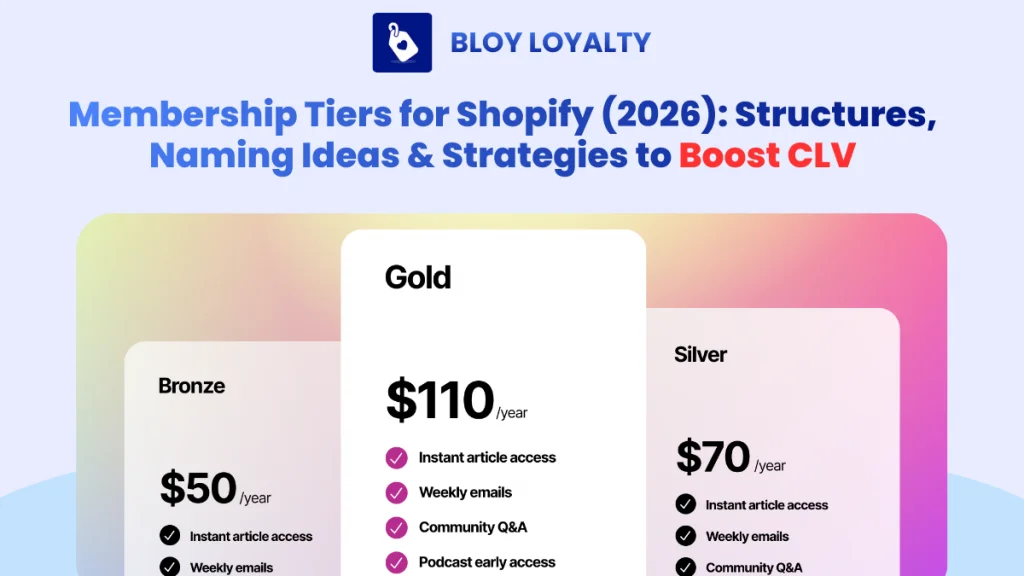
Membership tiers are one of the most proven ways to increase repeat purchase rate in eCommerce. Done right, they turn one-time buyers into loyal brand advocates through status progression, psychological triggers, and spend-based rewards. This guide covers tier structures, naming frameworks, real-world examples, and how to implement them inside Shopify.
Quick Reference: Membership Tier Examples
| Tier Example | Spend Threshold | Psychological Trigger |
| Bronze > Silver > Gold | $0 > $500 > $1,000 | Status Progression |
| Insider > Icon > Legend | Points-based | Identity |
| $500 Club > 1K Elite | Revenue-based | Goal Gradient Effect |
| VIP Instant Access | Paid Tier | Exclusivity & Shortcut |
What Are Membership Tiers in Shopify?
Membership tiers are structured loyalty levels that reward customers based on their spending, points accumulation, or subscription status. In a Shopify context, tiers go far beyond a simple points program. They create a progression system where each level unlocks new benefits, exclusive perks, and a stronger sense of belonging to the brand.
It is important to distinguish between three related but different concepts:
Points-only programs reward customers for each purchase but offer no sense of progression or status. Everyone is essentially at the same level regardless of how much they spend.
Tiered loyalty programs add a ladder structure on top of points. Customers graduate from one level to the next as they hit thresholds, and each level delivers more valuable benefits. This structure is the core of what makes tiers so effective at driving repeat purchases.
Subscription tiers require customers to pay a recurring fee (monthly or annually) to access premium benefits, similar to Amazon Prime or Costco Executive membership.
Understanding which model fits your brand is the first strategic decision every Shopify merchant needs to make before naming a single tier.
The real power of tiers is behavioral momentum. When a customer knows they are 200 points away from Gold status, they are far more likely to return and make another purchase than if they had no visible progress to chase. Research from the Journal of Marketing Research confirms that goal gradient effects, where effort and purchase frequency increase as people approach a reward threshold, are amplified in tiered loyalty programs compared to flat reward structures.
Free vs Paid vs Hybrid Membership Tiers
One of the most overlooked decisions in building a loyalty program is choosing the entry model.
Free tiers are the most common approach. Customers join at no cost and earn their way up through spending or engagement. Free tiers lower the barrier to entry and maximize enrollment, but they require patience because customers must earn their way to the most valuable benefits.
Paid tiers flip the model. Instead of earning status, customers buy access to it instantly. Think of Costco’s Executive upgrade or Amazon Prime. The psychology here is powerful: once someone has paid for a tier, they are motivated to recover the cost of their membership through increased purchasing. Studies from Harvard Business Review show that customers who pay for loyalty programs are significantly more engaged and spend more than those in free programs.
Hybrid models combine both approaches. A customer starts in a free tier and earns their way up through the program, but at a certain point they are offered the option to “skip the queue” with a paid VIP upgrade. This is the model many successful DTC Shopify brands are moving toward in 2026 because it captures both audiences: the deal-seekers who want to earn their status and the convenience-driven customers willing to pay for immediate access.
A practical hybrid example for Shopify:
- Member (Free): Basic points on every purchase
- Silver (Earned): $500 cumulative spend, 1.5x points, early access to sales
- Gold (Earned): $1,000 cumulative spend, 2x points, free shipping, birthday reward
- VIP (Paid, $49/year): Instant Gold-level benefits plus exclusive product drops and dedicated support
Why Membership Tiers Increase CLV in eCommerce
If your primary goal is to increase repeat purchase rate, membership tiers are one of the most direct levers available to you. Here is why they work at a mechanics level.
Status vs Savings
Most merchants assume customers join loyalty programs purely for discounts. The data tells a different story. According to Yotpo’s State of Brand Loyalty report, status and recognition are among the top reasons customers prefer one brand over another. When a customer achieves Gold or VIP status, they are not just saving money. They are receiving recognition that they are a valued member of the brand community. This emotional connection is far stickier than a 10% discount.
Spend Acceleration
Tiers create a natural pull toward the next threshold. A customer sitting at $430 lifetime spend who sees Gold status at $500 will often make a purchase they were not planning just to hit the milestone. This is the spend acceleration effect, and it directly increases purchase frequency and average order value.
Points Multipliers
Bonus multipliers at higher tiers reward your most loyal customers disproportionately. A 2x multiplier at Gold tier means your top customers feel like they are getting more from every purchase, reinforcing the behavior you want: continued buying from you instead of a competitor.
Loss Aversion and Tier Downgrade Risk
Annual tier resets are one of the most psychologically effective retention tools available. When a Gold customer receives an email warning them that their status will downgrade to Silver in 30 days unless they make a qualifying purchase, a significant portion of them will take action. Loss aversion, the tendency to fear losing something more than valuing gaining it, is one of the most documented principles in behavioral economics, as explored extensively in Kahneman and Tversky’s prospect theory research.
Goal Gradient Effect
The closer customers get to the next tier, the more frequently they purchase. A well-designed tier structure ensures there is always a visible “next level” that feels achievable, keeping customers in a constant state of motivated progress.
How Many Membership Tiers Should You Have?
The number of tiers directly affects both conversion into the program and long-term engagement. There is no single correct answer, but here is a practical framework based on what works across different Shopify store sizes.
2-tier model works best for smaller stores or brands just starting their loyalty program. It is simple to communicate, easy for customers to understand, and requires minimal infrastructure. The downside is that it creates only one progression moment, which limits its ability to drive repeat purchases over a long customer lifecycle.
3-tier model is the most common and generally most effective structure for mid-market Shopify brands. It creates two progression moments, gives customers a clear entry point and an aspirational goal, and is complex enough to feel meaningful without being overwhelming. Research from Loyalty360 consistently shows 3-tier programs outperform both 2-tier and 4-plus-tier structures in engagement metrics.
4-tier model makes sense for brands with a large and diverse customer base where clear segments exist across the spending range. Airlines and hotel chains use 4-tier models because they have enough customers at each level to justify the added complexity. For most DTC Shopify brands, a 4-tier model risks confusing customers or diluting the perceived value of upper tiers.
| Model | Best For | Progression Moments | Risk |
| 2 tiers | New programs, small stores | 1 | Low engagement ceiling |
| 3 tiers | Most DTC Shopify brands | 2 | Low if benefits are clear |
| 4 tiers | High-volume, diverse AOV range | 3 | Complexity, diluted upper tiers |
When too many tiers are added, customers lose track of where they are and what they are working toward. More than 4 tiers is almost never recommended unless the brand has a highly sophisticated loyalty engine and clear customer segmentation data to support the structure.
The 5 Core Frameworks for Naming Membership Tiers
The names you choose for your tiers communicate brand personality, set expectations for benefits, and influence whether customers feel excited to progress through the program. Here are the five most effective naming frameworks being used by Shopify brands.
1. Precious Metals
Examples: Bronze, Silver, Gold, Platinum
This is the most universally recognized tier framework. Customers immediately understand the hierarchy, and the names carry implicit prestige. The downside is that the framework is generic and does not reinforce brand identity. Best for brands where clarity is more important than personality.
Psychology: Instant recognition of status hierarchy reduces cognitive load and makes tier value self-explanatory.
2. Growth-Based
Examples: Seedling, Bloom, Flourish / Spark, Glow, Radiance
Growth names work exceptionally well for beauty, wellness, and lifestyle brands where the product narrative is about personal transformation. They tie the loyalty journey to the brand story, making progression feel meaningful beyond just points and discounts.
Psychology: Metaphorical alignment between the customer journey and the brand narrative deepens emotional connection.
3. Identity-Based
Examples: Insider, Enthusiast, Icon, Legend / Member, Devotee, Ambassador
Identity names are powerful because they tell customers who they are becoming, not just what they are earning. A customer who identifies as a “Legend” within a brand community is far less likely to churn than someone who is simply labeled “Gold.”
Psychology: Identity-based labels create self-concept alignment, making brand loyalty a part of how customers see themselves.
4. Spend-Based
Examples: $500 Club, 1K Elite, Platinum 5K
Explicit spend-based names are transparent and motivating because customers always know exactly what they need to do to reach the next tier. This framework works particularly well in B2B or high-ticket retail contexts where the spend thresholds themselves carry prestige.
Psychology: Transparency activates the goal gradient effect directly by making the target explicit.
5. Action-Oriented
Examples: Explorer, Pioneer, Trailblazer / Starter, Builder, Architect
Action-oriented names position customers as active participants in a journey rather than passive reward recipients. They work well for outdoor, fitness, and lifestyle brands where the product community has a strong cultural identity.
Psychology: Agency language increases perceived program value and reinforces the brand’s positioning around activity and ambition.
Industry Applications of Membership Tiers
Different industries have unique loyalty dynamics that affect how tiers should be structured and named. Here is a brief overview of how membership tiers perform across key DTC verticals.
Fashion: Tiers reward purchase frequency and seasonal re-engagement. Early access to new collections and exclusive member pricing are the most valued benefits. Naming tends toward identity frameworks (Stylist, Muse, Icon).
Beauty: Points multipliers on replenishment products drive the repeat purchase rate exceptionally well. Status perks like early access to limited-edition drops are highly effective in beauty communities. Sephora Beauty Insider is the benchmark in this category.
>> Maybe you want to read: Beauty Loyalty Programs: Why Points Alone Don’t Build Real Beauty Loyalty
Supplements: Subscription-tier hybrids work particularly well because the replenishment cycle creates a natural recurring revenue base. Combining a subscription discount with a tiered loyalty overlay maximizes both retention and CLV. The replenishment cycle already creates predictable revenue but when we introduced a tiered overlay for one supplement brand, it unlocked an additional 10% increase in order volume by incentivizing customers to move up tiers faster.
Pet: Emotional connection to pets makes identity-based tiers (“Pet Parent”, “Pack Leader”, “Top Dog”) resonate strongly. Charitable giving tiers, where higher-status members unlock brand donations to animal shelters, add a values-based dimension that resonates with this audience.
Electronics: Spend-based naming aligns well with high-ticket categories. Benefits focused on extended warranties, priority support, and early access to new products tend to outperform discount-based rewards in electronics loyalty programs.
Gym and Fitness: Action-oriented naming (Starter, Builder, Champion) aligns with the customer’s fitness journey and strengthens identity-based motivation.
Real-World Membership Tier Examples
Sephora Beauty Insider
Sephora’s Beauty Insider program is widely considered the gold standard in retail tiered loyalty. The three-tier structure (Insider, VIB, Rouge) uses a spend-based qualification system combined with a points economy, exclusive events, and experiential rewards. What makes it exceptionally effective at driving repeat purchases is the combination of points expiration, annual tier resets, and high-value experiences at the top tier that money alone cannot buy. According to Sephora’s own reporting, the Beauty Insider community drives a majority of their total annual revenue.
Gymshark Loyalty Model
Gymshark’s approach is more community-driven than transactional. Their program rewards engagement and advocacy alongside purchasing, which reflects an understanding that in fitness communities, social identity is as motivating as savings. This hybrid model is increasingly relevant for DTC Shopify brands targeting community-centric audiences.
Costco Executive Tier
Costco’s paid upgrade model is one of the clearest real-world examples of a hybrid membership tier in practice. Customers who upgrade to Executive membership pay a higher annual fee but receive 2% cash back on qualifying purchases. The financial incentive is straightforward, but the behavioral effect is significant: Executive members visit more frequently and spend considerably more per year than Basic members because they are motivated to justify the membership cost.
Marriott Bonvoy
Marriott Bonvoy’s six-tier status ladder is a masterclass in using loss aversion and spend acceleration to drive repeat bookings. The annual qualification window, combined with multiple “nights to next status” visible in every member communication, creates a year-round engagement engine. The Titanium and Ambassador tiers include personal concierge-style benefits that cannot be replicated by competitor programs, creating genuine switching costs at the top of the loyalty ladder.
Where Membership Tiers Appear in Shopify
One of the most common mistakes Shopify merchants make with loyalty programs is building a great tier structure and then failing to surface it consistently across the customer experience. For tiers to drive repeat purchase rate, customers need to see their status and progress everywhere they interact with the brand.
Customer Account Page: The most important touchpoint. Customers who log in should immediately see their current tier, points balance, progress to the next tier, and available rewards. A clean, visual progress bar is more effective than a numerical display.
Loyalty Widget: A floating or embedded widget on the storefront ensures customers are reminded of their status and points balance during the browsing and checkout experience. This is particularly effective at reducing cart abandonment from loyalty members.
Checkout Extension: Shopify Plus merchants can use checkout extensions to display tier-specific perks (free shipping threshold, bonus points) directly at checkout, reinforcing the value of the loyalty program at the highest-intent moment of the customer journey.
Post-Purchase Upsell: The moment after a purchase is an ideal time to show customers how close they are to the next tier. A post-purchase page that says “You are $47 away from Gold status” can drive immediate additional purchases or seed the intent for the next visit.
Email Flows (Klaviyo): Tier-based dynamic content in email is one of the most effective channels for increasing repeat purchase rate. Segment-specific flows for near-tier customers, tier achievement celebratory emails, and downgrade warning emails consistently generate some of the highest conversion rates in any loyalty email program.
SMS Tier Alerts: Short, personalized SMS messages triggered by tier milestones or near-threshold moments have extremely high open rates and drive immediate action.
Shopify POS: For brands with physical retail locations, syncing loyalty tiers across online and in-store channels ensures a consistent experience and allows store associates to acknowledge customer status during in-person interactions.
Tier Migration Strategy: From Naming to Revenue
The most sophisticated element of any membership tier program is the migration strategy, which covers how you move customers from one tier to the next and what you do to prevent churn at critical threshold moments.
When a customer reaches 80% of the qualifying spend for their next tier, trigger an automated email or SMS alert. This “you are close” message should be specific (“You are $89 away from Gold”), visually engaging, and include a relevant product recommendation that helps them close the gap.
Cart progress bars are highly effective on-site tools that show loyalty members how much additional spend earns them a reward or tier upgrade. Shopify apps like Loyalty Lion and Smile.io offer this functionality natively. According to Smile.io’s merchant data, stores with visible progress indicators report measurably higher repeat purchase rates than those without.
Double-point events are time-limited campaigns that accelerate tier progression. Running a “Earn 2x Points This Weekend” event during a slow period is more effective than a flat discount because it rewards your loyalty members specifically while also creating urgency for customers near a tier threshold.
Tier maintenance reminder flows, sent 60 and 30 days before annual resets, are critical for retaining high-value customers. These emails should lead with the customer’s current status, clearly state the spend needed to maintain it, and include a personalized product recommendation. The loss aversion psychology behind these emails makes them among the highest-ROI messages in any DTC email program.
The Naming Redline: What Not to Do
Even brands with strong tier structures undermine their programs with poor naming choices. Here are the most common mistakes to avoid.
Tier 1, Tier 2, Tier 3 is the most common mistake. Numbered tiers communicate nothing about status, identity, or aspiration. They feel like internal system labels, not customer-facing experiences.
Internal jargon that makes sense to your team but means nothing to your customer creates confusion and reduces program enrollment. Tier names should be immediately legible to a first-time visitor with no context.
Overly complex fantasy names that require explanation defeat the purpose of naming entirely. If a customer needs to read a paragraph to understand what “Arcane Sovereign” means in your loyalty program, the name is working against you.
Names disconnected from benefits create cognitive dissonance. If your top tier is called “Bronze” but delivers platinum-level service, the disconnect between the name and the experience erodes trust.
Too many levels dilute the perceived value of each tier and make the program feel difficult to navigate. If customers cannot remember which tier they are in or what it entitles them to, the program has failed its most basic function.
How to Implement Membership Tiers in Shopify
The implementation process for Shopify loyalty tiers follows a consistent five-step framework regardless of which app you use.
Step 1: Define thresholds. Before building anything, decide whether your tiers will be spend-based, points-based, or hybrid. Run your customer data to identify natural spend clusters in your customer base. Your tier thresholds should align with real purchasing behavior, not arbitrary round numbers.
Step 2: Assign benefits. Map specific, concrete benefits to each tier. Benefits should be meaningful at every level (not just at the top) and should escalate clearly as customers move up. Common benefit categories include points multipliers, free shipping thresholds, early access, birthday rewards, and exclusive products.
Step 3: Sync multipliers. Configure your points multipliers, bonus earning rules, and any tier-specific discount logic inside your loyalty app. Test every earning rule thoroughly before launch to avoid calculation errors that erode trust.
Step 4: Automate promotion. Build the email and SMS flows for tier achievement, near-threshold nudges, and annual reset reminders before launch. These automations are what transform a loyalty structure into an active repeat purchase driver.
Step 5: Display clearly across touchpoints. Implement the customer account page, loyalty widget, and any checkout extensions needed to surface tier information throughout the customer experience. Conduct a full UX audit to ensure customers can always find their status and progress in three clicks or fewer.
FAQs
What are membership tiers? Membership tiers are structured loyalty levels within a customer rewards program. Each tier unlocks different benefits, with higher tiers typically offering more valuable rewards in exchange for greater spending or engagement.
How many membership tiers should I have? For most Shopify brands, three tiers is the optimal structure. It creates two clear progression moments, is easy for customers to understand, and gives the program enough complexity to drive long-term engagement without becoming confusing.
What is the best 3-tier structure? An entry tier (free to join), a mid tier (earn through spending), and a top tier (highest spenders or paid upgrade option) is the most effective 3-tier model for DTC Shopify brands in 2026.
Should tiers reset annually? Annual resets are highly recommended because they reactivate the loss aversion trigger every year. Without a reset mechanism, top-tier customers have no reason to maintain their spending level after qualifying. Annual resets, communicated with proactive reminder emails, consistently drive end-of-year repeat purchases.
Are paid VIP tiers worth it? Yes, particularly for brands with a clear segment of high-frequency buyers. McKinsey research on paid loyalty programs shows that paid loyalty members spend 60% more annually than non-paying members, making the conversion from free to paid tier one of the highest-ROI moves available to DTC brands.
How do I name membership levels? Choose a naming framework that aligns with your brand voice: Precious Metals for clarity, Growth-Based for wellness and lifestyle brands, Identity-Based for community-driven brands, Spend-Based for high-ticket or B2B contexts, or Action-Oriented for fitness and outdoor brands.
Conclusion
Membership tiers are not decoration. They are behavioral architecture. The right tier structure tells customers exactly what to do next, rewards them for doing it, and gives them a reason to keep coming back long after the initial purchase excitement has faded.
The brands that consistently increase repeat purchase rate in 2026 are the ones that treat their loyalty program as a core growth channel, not an afterthought. Every naming decision, every threshold, every benefit, and every automation contributes to a system that either builds compounding customer value or slowly leaks it.
Structure drives behavior. Naming influences perceived value. Implementation drives CLV. When all three are aligned, membership tiers become one of the most powerful tools available to any Shopify merchant.

Yến Lê Hải
Content author at BLOY, focusing on product-led content, SEO, and educational resources to help merchants improve conversion and customer engagement.