Retail Store Loyalty Program: How to Build One That Brings Customers Back
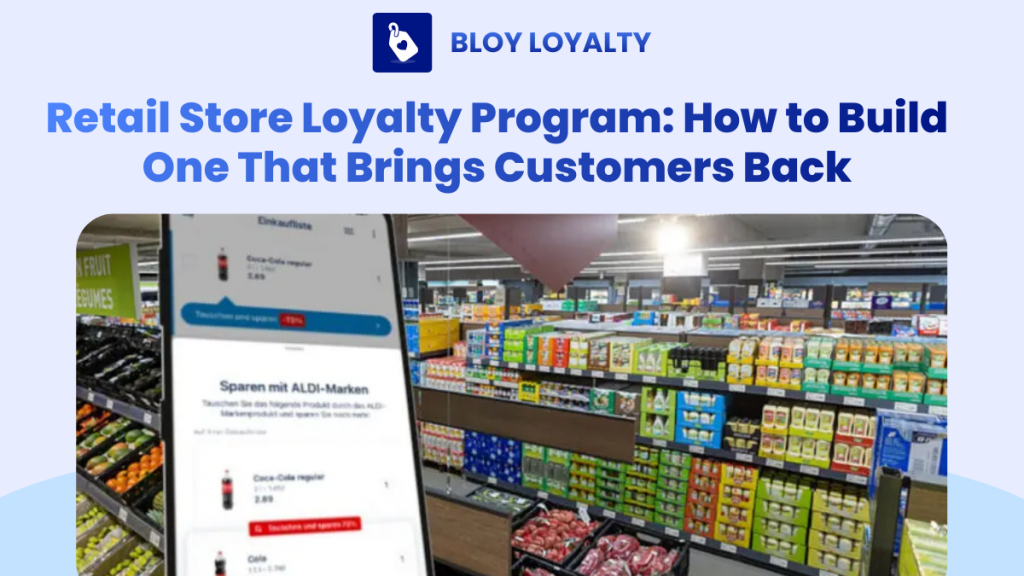
Running a loyalty program for a retail store is very different from running one for an online shop. In-store purchases are driven by habit, convenience, and personal recognition rather than email flows or pop-ups. However, many retail businesses still copy ecommerce loyalty models that focus on points, discounts, and sign-ups, only to see customers earn rewards once and never return.
A well-designed retail store loyalty program is not about giving more rewards. It focuses on building familiarity across both in-store and online touchpoints, recognizing repeat customers, and creating clear reasons to come back without relying on constant discounts. In this guide, you will learn how retail loyalty programs actually work, which models fit small retail stores best, and how to choose a system that supports long-term omnichannel growth.
1. What is a retail store loyalty program (and why do many fail)?
A retail store loyalty program is a structured way for physical stores to recognize repeat customers and encourage them to return more often. Instead of focusing only on one-time promotions, loyalty programs reward ongoing behavior such as frequent visits, repeat purchases, or higher lifetime value. In retail environments, loyalty is closely tied to familiarity, staff interactions, and consistent in-store experiences.
However, many retail loyalty programs fail to deliver real results. One common reason is that they are copied directly from ecommerce models without considering in-store behavior. Customers may earn points or receive a discount, but there is no clear incentive to return again. Another issue is poor integration between offline and online channels, which leads to fragmented customer data and inconsistent experiences. Retailers often know someone is a repeat buyer but lack a system to recognize them across visits.
Finally, some programs fail because they focus on rewards instead of behavior change. When loyalty becomes just another discount mechanic, customers learn to wait for incentives rather than build a habit of returning. A successful retail store loyalty program should support recognition, consistency, and long-term engagement, not just short-term transactions.
2. Retail loyalty vs ecommerce loyalty: what store owners need to know
Retail loyalty programs work in a very different environment compared to ecommerce loyalty programs. In online stores, loyalty is often driven by automated emails, personalized recommendations, and account based tracking. Customers are identified as soon as they log in, and every interaction is recorded by default.
In physical retail stores, loyalty depends much more on in person behavior. Customers may walk in without identifying themselves, interact directly with staff, and make quick purchasing decisions based on convenience or familiarity. This makes recognition a central challenge for retail loyalty. If a store cannot easily recognize returning customers, rewards alone will not create a strong reason to come back.
Another key difference lies in how rewards are experienced. Ecommerce loyalty programs often focus on future discounts or free shipping, while retail loyalty programs need to reinforce immediate value at the point of sale. This can include visit based rewards, tier recognition, or exclusive in store benefits that feel personal and tangible.
For store owners who sell both offline and online, the gap becomes even more visible. Without a unified approach, customers may earn rewards in one channel but feel invisible in another. Effective retail loyalty programs are designed to bridge this gap and support consistent recognition across all customer touchpoints.
3. Common types of retail store loyalty programs
There is no single loyalty model that works for every retail store. The right structure depends on how often customers visit, how they interact with staff, and whether the store also sells online. Below are the most common types of retail store loyalty programs used by small and medium sized retailers.
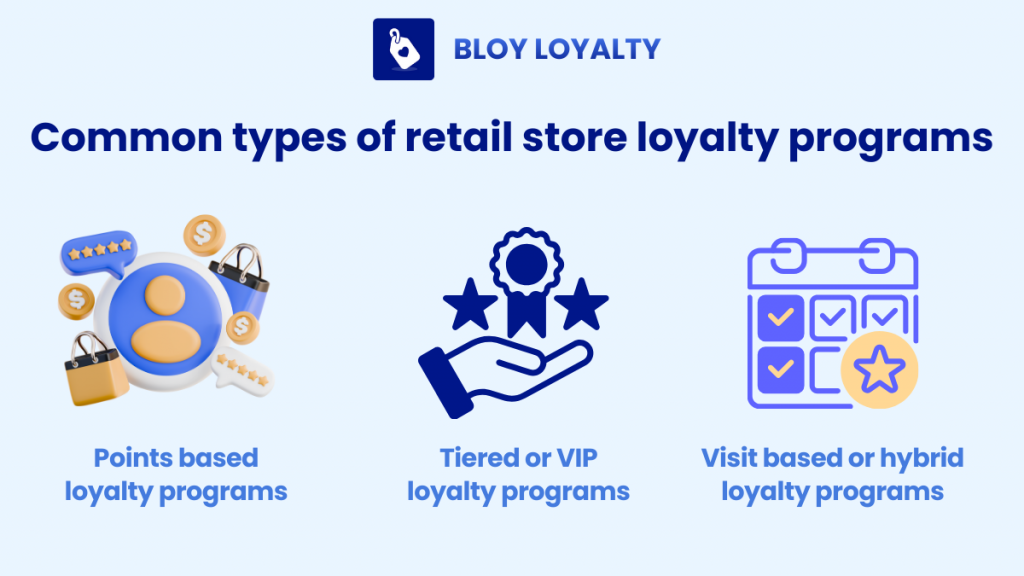
3.1. Points based loyalty programs
This is the most familiar model for retail stores.
- Customers earn points based on spending or purchases
- Points can be redeemed for discounts, products, or rewards
- Easy for customers to understand and easy to launch
However, points based programs often struggle to drive repeat visits if rewards feel too far away or disconnected from the in store experience.
3.2. Tiered or VIP loyalty programs
Tiered loyalty focuses on recognition rather than transactions.
- Customers unlock tiers based on spending or visit frequency
- Higher tiers receive exclusive perks or in store benefits
- Strong at building emotional loyalty and repeat behavior
This model works well for retail stores that want to reward their best customers and create a sense of status inside the store.
3.3. Visit based or hybrid loyalty programs
Visit based programs reward frequency instead of spend.
- Customers earn rewards after a set number of visits
- Simple structure that fits cafés, salons, and local shops
- Often combined with points or tiers in hybrid models
Hybrid loyalty programs are becoming more common as retail stores move toward omnichannel setups. They allow businesses to reward both spending and engagement without overcomplicating the experience.
4. How to choose the right loyalty program for a retail store
Choosing a retail store loyalty program should start with understanding how your customers actually behave, not with copying popular models. A loyalty program works best when it fits the store’s size, purchase patterns, and operational capacity.
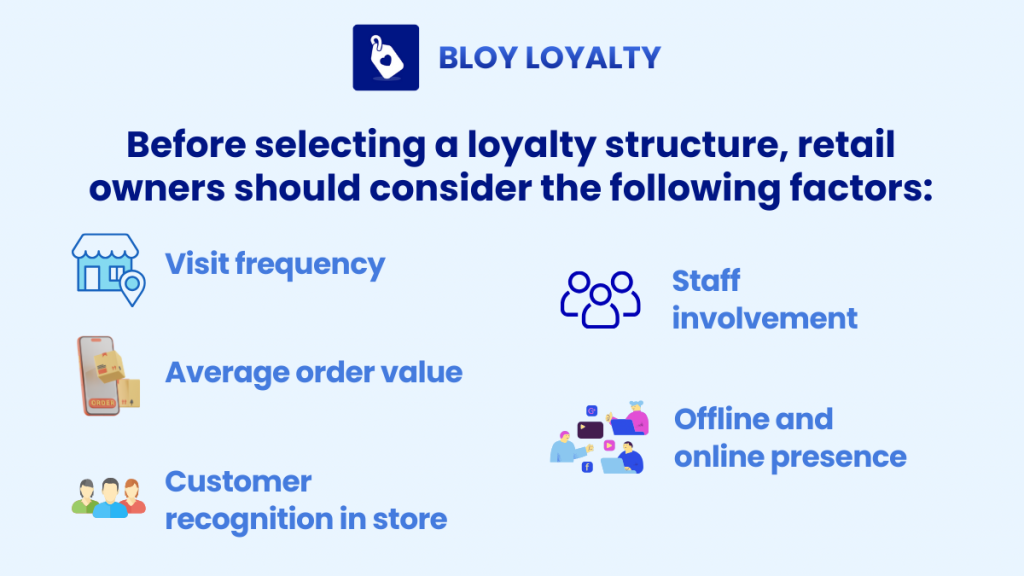
Before selecting a loyalty structure, retail owners should consider the following factors.
- Visit frequency
Stores with frequent visits benefit from visit based or tiered programs, while lower frequency stores may need rewards that feel more meaningful per purchase. - Average order value
If customers spend small amounts per visit, long point accumulation cycles can reduce motivation. Immediate or milestone based rewards often work better. - Customer recognition in store
Loyalty programs should make it easy for staff to identify repeat customers and acknowledge them during checkout or interactions. - Staff involvement
Simple programs are more likely to be adopted by staff. Overly complex rules often lead to inconsistent execution at the point of sale. - Offline and online presence
Retail stores that also sell online should avoid separating loyalty experiences by channel. Customers expect their loyalty status to follow them everywhere.
The right loyalty program is one that supports habit building, makes customers feel recognized, and can be managed consistently without adding operational friction.
5. How omnichannel loyalty works for modern retail stores
Modern retail stores rarely operate in a single channel. Many customers discover a brand online, visit the physical store to purchase, and return later through another channel. Omnichannel loyalty connects these touchpoints into one continuous experience so customers are recognized wherever they interact.
In practice, omnichannel loyalty allows customer activity to flow across both in store and online environments. A customer might earn rewards during an in store purchase and later check their points balance online. Another customer may join the loyalty program online but redeem rewards when visiting the physical store. When these actions are connected, loyalty feels consistent instead of fragmented.
For small retail businesses, the value of omnichannel loyalty lies in visibility and continuity. Store owners can understand how often customers return, which channels they prefer, and how loyalty influences repeat behavior over time. Customers, in turn, feel remembered rather than treated like a new visitor on every purchase.
When omnichannel loyalty is done well, it supports three core outcomes.
- Customers are recognized across visits and channels
- Rewards feel relevant at the moment of purchase
- Loyalty status remains consistent whether shopping online or in store
This consistency is what turns loyalty programs into long term retention systems rather than short term promotional tools.
6. What to look for in a retail loyalty system before choosing any app
Before choosing a loyalty app or platform, retail store owners should focus on the system behind the program rather than the rewards themselves. A loyalty system that fits retail operations should support daily workflows and customer recognition without creating friction for staff or customers.
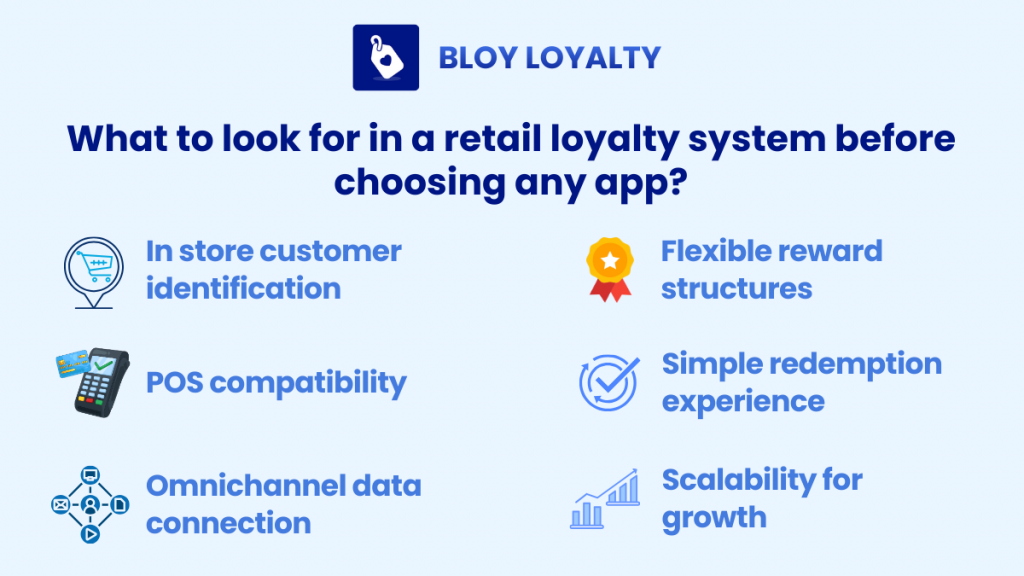
Below are the key criteria that matter most for small retail stores.
- In store customer identification
The system should make it easy to recognize returning customers during checkout or staff interactions, not only after the transaction is complete. - POS compatibility
Loyalty should work naturally with existing point of sale processes. If staff need to switch tools or follow complex steps, adoption will drop quickly. - Omnichannel data connection
Customer activity should be unified across in store and online channels so loyalty status, rewards, and history remain consistent. - Flexible reward structures
Retail stores benefit from systems that support points, tiers, visit based rewards, or combinations of these, depending on customer behavior. - Simple redemption experience
Rewards should be easy to understand and easy to redeem at the moment of purchase. Complicated redemption rules often reduce perceived value. - Scalability for growth
As stores add new locations or sales channels, the loyalty system should scale without requiring a complete redesign.
A strong retail loyalty system supports recognition, consistency, and long term engagement. Choosing the right foundation makes it much easier for loyalty programs to deliver real behavioral impact instead of becoming another unused feature.
7. Common mistakes retail stores make with loyalty programs
Many retail loyalty programs fail not because the idea is wrong, but because of how they are implemented in day to day operations. These mistakes often cause loyalty programs to become inactive or ignored over time.
One common mistake is treating loyalty as a discount tool. When customers only engage with a program to receive price reductions, loyalty quickly turns into price sensitivity. Instead of building habits, the program trains customers to wait for incentives.
Another issue is overcomplicating the program structure. Retail stores sometimes introduce too many rules, reward types, or conditions. When staff struggle to explain how the program works, customers are unlikely to remember or use it consistently.
Poor staff adoption is also a major factor. If employees are not trained or motivated to promote loyalty at checkout, even well designed programs will fail to gain traction. Loyalty works best when staff see it as part of the customer experience rather than an extra task.
Finally, many retail stores fail to measure whether loyalty is actually changing customer behavior. Without tracking repeat visits, purchase frequency, or customer retention, it becomes impossible to improve or justify the program over time.
Avoiding these mistakes helps loyalty programs remain active, relevant, and aligned with real retail behavior.
Conclusion
A retail store loyalty program is not just a set of rewards. It is a system designed to recognize customers, reinforce positive habits, and create reasons for them to return without relying on constant discounts. When loyalty programs focus only on points or promotions, they often fail to change real customer behavior.
For small retail stores, the most effective loyalty programs are simple, consistent, and aligned with how customers actually shop. This means recognizing repeat visits, connecting in store and online experiences, and making loyalty easy for both customers and staff to use. When loyalty feels natural at the point of purchase, it becomes part of the overall retail experience rather than an extra feature.
If you are exploring ways to build or improve a retail store loyalty program, start by evaluating whether your current setup supports customer recognition across channels and scales as your business grows. Choosing the right loyalty system early can make the difference between a program that fades away and one that truly supports long term customer retention.

Yến Lê Hải
Content author at BLOY, focusing on product-led content, SEO, and educational resources to help merchants improve conversion and customer engagement.