How to Create a Loyalty Program for Small Business (That Customers Actually Use)
How to create a loyalty program for small business is a common question, but many owners struggle to make it work in practice.
Customers sign up, earn a few points, then forget it exists. The program gets installed and quietly frozen.
In this guide, you’ll learn how to create a loyalty program that’s simple to launch, easy to manage, and designed to drive real repeat purchases, not just vanity sign-ups. Whether you run a Shopify store or a small retail brand, this step-by-step approach helps you start small and build loyalty that actually gets used.
1. What is a loyalty program for small business (and why most fail)
A loyalty program for a small business is a simple way to encourage customers to come back by using structured customer loyalty programs that reward repeat behavior but sometimes referrals or engagement as well. In its simplest form, customers earn something of value over time, instead of being pushed to buy only when there’s a discount.
For small businesses, loyalty programs are not about copying what big brands do. They are about creating a habit. A good loyalty program gives customers a clear reason to return, without requiring constant promotions or manual follow-ups from the business owner.
The problem is that many small business loyalty programs fail not because the idea is wrong, but because the execution doesn’t match the reality of a small team.
Common reasons loyalty programs fail for small businesses include many of the same patterns seen in research on why loyalty programs fail across industries.
- They are too complicated
Customers don’t understand how rewards work, how many points they need, or where to check their progress. If the program needs explanation every time, it won’t be used. - They are copied from larger brands
Tier structures, rewards, and rules designed for enterprise brands often assume large budgets, dedicated teams, and high purchase frequency, none of which apply to most small businesses. - They exist, but don’t change behavior
Many programs are installed and technically “live,” but customers forget about them after signing up. Points accumulate slowly, rewards feel distant, and there’s no clear moment that triggers repeat purchases. - They add more work instead of removing it
When loyalty requires manual tracking, customer support explanations, or constant adjustments, it quickly becomes something the business avoids touching.
In reality, a loyalty program only works for a small business if two things happen at the same time: customers clearly understand the value, and the business can run the program without extra operational stress.
Understanding how customers behave after their first purchase is essential if you want to learn how to create a loyalty program for small business that actually drives repeat sales.
2. Before you start: what small businesses should decide first
Before thinking about points, rewards, or tools, small businesses need to make a few key decisions.
Skipping this step is one of the biggest reasons loyalty programs end up installed but rarely used.
A loyalty program is not just a feature. It is part of a broader customer retention strategy for small businesses that focuses on long term behavior, not one time purchases.
2.1. What problem are you trying to solve?
For small businesses, a loyalty program should focus on one primary outcome, not everything at once.
Common goals include:
- Getting first-time customers to return
- Increasing repeat purchase frequency
- Rewarding high-value customers without heavy discounts
Trying to solve all three from day one usually leads to confusing rules and weak engagement. A focused goal makes it easier to design rewards that actually change customer behavior.
Learning how to create a loyalty program for small business starts with solving one clear problem instead of copying complex programs from larger brands.
2.2. How simple can your first loyalty program be?
Many small businesses overthink their first loyalty program.
In reality, the first version should be simple enough to explain in a single sentence.
If customers need a long explanation or staff need to remind them how it works the program is already too complex.
A strong rule of thumb for small businesses:
- Start with one earning action
- Offer one clear reward
- Make progress visible and easy to understand
The goal is not to launch a perfect loyalty system.
The goal is to launch something customers actually use and improve it based on real behavior, not assumptions.
2.3. Do you have the capacity to run it consistently?
Even the best-designed loyalty program will fail if it adds friction to daily operations.
Small businesses should be honest about:
- How much manual work they can handle
- Whether staff need to explain the program repeatedly
- How often the program will realistically be updated
If a loyalty program depends too much on manual effort, it often becomes “something we’ll optimize later” and later never comes.
That’s why successful small business loyalty programs are designed to be low-effort by default, with room to evolve only after they prove their value.
3. Step-by-step: how to create a loyalty program for small business
Once the foundation is clear, small businesses can move into execution.
This is where understanding how to create a loyalty program for small business becomes less about theory and more about practical choices that can be launched and adjusted over time.
The key is to start with a structure that is easy to launch and easy to understand, then improve it based on real customer behavior.
This step by step approach focuses on simplicity first, not perfection.
3.1. Choose the right loyalty structure
Small businesses do not need every type of loyalty program at once.
In most cases, starting with a single structure works better than launching multiple mechanics together.
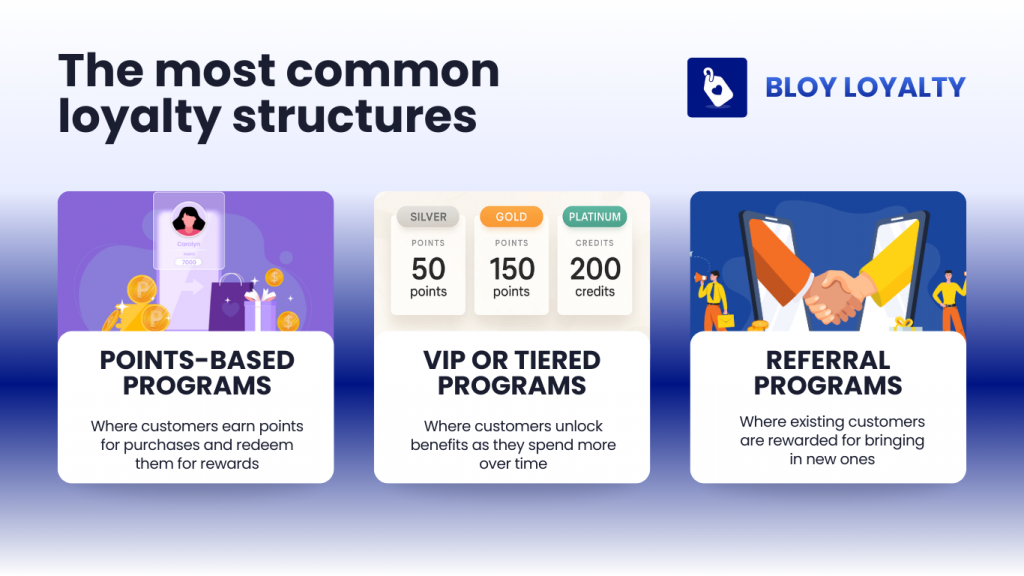
For many small businesses, a points based loyalty program is the easiest place to start because it is familiar, flexible, and easy to explain. It is familiar to customers, simple to explain, and flexible enough to evolve into tiers or referrals later.
The goal at this stage is clarity. Customers should immediately understand what they earn and what they get in return.
3.2. Decide what actions customers are rewarded for
A loyalty program only works when rewards are tied to behaviors that matter to the business and influence repeat purchase behavior over time.
Instead of rewarding everything, small businesses should focus on one or two core actions, such as:
- Making a purchase
- Reaching a spending threshold
- Returning within a specific time period
Rewarding too many actions at once often leads to confusion and slow progress toward rewards.
A clear earning rule helps customers build momentum and makes the program feel achievable, even for first-time buyers.
3.3. Choose rewards customers actually want
Not all rewards are equally motivating.
For small businesses, the best rewards are usually simple, relevant, and easy to deliver.
Choosing the right rewards is a critical part of building customer loyalty rewards that feel motivating instead of transactional.
- Store credit or discounts on future purchases
- Free shipping or upgrades
- Early access to products or collections
Rewards should feel attainable. If customers have to wait too long to redeem their first reward, they are likely to lose interest before forming a habit.
3.4. Decide where customers see and use the program
Visibility plays a major role in whether a loyalty program is used or forgotten.
Small businesses should make sure customers can:
- See their rewards progress without effort
- Understand how close they are to their next benefit
- Redeem rewards at a natural point in the buying journey
If customers only discover the loyalty program after checkout, it rarely influences behavior. The program should be visible before and during the purchase, not just after.
3.5. Launch small and improve based on behavior
The first version of a loyalty program is not meant to be final. It is meant to collect real data about how customers respond.
During the first few weeks, small businesses should observe:
- How many customers join the program
- How often rewards are earned
- Whether rewards are actually redeemed
These signals help identify what is working and what needs adjustment.
Many small businesses use tools or platforms to manage this process more easily, especially when running loyalty programs on Shopify. The important part is not the tool itself, but the ability to iterate without adding operational complexity.
4. How to run a loyalty program without extra workload
One of the biggest reasons small businesses stop investing in loyalty programs is not performance, but effort.
If a program adds friction to daily operations, it slowly becomes something that is ignored, even if it has potential.
A loyalty program should reduce manual work, not create more of it.
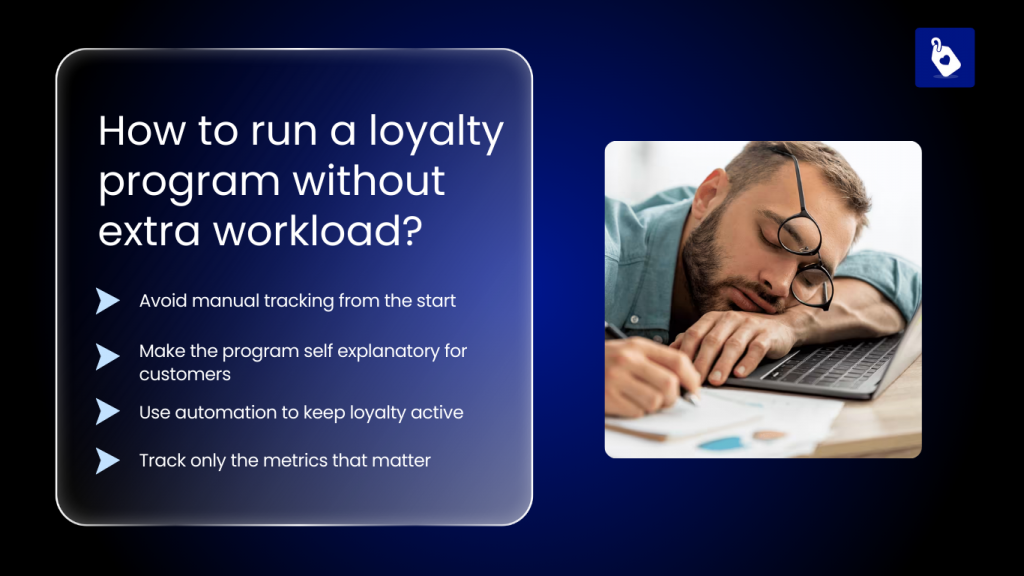
4.1. Avoid manual tracking from the start
Tracking loyalty manually may seem manageable at first, but it rarely scales.
Common problems with manual setups include:
- Inconsistent point tracking
- Missed rewards or human error
- Customers asking for updates on their progress
Once customer volume grows, manual systems become harder to maintain and easier to abandon. This is often when loyalty programs become frozen rather than improved.
4.2. Make the program self explanatory for customers
A loyalty program should not rely on staff explanations to function.
Customers should be able to:
- Understand how rewards work on their own
- Check their progress without contacting support
- Redeem rewards without special instructions
When a program explains itself, it removes pressure from the business and increases customer confidence. Clear visibility is often more important than offering more rewards.
4.3. Use automation to keep loyalty active
Automation plays a key role in automating customer retention, especially for small teams that cannot manage loyalty manually every day.
For Shopify small businesses, automation helps ensure that:
- Points are earned and updated automatically
- Rewards are applied correctly at checkout
- Customers receive timely reminders about their benefits
Many Shopify merchants use loyalty apps to handle these tasks, rather than managing everything manually. Tools like Bloy are often used as an execution layer, allowing small teams to run points and VIP programs without adding operational overhead.
The value of automation is not speed alone, but consistency. A program that runs smoothly in the background is more likely to stay active and effective over time.
4.4. Track only the metrics that matter
Small businesses do not need complex dashboards to understand whether loyalty is working.
A few simple customer retention metrics are often enough to understand whether a loyalty program is working.
- How many customers join the loyalty program
- How often rewards are redeemed
- Whether repeat purchases increase over time
If rewards are being earned but never redeemed, the program may be too slow or unclear. If customers redeem rewards but never return, the value proposition may need adjustment.
The goal is not to optimize everything at once, but to keep the program alive and improving.
5. Common mistakes small businesses make with loyalty programs
Even well intentioned loyalty programs can fail when small businesses fall into a few common traps. Avoiding these mistakes early can save time, effort, and lose momentum.
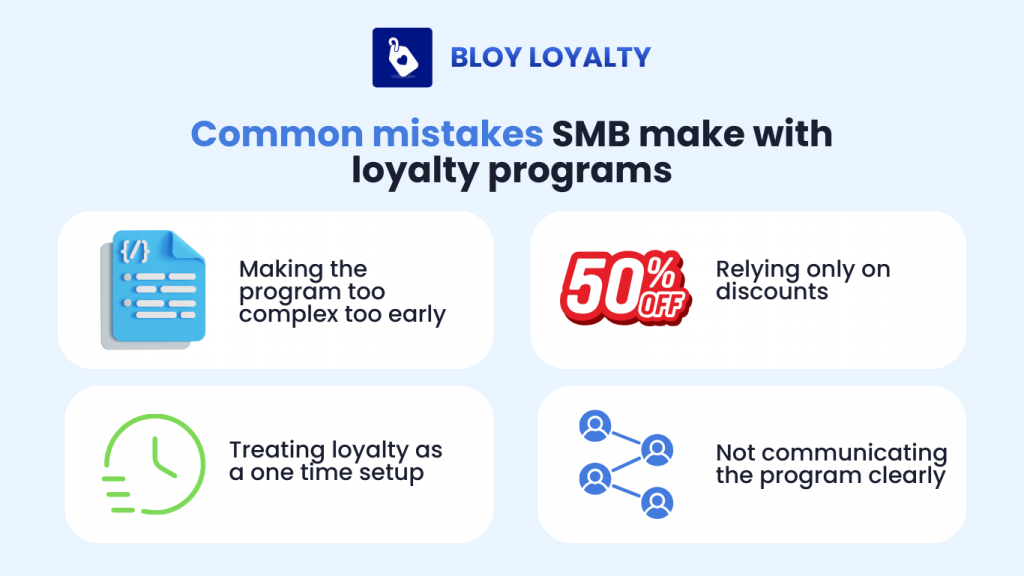
5.1. Making the program too complex too early
Many small businesses try to launch points, tiers, referrals, and special rules all at once. This often overwhelms customers and slows down engagement.
A loyalty program should start simple and earn the right to grow. Complexity should be added only after customers actively use the program.
5.2. Treating loyalty as a one time setup
Installing a loyalty program is not the same as running one.
When programs are launched and never revisited, customers stop noticing them. Loyalty needs light but consistent attention, even if changes are small.
Small improvements over time usually outperform big redesigns that never happen.
5.3. Relying only on discounts
Discount driven loyalty programs can attract short term behavior but rarely build long term habits.
If customers only return when there is a discount, loyalty becomes fragile. Once discounts stop, engagement often disappears.
Balanced programs mix tangible rewards with experiences or recognition that feel earned, not expected.
5.4. Not communicating the program clearly
A loyalty program cannot work if customers forget it exists. When benefits are hidden or poorly explained, customers do not connect their actions to rewards. Clear reminders, visible progress, and simple messaging are often more impactful than adding new features.
6. Conclusion
When approached the right way, how to create a loyalty program for small business becomes a practical growth lever rather than another tool that gets ignored.
The most effective programs:
- Focus on one clear goal
- Use simple earning and reward rules
- Stay visible throughout the customer journey
- Run consistently without adding operational stress
For Shopify small businesses, starting small and improving over time is usually the fastest path to results. Many merchants choose tools that help them launch and manage loyalty programs without heavy setup, especially when running points or VIP structures at scale.
If you are looking to create a loyalty program that fits a small team and grows with your store, platforms like Bloy can help you get started quickly while keeping operations simple.
The key is not choosing the most advanced solution. It is choosing one that your customers will actually use.

Yến Lê Hải
Content author at BLOY, focusing on product-led content, SEO, and educational resources to help merchants improve conversion and customer engagement.