How a Restaurant Loyalty App Drives Repeat Visits in Real Operations
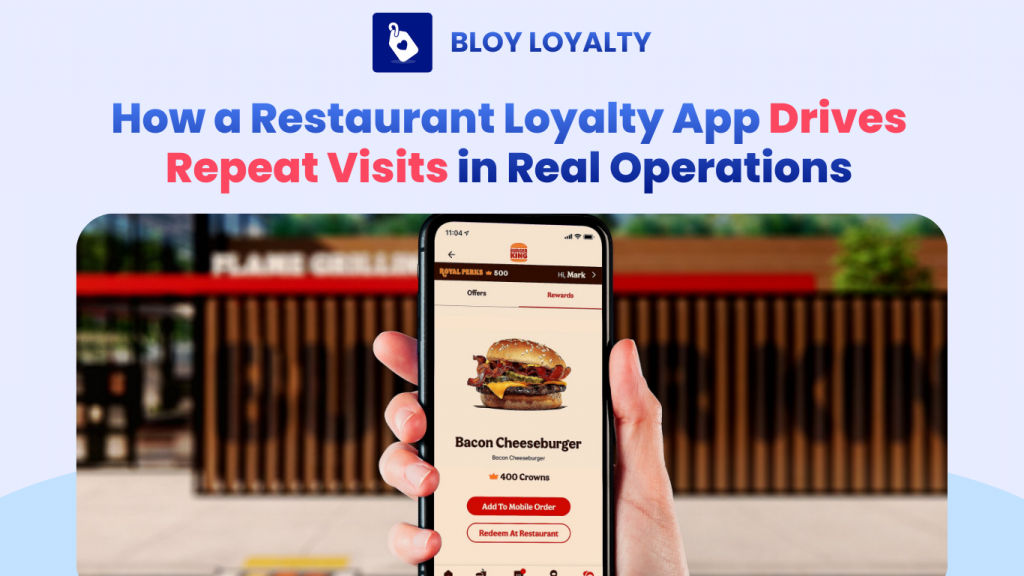
Running a restaurant is not just about serving good food. The real challenge is getting customers to come back consistently without relying on constant discounts.
A restaurant loyalty app, often referred to as restaurant loyalty software, helps restaurants reward repeat visits, understand customer behavior, and increase long-term retention in a way that fits daily operations.
This guide focuses on how to choose the right restaurant loyalty app based on your restaurant model, workflow, and growth stage, not just feature lists or marketing promises.
1. How to choose a restaurant loyalty app based on your restaurant type
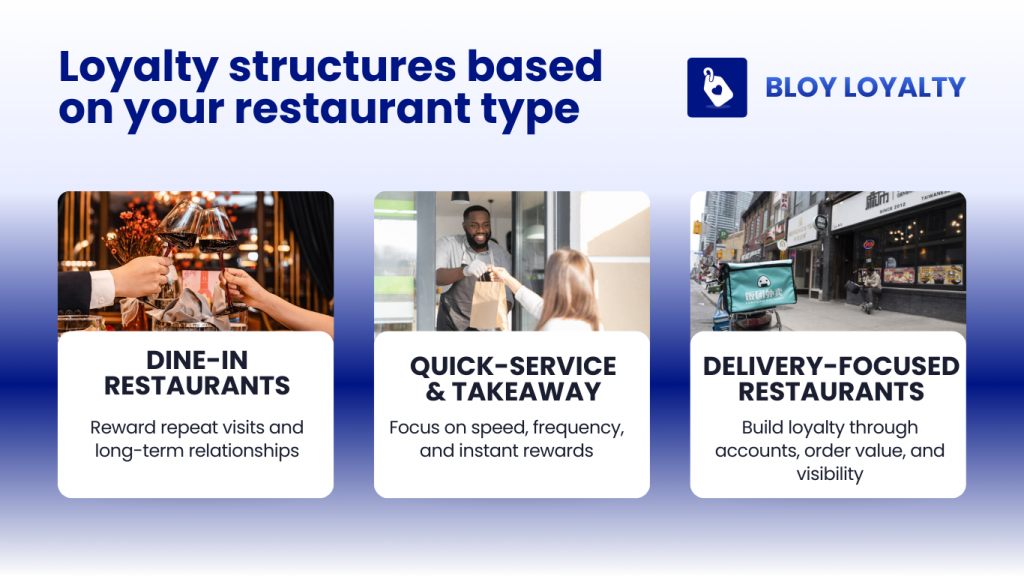
A restaurant loyalty app only works when it matches how your restaurant actually operates. Customer behavior, visit frequency, and ordering flow vary significantly between restaurant models, which means a single loyalty setup rarely fits all.
Before comparing features or pricing, restaurant owners should first identify which loyalty structure aligns best with their business model.
1.1. Loyalty apps for dine-in restaurants
Dine-in restaurants typically rely on repeat visits, longer customer relationships, and in-person interactions. Research into how restaurant type affects customer ordering behavior consistently shows that dine-in customers value experience and recognition more than speed alone.
For this model, a loyalty app should focus on rewarding frequency and overall spend rather than transaction volume.
💡 Key considerations for dine-in restaurants include:
- Rewards based on visits or total spend instead of single orders
- Simple redemption that does not interrupt table service or checkout
- Clear visibility for customers to track progress toward rewards
- Minimal staff involvement during busy service hours
Overly complex loyalty mechanics often fail in dine-in settings, where staff attention and service flow matter more than gamified rewards.
1.2. Loyalty apps for quick-service and takeaway restaurants
Quick-service and takeaway restaurants operate at high speed, with shorter customer interactions and higher order frequency. In this environment, loyalty programs must be frictionless and fast to succeed.
💡 A suitable restaurant loyalty app for quick-service formats should:
- Reward repeat purchases without manual input
- Support fast sign-up methods such as QR codes or phone numbers
- Allow instant redemption at checkout
- Avoid complex tiers or delayed rewards
Any extra step added to the checkout flow increases friction and reduces loyalty participation.
1.3. Loyalty apps for delivery-focused restaurants
Delivery-focused restaurants face a different challenge: limited direct interaction with customers. Loyalty apps in this model must clearly communicate value without relying on staff reminders.
💡 Effective loyalty apps for delivery-heavy restaurants often include:
- Account-based tracking tied to email or phone number
- Rewards linked to order value or order frequency
- Clear digital visibility of points and rewards
- Integration with online ordering or customer accounts
If customers do not regularly see their loyalty progress, engagement quickly drops.
2. How does a restaurant loyalty app fits into daily operations?
A restaurant loyalty app should support daily operations instead of creating extra friction for staff and customers. If loyalty slows down service, complicates checkout, or relies too much on staff explanations, adoption will drop quickly.
Understanding how loyalty software fits into real restaurant workflows is essential before choosing any solution.
2.1. Loyalty apps during peak hours
Peak hours are when most loyalty programs fail in practice. Staff are focused on speed and accuracy, leaving little room for explaining rewards or troubleshooting redemptions.
Studies on restaurant checkout flow and staff efficiency during peak hours highlight that any additional step added to the ordering process increases wait times and operational stress.
For this reason, a restaurant loyalty app should:
- Run automatically in the background
- Avoid manual reward calculations
- Require minimal confirmation steps at checkout
If loyalty actions depend on staff remembering to ask or explain, performance will drop during the busiest times of day.
2.2. Loyalty apps at checkout
Checkout is the most sensitive moment in the customer journey. Loyalty redemption should feel like a benefit, not a delay.
An effective restaurant loyalty app integrates smoothly into the checkout flow so that: (code)
- Customers can redeem rewards without disrupting payment
- Staff can apply rewards in seconds
- The process remains consistent across in-store and online orders
When loyalty redemption interrupts checkout, customers often skip rewards altogether, reducing the perceived value of the program.
2.3. Staff involvement and training requirements
Staff buy-in plays a major role in loyalty success, but loyalty apps should not rely heavily on staff promotion. High staff turnover and limited training time make complex loyalty systems unrealistic for most restaurants.
Best-performing loyalty apps:
- Require minimal training
- Do not depend on staff explaining reward rules
- Keep staff actions simple and repeatable
Loyalty software that works with existing workflows reduces resistance and ensures consistency across shifts.
2.4. Customer redemption experience
From the customer’s perspective, loyalty value must be immediately visible. If customers struggle to understand how many points they have or how to redeem rewards, engagement drops.
Research into customer loyalty program usability in food service environments shows that clear progress tracking and simple redemption significantly improve participation.
A strong restaurant loyalty app ensures:
- Customers can easily see rewards and progress
- Redemption rules are clear and predictable
- Rewards feel achievable within a reasonable number of visits
When customers regularly see progress, loyalty becomes part of their routine rather than an afterthought.
3. When a restaurant loyalty app may not be the right choice
While restaurant loyalty apps can be powerful retention tools, they are not always the right solution for every business. In some situations, implementing loyalty software too early or without the right conditions can lead to low engagement and wasted effort.
This section outlines when restaurants should reconsider or delay adopting a loyalty app.
3.1. Restaurants with low repeat visit frequency
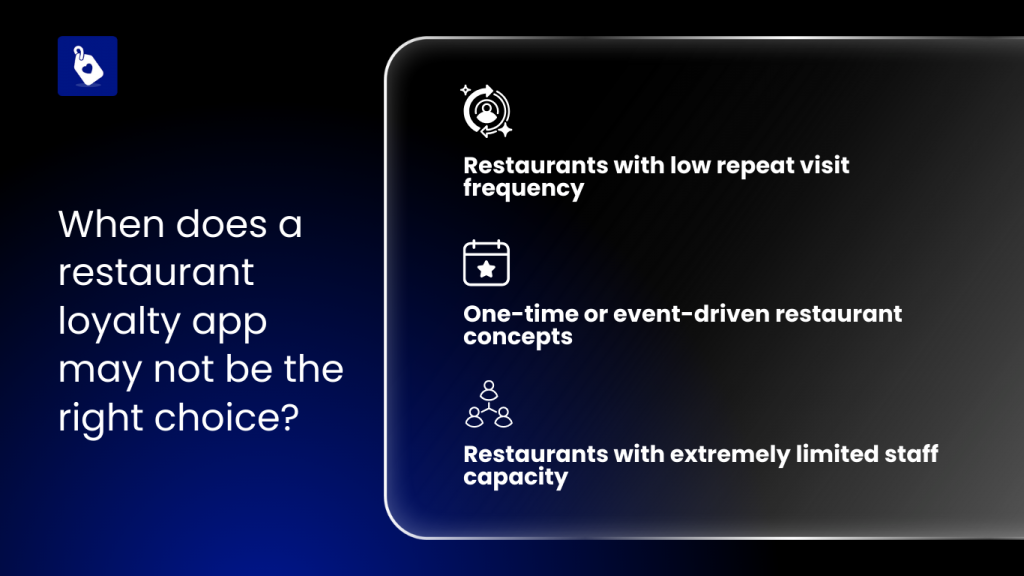
Loyalty programs rely on customers returning often enough to see progress and feel motivated. Restaurants with naturally low repeat frequency, such as destination dining or special-occasion concepts, may struggle to generate meaningful loyalty engagement.
In these cases, a loyalty app may:
- Feel irrelevant to customers
- Fail to deliver perceived value
- Create unnecessary operational overhead
For restaurants with low repeat behavior, improving awareness or experience consistency may be more impactful than launching a loyalty program.
3.2. One-time or event-driven restaurant concepts
Some restaurant models are built around one-time experiences, pop-ups, or limited-time concepts. In these situations, customers have little incentive to track points or rewards tied to future visits.
A restaurant loyalty app may not be suitable when:
- The concept is temporary or seasonal
- Customers are unlikely to return to the same brand
- Loyalty rewards cannot realistically be redeemed
Instead of loyalty software, these businesses often benefit more from simple follow-up communication or social engagement strategies.
3.3. Restaurants with extremely limited staff capacity
Loyalty apps require at least minimal operational support. Restaurants operating with very small teams or limited technical capacity may struggle to manage even simple loyalty workflows.
In these environments, loyalty apps may:
- Add stress during service hours
- Be inconsistently promoted or applied
- Deliver unreliable customer experiences
For these restaurants, stabilizing operations first is usually a better step before introducing loyalty software.
4. Key features to look for in a restaurant loyalty app or software
Choosing a restaurant loyalty app based solely on feature lists often leads to poor adoption. The most effective loyalty software focuses on features that support real customer behavior and daily restaurant operations.
Instead of looking for “more”, restaurant owners should prioritize features that are simple, visible, and easy to manage.
4.1. Flexible reward structures
Restaurants serve different customer segments, and loyalty programs must adapt to those differences. A good restaurant loyalty app allows flexible reward structures that fit visit frequency and average order value.
💡 Effective reward options often include:
- Points based on spend or visits
- Free items or perks after a set number of orders
- Tier-based benefits for frequent customers
4.2. Simple customer sign-up and visibility
If customers struggle to join or track their rewards, loyalty engagement drops quickly. Loyalty apps should make participation effortless from the first interaction.
Strong restaurant loyalty software ensures that:
- Customers can sign up quickly using a phone number, QR code, or email
- Reward progress is clearly visible after each visit
- Customers understand exactly how close they are to redeeming rewards
💡 Strong restaurant loyalty software ensures that:
- Customers can sign up quickly using a phone number, QR code, or email
- Reward progress is clearly visible after each visit
- Customers understand exactly how close they are to redeeming rewards
Clear visibility turns loyalty from a forgotten feature into an ongoing incentive.
4.3. Easy redemption without disrupting service
Redemption is the moment where loyalty proves its value. If redeeming rewards causes confusion or delays, customers may avoid using them.
💡 An effective restaurant loyalty app allows:
- Fast reward application at checkout
- Consistent redemption across in-store and online orders
- Clear rules that staff and customers both understand
4.4. Reporting and customer insights
Loyalty programs are not only about rewards. They are also a source of valuable customer data. Without basic reporting, restaurants cannot improve or optimize their programs.
Useful loyalty software provides insights such as:
- Repeat visit frequency
- Popular rewards and redemption rates
- Differences between casual and loyal customers
Access to these insights helps restaurants refine rewards, identify high-value customers, and make data-informed decisions.
Why features should support behavior, not complexity
Many loyalty apps offer advanced features that look impressive but add little value in practice. Restaurants benefit most from loyalty software that aligns with customer habits and operational realities.
By prioritizing features that support visibility, simplicity, and behavior-driven rewards, restaurants create loyalty programs that customers actually use.
5. Restaurant loyalty app vs loyalty cards
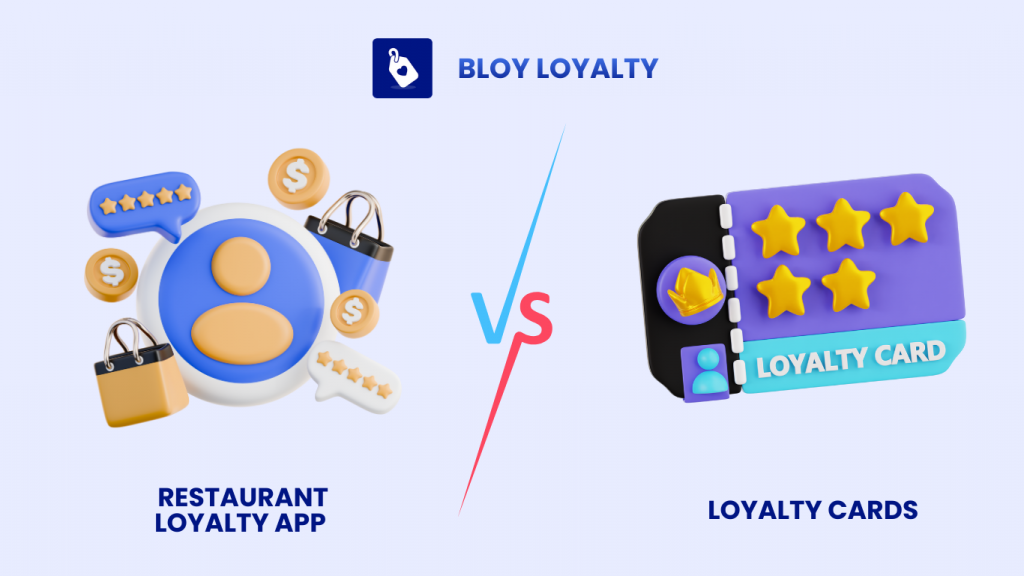
Many restaurants still rely on physical loyalty cards because they are simple to start. However, as customer expectations and operations evolve, the limitations of loyalty cards become more visible.
Understanding the difference between a restaurant loyalty app and traditional loyalty cards helps restaurant owners decide when it is time to upgrade.
5.1. Limitations of traditional restaurant loyalty cards
Physical loyalty cards are easy to introduce but difficult to scale. Cards are often forgotten, lost, or inconsistently used, which reduces their long-term effectiveness.
Common limitations of traditional restaurant loyalty cards include:
- No customer data or behavior tracking
- Manual stamping or tracking by staff
- No visibility into repeat visit patterns
- Limited flexibility in reward design
Research into offline loyalty programs and customer engagement shows that physical cards struggle to sustain engagement once novelty wears off.
5.2. Why restaurant loyalty apps outperform loyalty cards
A restaurant loyalty app replaces manual processes with automation and visibility. Customers no longer need to remember a card, and restaurants gain access to actionable insights.
Compared to loyalty cards, restaurant loyalty apps offer:
- Automatic tracking of visits or spend
- Clear reward progress visible to customers
- Consistent redemption across locations or channels
- Data to improve loyalty strategy over time
As customer journeys become increasingly digital, loyalty apps align better with how customers interact with restaurants today.
When should restaurants move from cards to apps?
Restaurants often benefit from switching to a loyalty app when:
- Physical cards are frequently forgotten or unused
- The restaurant wants to understand repeat customer behavior
- Multiple locations or channels need consistent loyalty tracking
At this stage, a restaurant loyalty app becomes a foundation for scalable retention rather than a simple punch-card replacement.
6. Common mistakes when choosing a restaurant loyalty app
Many restaurant loyalty programs fail not because the idea is wrong, but because the app was chosen without considering real customer behavior and operational constraints. These mistakes often lead to low adoption, staff resistance, and disappointing results.
Understanding these common pitfalls helps restaurant owners avoid costly trial-and-error decisions.
6.1. Choosing features over operational fit
A common mistake is selecting a loyalty app based on feature lists rather than how those features work in real service conditions. Advanced dashboards and complex reward rules often look appealing but add little value during busy shifts.
Insights from restaurant technology adoption and operational fit show that tools misaligned with daily workflows are quickly abandoned by staff.
Restaurants benefit more from simple loyalty software that supports existing processes rather than forcing teams to change how they operate.
6.2. Treating loyalty as a discount program
Many restaurants mistakenly use loyalty apps as ongoing discount engines. While discounts may drive short-term visits, they often reduce margins and train customers to wait for promotions.
Research into discount-driven loyalty programs and customer behavior highlights that customers respond better to recognition and achievable rewards than constant price reductions.
Effective restaurant loyalty apps reward behavior, frequency, and engagement rather than relying solely on discounts.
6.3. Relying too heavily on staff promotion
Loyalty programs that depend on staff consistently promoting sign-ups often struggle, especially in restaurants with high turnover or limited training time.
Studies on staff-led loyalty promotion in food service indicate that programs requiring repeated explanations quickly lose consistency across shifts.
Strong loyalty apps minimize staff involvement by making rewards visible and intuitive for customers, reducing reliance on verbal reminders.
6.4. Ignoring customer visibility and progress tracking
Even well-designed loyalty programs fail when customers cannot easily see their progress. If customers forget they are earning rewards, engagement drops.
Research into customer loyalty visibility and engagement patterns shows that clear progress indicators significantly improve participation and redemption rates.
A restaurant loyalty app should consistently remind customers of their progress without requiring extra effort from staff.
Conclusion
Choosing a restaurant loyalty app is less about features and more about fit. The right loyalty software should align with how your restaurant operates, how often customers return, and how much complexity your team can manage.
Restaurants see the best results when loyalty programs are simple, visible, and easy to use in daily operations. Programs that rely on heavy discounts or complex rules often struggle with adoption and long-term impact.
Whether called a restaurant loyalty app or restaurant loyalty software, loyalty works best as a long-term retention system, not a short-term promotion. When aligned with your restaurant model and customer behavior, it becomes a reliable driver of repeat visits and sustainable growth.
FAQs about restaurant loyalty apps
Can loyalty programs backfire for restaurants?
Yes, loyalty programs can backfire when they rely too heavily on discounts or add friction to daily operations. Poorly designed loyalty apps may train customers to wait for deals, reduce margins, or create extra work for staff.
Successful restaurant loyalty apps focus on rewarding repeat behavior and engagement rather than constant price reductions.
What is the most successful loyalty program for restaurants?
The most successful restaurant loyalty programs are simple, achievable, and aligned with customer behavior. Programs that reward frequent visits, consistent spending, or long-term engagement tend to perform better than complex tier systems with unclear benefits.
Rather than copying competitors, restaurants see better results when loyalty programs reflect their own service model and customer habits.
Are digital loyalty cards better than physical loyalty cards?
Digital loyalty cards generally outperform physical cards because they are easier to track, harder to lose, and provide better visibility for customers. Restaurant loyalty apps automate reward tracking and give restaurants access to customer insights that physical cards cannot provide.
For restaurants aiming to scale or understand repeat behavior, digital loyalty solutions offer clear advantages.
Who has the best loyalty app for restaurants?
There is no single “best” loyalty app for all restaurants. The right loyalty app depends on factors such as restaurant type, visit frequency, staff capacity, and customer behavior.
Restaurants benefit most from choosing loyalty software that fits their daily operations rather than selecting based on popularity alone.
What are the 3 R’s of customer loyalty?
The 3 R’s of customer loyalty are commonly defined as Reward, Recognition, and Relationship.
Effective restaurant loyalty apps support all three by offering meaningful rewards, recognizing repeat customers, and building long-term engagement rather than one-time transactions.

Yến Lê Hải
Content author at BLOY, focusing on product-led content, SEO, and educational resources to help merchants improve conversion and customer engagement.