Gym Membership Referral Program: How Gyms Turn Members Into Their Best Growth Channel
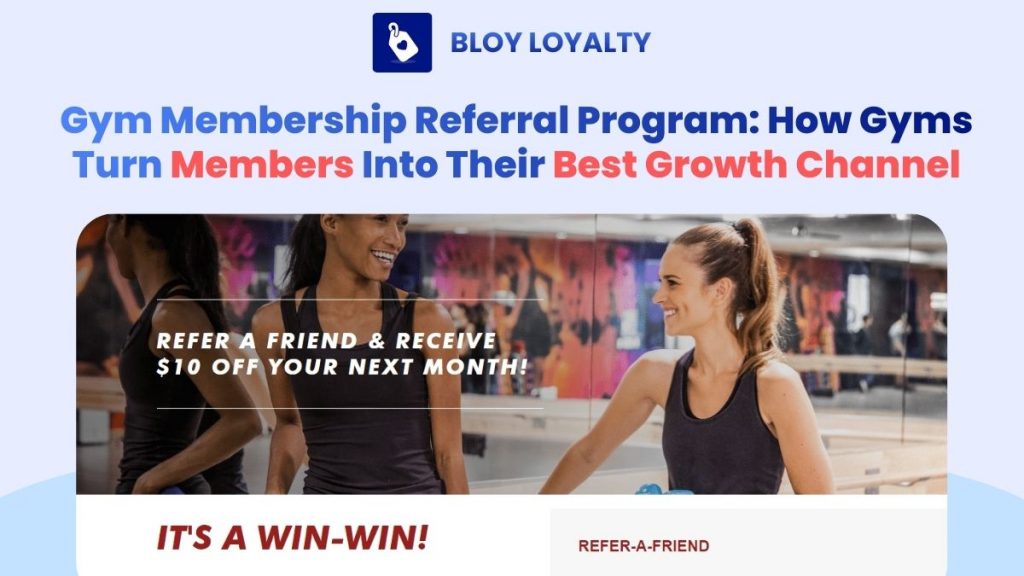
Gym membership referral program often looks simple on the surface. Members refer friends, rewards are issued, and sign-ups increase. But most gyms don’t struggle because referrals do not work. They struggle because nothing consistently pulls members back into the habit once motivation fades.
That is why many referral programs quietly fail in practice. Rewards exist, but behavior does not change. Referrals happen once, then stop.
When designed properly, a gym membership referral program is not a short-term acquisition tactic. It becomes a behavioral loop that turns existing members into a reliable growth channel.
1. What is a gym membership referral program and why most do not work
A gym membership referral program is a system that rewards existing members for bringing in new members. Rewards are usually simple and familiar, such as a free month, account credit, or small perks tied to the membership.
On paper, the structure looks straightforward:
- A member refers a friend
- The friend signs up
- Both receive a reward
This simplicity is also where most gym referral programs break down.
In practice, many programs are launched as one-off initiatives rather than ongoing systems. As a result, common patterns quickly appear:
- Rewards feel generic and easy to ignore
- Members participate once but do not repeat
- Referrals spike briefly, then disappear
- The program exists, but behavior does not change
The core issue is not awareness or execution. It is intentional.
Most referral programs are designed to exist, not to influence how members behave over time.
When referrals are disconnected from how members already interact with the gym, the program fades into the background. Members may notice it once, but it does not give them a reason to return, talk about it again, or actively recommend the gym.
A referral program only works long term when it feels worth repeating, not just worth trying.
2. Who gym referral programs are really for and who they usually miss
Gym referral programs are often positioned as a universal growth lever, but in reality, they only work well for a very specific type of gym.
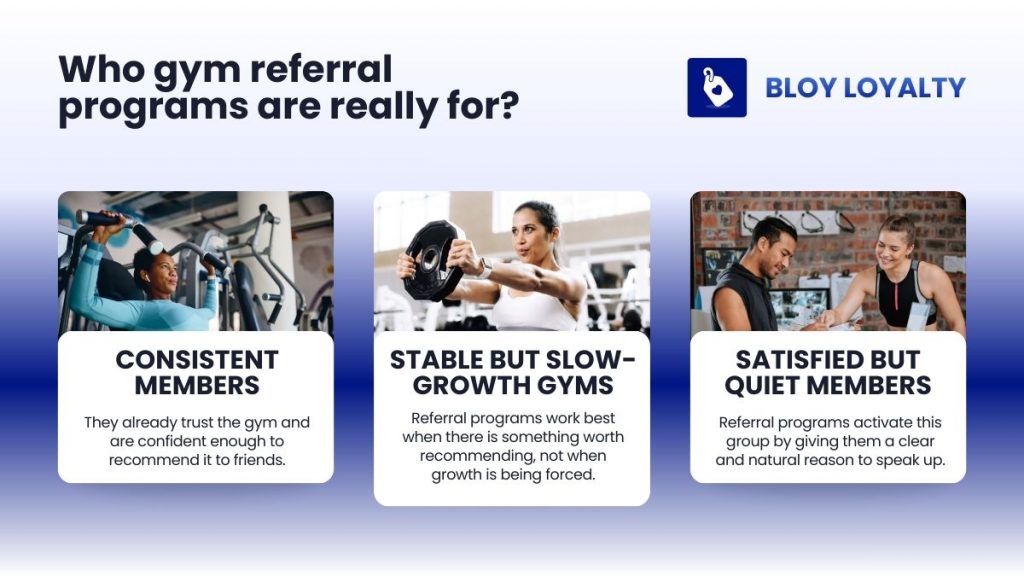
At their core, referral programs are most effective for gyms that already have a stable base of engaged members. These gyms usually share a few characteristics:
- Membership-based or subscription-driven revenue
- A consistent flow of active members, even if growth has slowed
- Some level of churn, but not a complete engagement collapse
- A clear idea of what members value beyond price
For these gyms, referrals act as an extension of existing behavior. Members already trust the brand, feel comfortable recommending it, and simply need a reason to do so consistently.
However, referral programs are often mistakenly applied to gyms that are not ready for them.
Gyms tend to struggle with referrals when:
- Most members are inactive or irregular
- The core experience is inconsistent or unclear
- Retention problems are severe and unresolved
- Members do not feel confident recommending the gym yet
In these situations, referral programs become cosmetic. They exist in the interface, but they do not translate into real advocacy.
There is also a group that referral programs frequently overlook. These are members who are satisfied but not enthusiastic. They show up, they pay, but they do not actively promote the gym.
This middle group is critical. They are often the easiest segment to activate through referrals, but only when the program aligns with what already matters to them, such as convenience, progress, or tangible value tied to their routine.
A referral program works best not when it tries to convince unhappy members to advocate, but when it gives satisfied members a natural reason to speak up.
3. What rewards actually work in a gym referral program
4.1. Why generic rewards stop working so quickly
Most gyms default to the same small set of referral incentives. They are easy to set up and familiar to members, but familiarity does not equal effectiveness. Referrals work because people trust recommendations from friends far more than promotions, particularly for decisions tied to long-term habits like fitness.
Common examples include:
- A free month of membership
- A one-time discount
- Guest passes or short-term perks
These rewards usually fail for the same reason. They are detached from the daily reality of being a gym member.
A free month feels abstract, especially for members who already plan to stay. Discounts are easy to forget. Guest passes often go unused. None of these rewards change how members engage with the gym week after week.
4.2. Rewards that reinforce habits outperform rewards that feel promotional
Referral rewards work best when they strengthen behaviors members already have, rather than trying to introduce new ones.
In gyms, those behaviors usually include:
- Showing up consistently
- Tracking progress over time
- Investing in recovery, nutrition, or performance
- Feeling committed to a longer-term fitness identity
When rewards align with these behaviors, referrals stop feeling like a side task and start feeling like a natural extension of membership.
This is why rewards tied to real usage, progress, or tangible value tend to outperform generic incentives.
4.3. Tangible rewards feel more valuable than abstract benefits
There is a practical reason tangible rewards perform better in referral programs. Members can immediately understand their value.
Compared to abstract perks, tangible rewards:
- Are easier to explain to a friend
- Feel earned rather than gifted
- Create a clearer sense of payoff
When members know exactly what they will receive and how they will use it, the decision to refer becomes simpler and more repeatable.
This principle applies beyond gyms and is especially visible in subscription-based businesses where loyalty rewards are redeemed for real products instead of future discounts.
4.4. The best referral rewards give members a reason to come back
A strong referral reward does more than trigger a single action. It creates a reason for members to re-engage with the program over time.
Effective rewards usually share a few traits:
- They are tied to ongoing participation, not one-off actions
- They feel relevant even after the first redemption
- They fit naturally into how members already use the gym
When referral rewards meet these criteria, members do not need to be reminded to refer. The program stays top of mind because it remains useful.
This is where referral programs begin to compound instead of resetting every few months.
5. Why product-based rewards outperform generic gym incentives
Generic rewards often fail because they feel interchangeable. Product-based rewards work because they feel concrete and immediately useful.
When members receive something they can actually use, the value of the reward is clear. There is no need to calculate future savings or imagine a benefit later. This makes the referral decision simpler and easier to repeat.
5.1. Product-based rewards lower the mental barrier to referring
Referral programs perform better when members do not need to overthink the reward.
Compared to abstract incentives, product-based rewards are:
- Easier to understand at a glance
- Easier to explain to friends
- Easier to associate with real value
This clarity reduces hesitation and makes referrals feel more natural.
5.2. How Supra Protein applies product-based rewards in practice
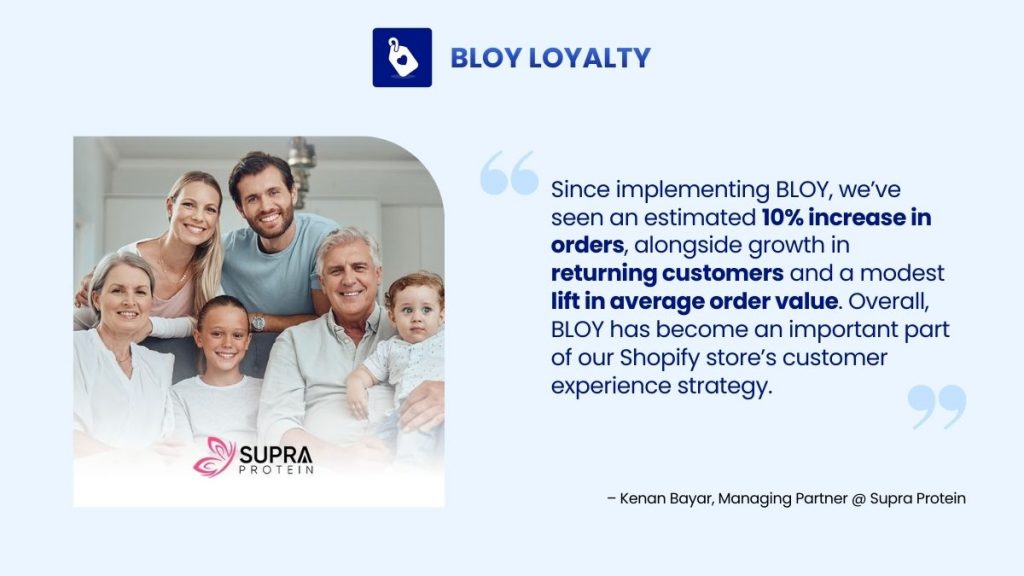
One of our customers, Supra Protein, a wellness-focused direct-to-consumer brand selling premium nutritional supplements, uses a product-based loyalty approach to reinforce repeat purchasing behavior.
Instead of positioning discounts as the primary incentive, customers earn points through purchases and engagement, then redeem those points for real products such as Omega-3, Collagen, and Magnesium that are already part of their daily wellness routine.
This setup helps keep rewards relevant, encourages repeat engagement, and strengthens long-term customer value without adding operational complexity.
>> You may find the full version of Supra Protein’s case study here: Supra Protein: 10% increase in number of order
5.3. Why this logic translates directly to gyms
For gyms that sell products alongside memberships, such as protein, supplements, or recovery items, the same reward logic applies.
Instead of offering generic perks, gyms can reward referrals with items members already buy or plan to buy. This keeps rewards relevant, reinforces existing habits, and makes referral programs easier to sustain over time.
When rewards align with how members already interact with the business, referral programs stop feeling like short-term tactics and start becoming part of a long-term growth system.
6. How to design a gym membership referral program that compounds
A gym membership referral program only compounds when it is designed as part of a system, not as a standalone feature. The goal is not to generate a short spike in sign-ups, but to create repeatable referral behavior over time.
6.1. Start with the right referral trigger
Referrals work best when they are tied to moments of confidence, not moments of promotion. Members are more likely to recommend a gym when they feel progress, stability, or pride in their routine.
Effective referral triggers often include:
- After a consistent training streak
- After reaching a milestone or goal
- After redeeming a reward or perk
- After a positive service interaction
Triggering referrals at the right moment increases both conversion and repeat participation.
6.2. Design rewards that scale with member engagement
A referral reward should not exist in isolation. It should connect naturally with how engaged a member already is.
Instead of a single fixed incentive, gyms can:
- Increase reward value for repeat referrals
- Tie rewards to ongoing participation or spending
- Combine referral rewards with loyalty points or credits
This structure encourages members to see referrals as part of a longer journey rather than a one-time action.
6.3. Connect referrals to loyalty, not just acquisition
When referral programs are separated from loyalty systems, momentum stops quickly. Members refer once, receive a reward, and disengage.
To avoid this, referrals should feed into the broader loyalty structure:
- Referral actions contribute to points or tier progress
- Rewards unlock future benefits, not just immediate perks
- Members see a reason to stay active after the referral
This connection transforms referrals from a transaction into a habit.
6.4. Keep the system simple for both members and staff
Complex referral mechanics reduce participation. If members or staff need explanations, the program is already too complicated.
Strong referral systems share a few traits:
- Clear rules that can be explained in one sentence
- Rewards that are easy to understand and redeem
- Minimal operational effort for the gym team
When simplicity is maintained, referral programs remain usable long after launch.
7. Referral vs loyalty vs rewards and what gyms should combine instead of choosing
Many gyms treat referral programs, loyalty programs, and rewards as separate initiatives. In reality, they serve different roles in the same growth system.
Referral programs focus on acquisition.
Loyalty programs focus on retention.
Rewards influence the behaviors that connect the two.
Problems arise when gyms try to choose one instead of designing them to work together.
7.1. What happens when gyms rely only on referrals
Referral programs alone tend to create short bursts of growth.
- Sign-ups increase temporarily
- Engagement drops after the reward is claimed
- Referrals slow down without constant promotion
Without a retention layer, referrals do not compound.
7.2. What happens when gyms rely only on loyalty
Loyalty programs without referrals strengthen existing relationships but rarely drive new growth.
- Active members become more engaged
- Inactive members remain inactive
- New member acquisition depends on ads or promotions
Loyalty without referrals stabilizes, but it does not scale.
7.3. Why rewards are the connecting layer
Rewards are not a standalone strategy. They shape how members move between referral and loyalty systems.
When rewards are designed well, they:
- Encourage members to take referral actions
- Give members reasons to stay engaged after referring
- Reinforce habits instead of one-time behavior
This is why rewards should never be designed in isolation.
7.4. The system gyms should aim to build
High-performing gyms do not ask whether they should run referrals or loyalty programs. They design a system where each element supports the others.
A combined approach usually looks like this:
- Referrals bring in new members
- Loyalty keeps members engaged over time
- Rewards influence which behaviors repeat
When these elements are aligned, growth becomes steadier and less dependent on constant promotions. Sustainable growth comes from designing systems that increase customer lifetime value, not from pushing harder short-term promotions.
8. Conclusions
A gym membership referral program only works when it fits naturally into how members already behave. Referrals drive acquisition, loyalty sustains engagement, and rewards determine which actions repeat.
When these elements are designed together, referrals stop being short-term tactics and start becoming part of a long-term growth system.
For gyms looking to build referral and loyalty programs that are simple to manage and easy for members to use, tools like Bloy help connect referrals, rewards, and ongoing engagement into one consistent experience, without adding operational complexity.
If referrals feel worth repeating, growth follows naturally.

Yến Lê Hải
Content author at BLOY, focusing on product-led content, SEO, and educational resources to help merchants improve conversion and customer engagement.