Fashion Loyalty Program: Why Your Best Customers Still Shop Elsewhere
Fashion loyalty program always starts the same way. You launch a loyalty program. Your best customers come back. Repeat purchases look healthy. And yet, those same customers still shop elsewhere.
That gap is where most fashion loyalty programs quietly fail. Not because rewards are missing, but because loyalty is designed around transactions, not around how people actually choose fashion brands. This article breaks down why that happens and what fashion brands often misunderstand about customer loyalty.
1. Why fashion customers buy again but don’t stick to one brand
Repeat purchases often look like loyalty in a fashion loyalty program. In fashion, they rarely are.
Most fashion customers buy again because the category itself encourages exploration. Styles change quickly. Trends rotate. Novelty matters. This creates a natural tendency toward variety seeking.
This behavior is not driven by dissatisfaction. It is driven by how fashion is consumed.
In practice, fashion buying is shaped by:
- emotional impulses rather than habits
- moment specific needs instead of routine demand
- the desire to discover something new, even after a good experience
As a result, customers can:
- purchase from the same brand multiple times
- actively participate in loyalty programs
- still divide their spending across several competitors
From the brand’s perspective, this looks like retention.
From the customer’s perspective, it is simply shopping the category.
When loyalty programs reward activity without influencing brand choice, they do not reduce switching. They only make repeat buying easier. This is what Accenture refers to as the “Loyalty Illusion” – where brands spend billions on rewards that fail to change underlying customer behavior.
2. The difference between repeat purchases and brand choice in fashion
Repeat purchases are easy to track. Brand choice is not. This is where fashion loyalty program start to feel misleading.
A customer buying several times a year does not automatically prefer your brand. It only means your brand was relevant at specific moments.
In fashion, relevance does not equal commitment.
Brand choice shows up when customers:
- return without promotions or reminders
- wait for your next collection instead of browsing alternatives
- recognize your brand as their default option in the category
Repeat purchases, by contrast, are often triggered by:
- discounts or limited time offers
- availability and convenience
- timing that happens to align with a trend
Loyalty programs that focus only on frequency or spend blur this distinction. They reward outcomes without understanding the motivation behind them.
This is how fashion brands can see healthy repeat rates while still losing share of wallet. In fact, research from Harvard Business Review indicates that without deep emotional connection, satisfaction metrics correlate poorly with actual share of wallet.
Until loyalty influences why customers choose your brand, not just how often they buy, it does very little to stop them from shopping elsewhere.
3. The difference between repeat purchases and brand choice in fashion
Repeat purchases are easy to track. Brand choice is not.
A customer buying several times a year does not automatically prefer your brand. It only means your brand was relevant in specific moments. In fashion, relevance does not equal commitment.
Brand choice shows up when customers return without prompts. They wait for your next collection instead of browsing alternatives, and they treat your brand as a default rather than one of many acceptable options. This is the point where loyalty starts influencing decisions, not just outcomes.
3.1. Repeat purchases are a weak proxy for loyalty in fashion
Repeat purchases are often driven by discounts, availability, or timing. Loyalty programs that focus on frequency or spend reinforce this signal without questioning its cause. As a result, brands reward behavior that looks positive but does little to strengthen brand preference.
This is why many fashion brands report healthy repeat rates while still losing share of wallet. Customers are not disloyal. They are unanchored.
3.2. Brand choice is about default preference, not frequency
True loyalty in fashion appears when customers actively choose a brand even when other options are available. This choice is tied to identity, trust, and anticipation, not to accumulated rewards.
Until a loyalty program influences this default preference, it will not prevent customers from shopping elsewhere, no matter how active they appear.
4. Three common fashion buying behaviors that pull customers elsewhere
One reason fashion loyalty program struggle is that not all customers buy for the same reason. Two people can purchase the same product from the same brand and still be driven by completely different motivations.
When loyalty programs treat all repeat buyers the same, they end up reinforcing switching instead of reducing it.
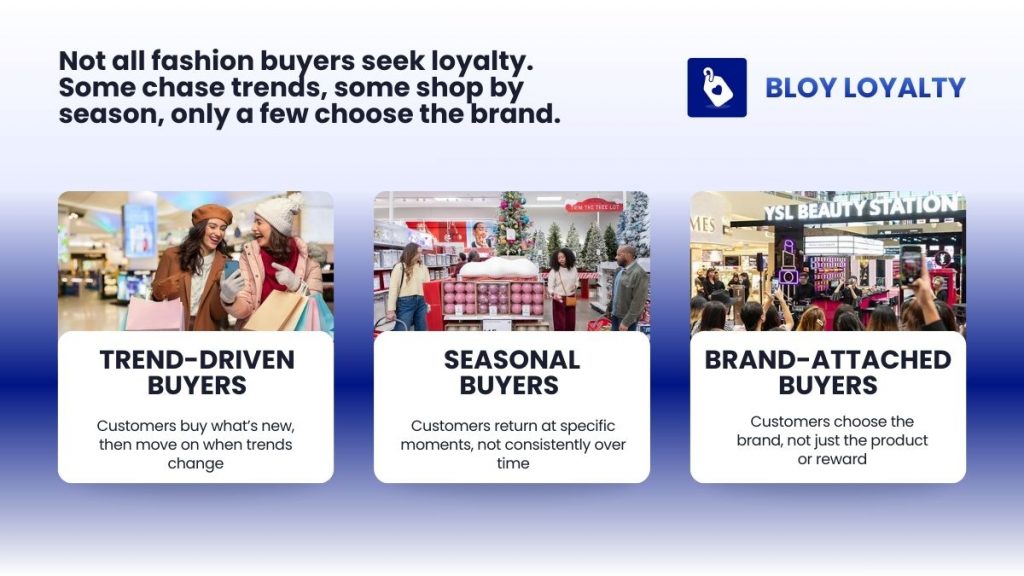
In fashion, most purchases fall into three broad behavior patterns. Each one pulls customers away from brands in a different way.
4.1. Trend driven buying
Trend driven customers buy because something feels new, relevant, or culturally timely. Their loyalty is short lived by nature. Once the trend fades, so does their attachment.
For this group, points and long term accumulation rarely matter. Loyalty mechanics that rely on waiting, saving, or progressing over time tend to miss the moment when these customers are most engaged.
If loyalty does not show up at the exact moment of interest, these buyers move on quickly.
4.2. Seasonal and occasion based buying
Some customers return around predictable moments. New seasons, specific events, or recurring needs bring them back. Their repeat purchases are real, but conditional.
They are loyal to timing, not necessarily to a brand.
When loyalty programs ignore these cycles and reward only total spend or visit frequency, they fail to anchor customers between moments. The result is repeat buying without continuity.
4.3. Brand attached buying
Brand attached customers behave differently. They anticipate releases, recognize design language, and feel aligned with what the brand represents. Their purchases are driven by identity rather than convenience. This mirrors findings from Capgemini’s study on Loyalty, which shows that emotions are the primary driver of genuine engagement and long-term value.
This group is where true loyalty lives. However, it is also the smallest segment early on. Loyalty programs that focus only on transactional rewards often underinvest here, even though this is the segment most likely to stop shopping elsewhere.
Without recognizing these different behaviors, fashion loyalty program end up treating switching as a failure rather than a design constraint.
5. How loyalty unintentionally trains customers to shop around
Most fashion loyalty programs are built with good intentions. They aim to encourage repeat purchases, increase engagement, and reward customers for coming back.
The problem is that many of these programs end up reinforcing the exact behavior brands are trying to reduce.
When loyalty is centered on points, discounts, or spend thresholds, it teaches customers a simple lesson. Buying is interchangeable. What matters is the incentive, not the brand behind it.
Over time, customers learn to separate product enjoyment from brand commitment. They wait for rewards, compare offers, and treat fashion brands as options rather than preferences. Loyalty does not anchor choice. It smooths switching.
This is especially damaging in fashion because switching already feels natural. Loyalty mechanics that focus on accumulation or redemption speed often amplify that instinct instead of countering it.
5.1. When rewards shift attention away from the brand
Transactional rewards train customers to focus on outcomes. Points earned. Discounts unlocked. Thresholds reached. The brand itself fades into the background.
In this setup, customers are not asking which brand they want to support. They are asking which brand gives them the best deal right now. Once another brand offers a similar incentive, switching feels risk free.
Loyalty becomes a price signal, not a relationship.
5.2. Why over incentivizing accelerates brand substitution
As rewards become more prominent, the perceived differences between brands shrink. Products start to feel comparable. Value becomes relative. Loyalty stops protecting the brand and starts making it easier to replace.
This is why some fashion brands see loyalty members purchasing more often while spreading their spend more widely. The program increases activity but weakens attachment.
When loyalty teaches customers how to optimize points and rewards instead of how to choose a brand, it does not reduce churn. It professionalizes it.
6. Matching loyalty mechanics to buying behavior instead of volume
Once fashion brands understand why customers switch, the next step is restraint.
Loyalty mechanics do not change behavior on their own. They amplify the motivation that already exists. When mechanics and motivation do not align, loyalty increases activity without strengthening preference.
This is where volume based loyalty struggles in fashion. Points and spend thresholds reward output, not intent. Customers participate, but their reason for choosing a brand stays the same. Buying becomes easier, not more meaningful.
By contrast, mechanics tied to access and recognition operate at the decision moment. Early access, previews, and visible status show up when customers are deciding where to shop next. These mechanics reinforce anticipation and belonging rather than optimization.
The problem is not mixing mechanics. It is mixing them without intent. When points, tiers, discounts, and perks coexist without a clear behavioral goal, customers stop paying attention to the brand and start extracting value. Loyalty becomes background noise instead of a signal.
8. When loyalty makes your brand easier to replace
Loyalty is meant to differentiate a brand. But in fashion, it can quietly do the opposite.
When loyalty programs focus too heavily on incentives, they train customers to compare brands instead of committing to one. The brand becomes a vehicle for rewards, not a preference in itself.
This is when loyalty stops protecting choice and starts flattening it.
8.1. How loyalty can turn brands into interchangeable options
Incentive driven loyalty teaches customers to optimize. They learn to wait for points, discounts, or thresholds, then decide where to shop based on who offers the best deal at that moment.
Over time, this creates a subtle shift:
- products feel comparable across brands
- rewards become the primary differentiator
- switching feels low risk and rational
The more visible the incentive, the less visible the brand.
8.2. Why “competitive loyalty” weakens brand preference
When fashion brands mirror each other’s loyalty mechanics, customers stop seeing loyalty as a relationship and start seeing it as a feature. Points, tiers, and discounts lose meaning because they exist everywhere.
At that point, loyalty no longer signals commitment. It signals replaceability.
This is why some fashion brands experience a paradox. Loyalty members buy more often, yet their spending spreads across more competitors. The program increases engagement but erodes preference.
9. Signals that show customers are loyal to the category, not your brand
Many fashion brands believe loyalty is working because the numbers look positive. Repeat purchase rate is up. Loyalty participation is growing. Redemptions are happening.
But these signals often describe category engagement, not brand preference.
The difference matters, because category loyal customers feel comfortable switching. They like shopping fashion. They do not necessarily like shopping with you.
There are a few warning signs that loyalty is reinforcing the category instead of anchoring the brand.
💡 The most common signals include:
- Loyalty members purchasing across many competing brands within the same period
- Higher redemption activity without a corresponding increase in brand preference
- Repeat purchases clustering around promotions, not around releases or collections
- Strong engagement metrics but flat or declining share of wallet
Individually, these signals do not mean loyalty is failing. Together, they point to a program that rewards participation without influencing choice.
True brand loyalty in fashion shows up differently. Customers return even when there is no immediate incentive. They wait for releases. They prioritize the brand over alternatives.
If loyalty metrics cannot distinguish between these behaviors, they create false confidence. The program feels successful while customers continue shopping elsewhere.
10. A decision check will your loyalty reduce or increase brand switching
Before launching or adjusting a fashion loyalty program, there is one question that matters more than any feature or incentive.
Will this program make customers choose your brand more often
or will it simply make them better at shopping around?
This quick check helps answer that question.
Your loyalty program is likely reducing brand switching if:
- Customers wait for your drops or collections instead of browsing competitors
- Engagement increases before releases, not only after purchases
- Loyalty members prioritize your brand even when promotions are similar elsewhere
- Rewards reinforce identity, access, or belonging rather than optimization
Your loyalty program is likely increasing brand switching if:
- Rewards matter more than the brand itself
- Engagement spikes only around discounts or redemptions
- Customers actively compare incentives across brands
- Loyalty members buy more often but spread their spend more widely
If most of your signals fall into the second group, loyalty is not failing.
It is doing exactly what it was designed to do.
The problem is not execution. It is intentional.
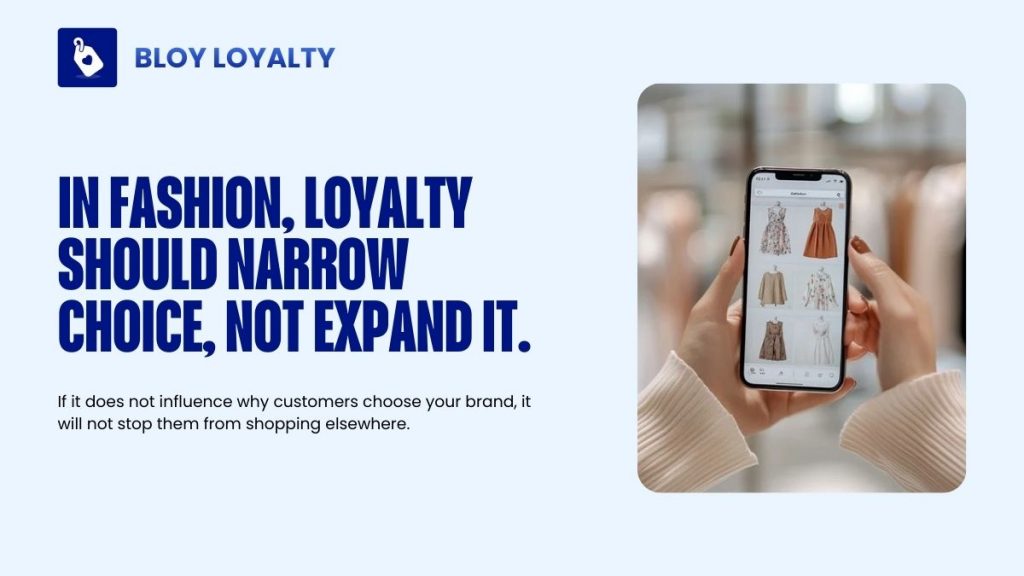
In fashion, loyalty should narrow choice, not expand it.
If it does not influence why customers choose your brand, it will not stop them from shopping elsewhere.
Conclusion
In fashion, a fashion loyalty program does not fail because customers stop buying.
It fails because buying does not always mean choosing.
Repeat purchases can hide switching behavior. Customers return, but their preference remains flexible. Loyalty exists, yet brand choice does not. Effective fashion loyalty shows up before the decision, not after the transaction. It reinforces anticipation, access, and identity rather than accumulation and optimization. If your best customers are still shopping elsewhere, the issue is not whether loyalty works. It is what kind of behavior your loyalty program is training.

Yến Lê Hải
Content author at BLOY, focusing on product-led content, SEO, and educational resources to help merchants improve conversion and customer engagement.