Data-Driven Loyalty Program: A Measurement-First Framework That Actually Changes Behavior
A data-driven loyalty program uses customer data to influence real purchasing decisions, not just to track points, members, or activity. The problem is that many loyalty programs collect data without using it to guide what actually matters.
A data-driven loyalty program is not about adding more metrics. It is about using customer data to decide which behaviors to influence, which customers to target, and how to know whether those decisions actually worked.
This article focuses on the practical side of data-driven loyalty. Instead of covering every possible angle, it breaks down the key decisions data should drive and how to avoid the most common mistakes that cause loyalty programs to stall.
1. What makes a loyalty program data driven
A loyalty program becomes data driven when data is used to shape decisions, not just to describe results.
In practice, this means three things.
First, data is used to identify which customer behaviors are worth influencing. Not every action deserves a reward. Data helps distinguish between behaviors that simply create activity and behaviors that lead to repeat purchases or long term value.
Second, data determines which customers should receive loyalty incentives. A data driven loyalty program does not treat all customers the same. It focuses incentives on customers whose next decision is still undecided, rather than overspending on customers who would return anyway.
Third, data is used to evaluate whether loyalty actually changed behavior. Instead of relying on vanity metrics like total members or points issued, a data driven approach looks for measurable shifts in future actions, such as faster repeat purchases or higher retention within a defined window.
If data does not influence these three areas, behavior, targeting, and evaluation, the loyalty program may be data informed, but it is not data driven.
2. The key loyalty decisions data should drive
In a data driven loyalty program, data is most valuable when it guides a small number of high impact decisions. Trying to optimize everything at once usually leads to complexity without results.
Below are the core loyalty decisions that should be informed by data if the program is meant to change real customer behavior.
Which behaviors are worth rewarding
Data should clarify which actions are linked to repeat purchases or long term value. In most cases, this means prioritizing behaviors like returning within a defined time window, increasing purchase frequency, or reactivating after inactivity. Rewarding actions simply because they are easy to track often creates noise rather than progress.
Which customers should receive incentives
Not all customers need loyalty incentives to return. Data helps identify customers whose next purchase decision is uncertain and where loyalty can make a difference. Focusing incentives on these customers reduces wasted spend and increases impact.
Which rewards actually influence behavior
Data should reveal which rewards are redeemed and followed by another purchase. Rewards that look attractive but rarely get used or fail to influence future behavior should be reconsidered. A smaller set of effective rewards often outperforms a large catalog.
When loyalty should intervene
Timing matters as much as value. Data helps identify when customers are most likely to decide whether to return, such as the typical gap between purchases or early signs of disengagement. Loyalty is most effective when it appears during these moments and stays quiet otherwise.
How success should be measured
Data driven loyalty focuses on future behavior, not surface level activity. Metrics like time to next purchase, repeat rate within a fixed window, and behavior after reward redemption are more meaningful than total members or points issued.
If data does not inform these decisions, loyalty programs tend to grow in size without growing in impact.
3. How to measure whether a data driven loyalty program is working
Measuring loyalty performance is where many programs lose focus. The most common mistake is treating activity as impact.
A data driven loyalty program should be evaluated based on whether it changes what customers do next, not how busy the program looks.
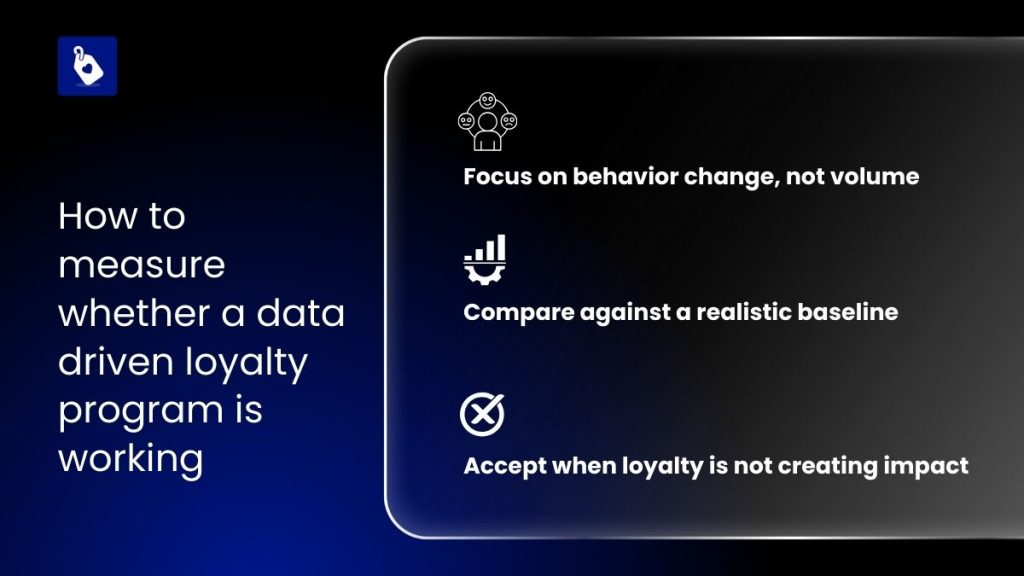
Focus on behavior change, not volume
Metrics like total members, points issued, or rewards claimed can increase even when loyalty has little effect on retention. These numbers describe scale, not success.
Instead, measurement should focus on indicators tied to future behavior, such as:
- Time to next purchase after a loyalty interaction
- Repeat purchase rate within a defined time window
- Return behavior following reward redemption
If these metrics do not move, loyalty is likely not influencing decisions.
Compare against a realistic baseline
Loyal customers often look better than non members by default. This makes simple comparisons misleading.
Where possible, performance should be compared against:
- Customers who were not exposed to loyalty incentives
- Similar customers before a loyalty change was introduced
- Segments with comparable purchase patterns
The goal is not perfect measurement, but directional clarity. You want to know whether loyalty made a difference compared to what would have happened otherwise.
Accept when loyalty is not creating impact
A data driven approach also means being willing to accept negative results.
If customers exposed to loyalty behave the same as those who are not, adding more rewards rarely fixes the problem. The more effective response is to revisit targeting, timing, or the behavior being incentivized.
Measurement exists to guide decisions, not to justify existing ones.
4. Common mistakes that prevent loyalty from being truly data driven
Many loyalty programs fail not because of a lack of data, but because data is used in the wrong way. Below are some of the most common mistakes that stop loyalty from influencing real customer behavior.
Treating more data as better decisions
Collecting more metrics does not automatically lead to better loyalty outcomes. When teams track too many numbers without a clear purpose, data becomes descriptive rather than actionable. A small set of metrics tied to specific decisions is far more effective than a large dashboard no one acts on.
Rewarding too many behaviors at once
When loyalty rewards everything, it ends up reinforcing nothing. Programs that issue points for every action often grow in activity but fail to change repeat purchase behavior. Data should be used to identify which behaviors actually matter, then focus rewards narrowly on those actions.
Giving incentives to customers who would return anyway
One of the biggest sources of wasted loyalty spend is targeting customers who are already highly likely to come back. Without data driven targeting, incentives are often distributed evenly, reducing their impact where they are truly needed.
Measuring success with surface level metrics
Metrics like total members, points issued, or rewards claimed are easy to report but poor indicators of impact. When these become the primary success signals, loyalty programs optimize for visibility instead of behavior change.
Avoiding uncomfortable results
A data driven loyalty program must be willing to accept when something is not working. Ignoring flat results or continuously adding rewards to force improvement usually leads to higher cost without better retention. Data should be used to remove or adjust rules, not just to justify them.
5. A quick checklist to assess if your loyalty program is truly data driven
Not every loyalty program needs advanced analytics to become more data driven. In many cases, the difference lies in how decisions are made.
Use the checklist below to evaluate whether data is actually guiding your loyalty program or simply reporting on it.
Does data guide which behaviors are rewarded
- Can you clearly explain why each rewarded action exists
- Are rewards tied to behaviors that lead to repeat purchases or retention
- Can you remove a reward if data shows it has no impact
If rewards exist without a clear behavioral reason, loyalty is likely activity driven, not data driven.
Does data determine who receives incentives
- Are incentives targeted at customers whose next purchase decision is uncertain
- Do highly engaged customers receive fewer unnecessary rewards
- Are different customer groups treated differently based on behavior
If all customers see the same loyalty experience, data is not influencing targeting.
Does data influence timing, not just value
- Do loyalty prompts appear at specific moments, such as before typical drop off points
- Are incentives shown only when they can affect a decision
- Is loyalty allowed to stay invisible when it is not needed
If loyalty is always visible, it often becomes background noise.
Does measurement focus on future behavior
- Are you tracking changes in time to next purchase or repeat rate within a window
- Do you compare exposed and unexposed customers where possible
- Are loyalty changes evaluated after being introduced
If success is defined only by points issued or members added, impact is likely overstated.
Are loyalty rules reviewed and adjusted regularly
- Do you periodically review which rules still serve a purpose
- Are underperforming rules adjusted or removed
- Is someone accountable for loyalty performance beyond setup
A program that never removes rules is rarely data driven.
6. Conclusion
A data driven loyalty program is not defined by how much data it collects, but by how clearly data shapes decisions.
When data is used to decide which behaviors to reward, who should receive incentives, when loyalty should intervene, and how success is measured, loyalty stops being a background feature and starts influencing real customer choices.
The most effective programs are rarely the most complex ones. They focus on a small number of decisions, measure impact on future behavior, and are willing to adjust or remove rules that do not work.
If you are exploring how to apply these principles in practice, using a loyalty system that makes behavior, segmentation, and performance visible can make the process significantly easier. The goal is not to add more rewards, but to build a loyalty program that adapts as customer behavior changes.

Yến Lê Hải
Content author at BLOY, focusing on product-led content, SEO, and educational resources to help merchants improve conversion and customer engagement.