Omnichannel Loyalty Programs: When Loyalty Stops Influencing Customer Decisions
Most Shopify merchants don’t struggle because they lack a loyalty program. They struggle because loyalty exists in isolation from how customers actually shop. Points are earned online, rewards live in an account page, and in-store purchases often sit somewhere else entirely.
As customers move fluidly between online stores, physical locations, email, and social touchpoints, loyalty systems built around a single channel quietly lose relevance. This gap is what drives interest in omnichannel loyalty programs, not as a trend, but as an attempt to realign loyalty with real customer behavior.
This article explains what omnichannel loyalty programs really are, how they differ from multi-channel setups, and when they genuinely make sense for Shopify SMBs, before any tools or tactics are considered. As a result, many Shopify SMBs start exploring omnichannel loyalty programs as a way to reconnect loyalty with real customer behavior.
1. What is an omnichannel loyalty program?
An omnichannel loyalty program is a customer loyalty system designed around the customer, not the channel. Instead of treating online stores, physical locations, and marketing touchpoints as separate environments, an omnichannel approach recognizes customer activity across all of them as part of one continuous relationship.
In this model, loyalty is not defined by where a transaction happens, but by how a customer interacts with the brand over time. Purchases, visits, referrals, and engagement signals are all part of a single loyalty context, even when they occur across different channels.
1.1 How omnichannel loyalty differs from traditional loyalty programs
Traditional loyalty programs are usually built around internal systems. Online orders, in-store purchases, and customer engagement are tracked separately because they live in different tools or workflows. Loyalty logic follows that structure.
This is why many programs appear active: points are issued, rewards exist but still fail to influence real behavior. Customers experience loyalty as fragmented, inconsistent, or disconnected from how they actually shop.
Omnichannel loyalty programs take a different approach. Instead of asking, “Which system did this interaction come from?”, they ask, “What does this action tell us about the customer’s relationship with the brand?” Loyalty recognition follows the customer, not the platform.
1.2 Loyalty built around behavior, not systems
The core shift in omnichannel loyalty is behavior-first thinking. Rather than designing rewards around technical capabilities, the program starts by identifying meaningful behaviors: repeat purchases, cross-channel visits, frequency, or long-term engagement.
From there, loyalty incentives are structured to reinforce those behaviors consistently, regardless of channel. A customer who buys online today and in-store next month is still recognized as the same returning customer, not two disconnected profiles.
For Shopify SMBs, this distinction is critical. Customers do not evaluate loyalty programs based on how advanced the system is. They evaluate it based on whether loyalty feels relevant and consistent when making a return decision.
2. Omnichannel loyalty vs multichannel loyalty: why the difference matters
Many Shopify SMBs already operate across multiple channels. They sell online, may have a physical store or pop-ups, and communicate with customers through email or social platforms. Because of this, “multichannel” and “omnichannel” are often used interchangeably when talking about loyalty.
However, the distinction matters. The way loyalty is structured under each model directly affects whether it can influence repeat purchase behavior or simply exist as background infrastructure.
2.1 Multichannel loyalty: loyalty duplicated across channels
In a multichannel loyalty setup, each channel tends to manage loyalty interactions independently. Online purchases may earn points in one system, in-store purchases in another, and customer engagement lives elsewhere. Even when data is technically connected, loyalty logic is often applied per channel.
From an operational standpoint, this approach is common and understandable. It aligns with how systems are deployed and teams are organized. From a customer perspective, however, it introduces subtle friction. Loyalty feels inconsistent, harder to track, and less motivating over time.
This is why multichannel loyalty programs can appear functional: points accumulate, rewards exist but fail to meaningfully influence where or when customers choose to buy again.
2.2 Omnichannel loyalty: one loyalty logic across all touchpoints
Omnichannel loyalty programs are designed around a single loyalty logic that spans all customer touchpoints. Instead of duplicating loyalty rules by channel, the program treats every interaction as part of one ongoing relationship.
In this model, loyalty outcomes are based on cumulative behavior rather than isolated actions. A purchase online, a visit in-store, or engagement through a campaign all contribute to the same loyalty context. The customer does not need to “start over” depending on where they interact with the brand.
For Shopify SMBs, this shift is less about adding complexity and more about removing contradictions. When loyalty recognition feels consistent across channels, it becomes easier for customers to remember, trust, and factor into their future purchase decisions.
3. Why most SMB loyalty programs look active but fail to change behavior
Most Shopify SMBs do not abandon loyalty programs because they fail technically. Points are issued, rewards are visible, and dashboards show ongoing activity. On the surface, everything appears to be working.
The problem is not whether loyalty exists, but whether it still influences customer decisions. This is where many programs quietly stop adding value, long before churn or disengagement becomes obvious.
3.1 Loyalty activity is not the same as loyalty influence
Loyalty programs often measure success through visible signals: points earned, rewards redeemed, or members enrolled. These metrics are easy to track and reassuring to report. However, they describe system activity, not customer motivation.
A program can issue points on every purchase without meaningfully affecting why a customer returns. In these cases, loyalty becomes passive. It runs in the background while customers continue to choose brands based on convenience, habit, or promotion timing rather than loyalty value.
This is why many SMB loyalty programs remain active for years while gradually losing relevance at the moment customers decide where to buy next.
3.2 Fragmented experiences weaken loyalty at the moment of choice
When loyalty recognition differs by channel, customers struggle to form a clear mental model of its value. Points earned online may not apply in-store. Rewards may exist in one account view but not surface during checkout or in-person interactions.
These gaps rarely cause immediate frustration. Instead, they create uncertainty. Customers stop factoring loyalty into their decision-making because it feels unreliable or disconnected from how they actually shop.
Over time, loyalty shifts from being a decision driver to background infrastructure; still present, but no longer influential when customers compare options or consider returning.
3.3 Loyalty loses impact when it is designed around systems, not behavior
Many SMB loyalty programs are shaped by system constraints rather than customer behavior. Rules are defined by what tools can easily track, not by what customers actually value or remember.
This leads to programs that reward transactions but ignore context, such as purchase frequency, cross-channel engagement, or changes in customer intent. As a result, loyalty incentives feel generic and interchangeable with discounts.
Omnichannel loyalty programs attempt to address this by reconnecting loyalty logic to observable behavior across touchpoints. Without that shift, loyalty risks becoming invisible at precisely the moment it is meant to matter.
4. The channels that actually matter in an omnichannel loyalty program
One of the biggest misconceptions about omnichannel loyalty programs is that they require every possible channel to be connected from day one.
In reality, omnichannel loyalty is not about how many channels you include, but which touchpoints meaningfully shape customer behavior. The goal is to support the moments where loyalty can realistically influence repeat decisions, not to connect everything at once.
4.1 Core channels that shape repeat purchase behavior
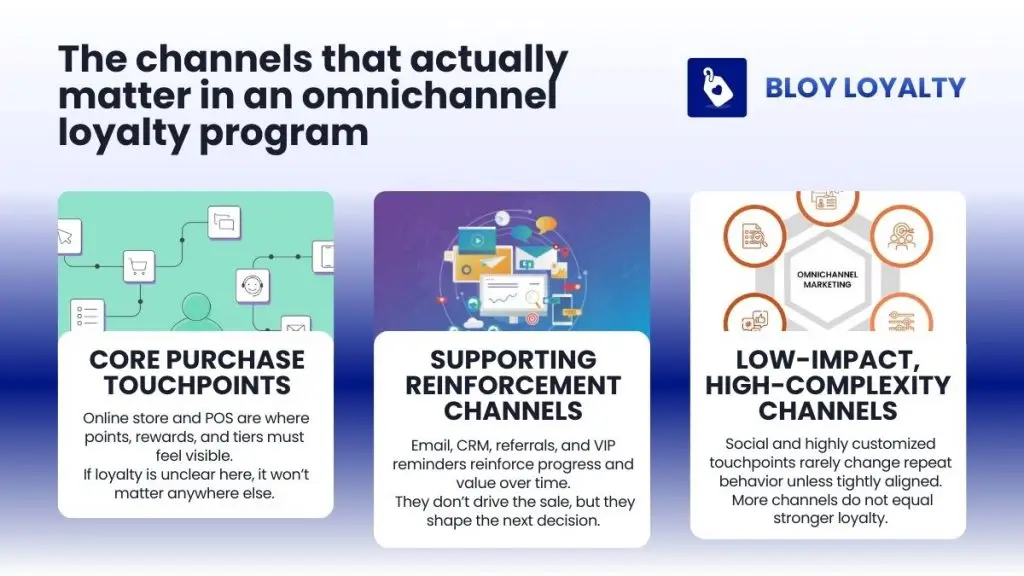
For most Shopify SMBs, a small set of channels consistently plays the largest role in repeat purchasing. These are the touchpoints where loyalty recognition is most likely to be noticed and remembered.
Online storefront interactions, including account pages and checkout experiences, form the foundation. This is where customers most often see point balances, rewards, or tier status. If loyalty feels unclear or invisible here, it is unlikely to matter elsewhere.
In addition, any physical point of salewhether a permanent store, pop-up, or event; becomes critical once customers engage offline. When in-store purchases are disconnected from loyalty recognition, customers quickly learn to treat online and offline interactions as separate experiences.
4.2 Supporting channels that reinforce loyalty over time
Beyond core purchasing moments, certain channels play a supporting role by reminding customers that loyalty exists and why it is valuable. These touchpoints do not usually drive immediate transactions, but they shape perception and memory.
Email and CRM communications are a common example. When loyalty milestones, rewards, or status updates are communicated clearly, customers are more likely to remember loyalty benefits before their next purchase. Referral and VIP mechanics can also strengthen this effect by framing loyalty as an ongoing relationship rather than a one-time incentive.
For SMBs, these channels should reinforce the same loyalty logic already present in core touchpoints, rather than introduce new or conflicting rules.
4.3 Channels that often add complexity without real impact
Not every channel contributes equally to loyalty effectiveness. Many SMBs attempt to extend loyalty into every possible touchpoint, only to find that the added complexity outweighs the behavioral impact.
Social platforms, standalone apps, or highly customized experiences may look impressive, but they rarely influence repeat purchase decisions unless they are tightly aligned with core loyalty logic. When loyalty feels fragmented or overly technical, customers are less likely to engage at all.
This is why successful omnichannel loyalty programs for SMBs tend to grow gradually. They prioritize consistency and clarity over channel coverage, expanding only when additional touchpoints demonstrably support customer behavior.
5. When SMBs should NOT build an omnichannel loyalty program yet
Omnichannel loyalty is often positioned as a natural next step for growing brands. However, for many Shopify SMBs, attempting to implement it too early can create more confusion than value.
This is not because omnichannel loyalty is ineffective, but because it relies on certain foundations being in place. Without those conditions, adding more channels or logic simply amplifies existing problems rather than solving them.
5.1 When core repeat behavior is still unclear
If a business does not yet understand why customers return, adding omnichannel loyalty layers will not create that clarity. Loyalty systems can reinforce behavior, but they cannot replace it.
Many SMBs introduce loyalty before identifying their core repeat triggers; such as product replenishment cycles, purchase frequency, or customer motivations. In these cases, loyalty rewards become generic incentives rather than meaningful signals that influence future decisions.
Until repeat behavior is observable and predictable, omnichannel loyalty risks becoming an additional system that runs without direction.
5.2 When customer data is fragmented or unreliable
Omnichannel loyalty depends on recognizing customers consistently across touchpoints. When customer profiles are incomplete, duplicated, or disconnected, loyalty logic quickly breaks down.
This often shows up as missing points, inconsistent rewards, or confusion about loyalty status across channels. While these issues may seem minor individually, they erode trust over time and reduce customers’ willingness to engage with loyalty at all.
For SMBs still consolidating customer data or aligning basic tracking, focusing on data consistency is usually more impactful than expanding loyalty coverage.
5.3 When loyalty is still treated as a discount mechanism
If loyalty primarily functions as a way to issue discounts, expanding it omnichannel can unintentionally accelerate margin erosion. The program becomes more visible, but not more meaningful.
Omnichannel loyalty works best when rewards signal recognition, progression, or long-term value; not just price reduction. When that shift has not yet occurred, adding more channels often increases operational complexity without changing customer behavior.
In these cases, refining the purpose of loyalty should come before extending it across channels.
6. What needs to be true before omnichannel loyalty is worth the effort
For Shopify SMBs, the question is rarely whether omnichannel loyalty can work. The more relevant question is whether the business is ready for it to work in a meaningful way.
Omnichannel loyalty becomes valuable when it reinforces behaviors that already exist and removes friction across touchpoints. Without these foundations, it risks adding complexity without improving customer decisions.
6.1 A clear understanding of repeat purchase drivers
Before expanding loyalty across channels, SMBs need clarity on what actually brings customers back. This does not require advanced analytics, but it does require observable patterns.
Examples might include replenishment cycles, product bundles customers return for, or time-based purchasing habits. When these drivers are understood, loyalty can be aligned to reinforce them consistently across channels.
Without this clarity, omnichannel loyalty often defaults to generic rewards that fail to connect with real customer motivation.
6.2 Consistent customer identification across touchpoints
Omnichannel loyalty depends on recognizing the same customer wherever they interact. This does not mean every system needs to be deeply integrated, but it does mean customer identity must be consistent enough to support continuity.
When customers are recognized differently online, in-store, or through communications, loyalty logic breaks down. Even small inconsistencies can undermine trust and reduce engagement.
For SMBs, prioritizing reliable customer identification is often a more impactful step than expanding loyalty mechanics.
6.3 A loyalty value proposition beyond discounts
Omnichannel loyalty works best when it communicates progression, recognition, or access; not just savings. This helps loyalty remain relevant across channels without turning into a constant discount engine.
For SMBs, this might mean emphasizing milestones, status, or experiential rewards rather than transactional discounts. When loyalty carries meaning beyond price, extending it across channels reinforces value instead of eroding margins.
This shift is often what allows omnichannel loyalty to influence long-term behavior rather than short-term conversions.
7. A simple way to think about omnichannel loyalty as an SMB
For Shopify SMBs, omnichannel loyalty does not need to start with technology decisions or channel diagrams. A simpler and more practical approach is to frame loyalty around a small set of guiding questions.
Instead of asking how many channels should be connected, SMBs benefit more from asking where loyalty can realistically influence behavior. This shift keeps the focus on customer decisions rather than system capabilities.
7.1 Three questions to guide omnichannel loyalty decisions
A useful mental model for SMBs is to pressure-test omnichannel loyalty through three questions:
- Where do customers decide to return?
Identify the moments that most strongly influence repeat purchases, whether online, in-store, or through follow-up communication. - Where does loyalty currently feel invisible or inconsistent?
Look for gaps where loyalty exists in theory but is not present when customers are making decisions. - Which touchpoints can reinforce the same loyalty logic without adding friction?
Prioritize channels that support clarity and consistency rather than expanding coverage for its own sake.
When these questions have clear answers, omnichannel loyalty becomes a way to simplify customer experience rather than complicate it.
7.2 Omnichannel loyalty as an evolution, not a switch
For most SMBs, omnichannel loyalty works best when approached as a gradual evolution. Programs often start with one or two core channels and expand only when additional touchpoints meaningfully reinforce existing loyalty logic.
This perspective helps avoid the common trap of overbuilding early. It also allows loyalty to mature alongside customer behavior, rather than forcing customers to adapt to complex systems.
Seen this way, omnichannel loyalty is less about scale and more about alignment between how customers shop and how loyalty recognizes them.
Frequently Asked Questions (FAQ)
What is an omnichannel loyalty program?
An omnichannel loyalty program is a customer loyalty system that recognizes and rewards customer behavior consistently across multiple touchpoints, such as online stores, physical locations, and communications. It focuses on the customer relationship rather than individual channels. Omnichannel loyalty programs are designed to recognize customer behavior consistently across touchpoints, rather than treating each channel separately.
Do small Shopify stores need omnichannel loyalty?
Not always. Many SMBs benefit more from clarifying repeat behavior and improving single-channel loyalty before expanding. Omnichannel loyalty becomes valuable when customers actively move between channels and expect consistent recognition.
Is omnichannel loyalty only relevant for brands with physical stores?
No. While physical stores add complexity, omnichannel loyalty also applies to brands using multiple digital touchpoints, such as online storefronts, email, and referrals. The key factor is cross-touchpoint customer behavior, not store count.
What’s the difference between POS loyalty and omnichannel loyalty?
POS loyalty focuses on rewarding in-store transactions. Omnichannel loyalty connects in-store activity with online behavior and other touchpoints under one loyalty logic, ensuring customers are recognized consistently regardless of where they interact.
Can an omnichannel loyalty program work without offline channels?
Yes. Omnichannel loyalty can exist entirely online if customers interact across multiple digital touchpoints. The concept is about continuity across interactions, not the presence of physical locations.

Yến Lê Hải
Content author at BLOY, focusing on product-led content, SEO, and educational resources to help merchants improve conversion and customer engagement.