Beauty Loyalty Programs: Why Points Alone Don’t Build Real Beauty Loyalty
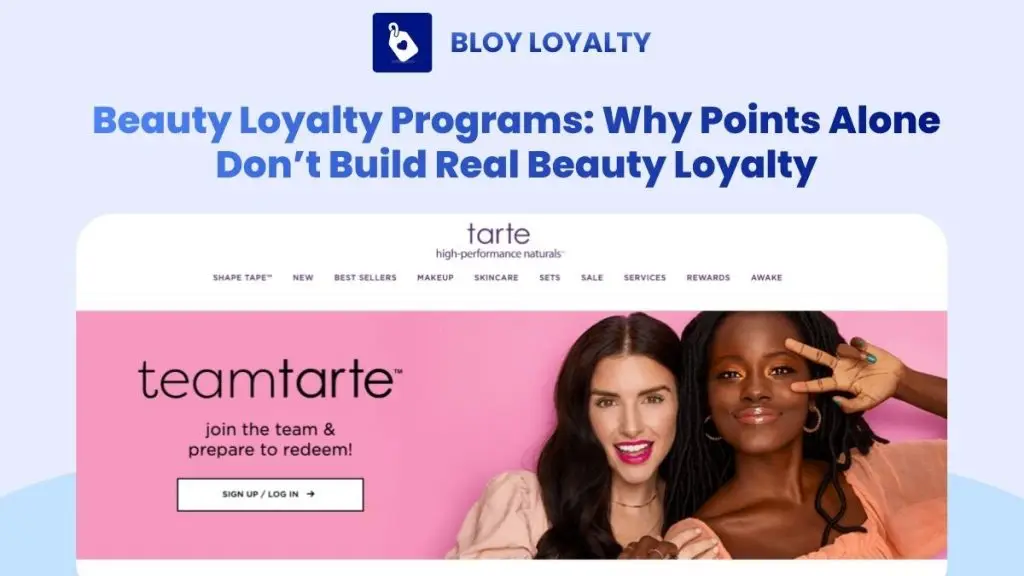
Many beauty loyalty programs appear to work because customers keep earning points and rewards remain active. However, in the beauty industry, points alone rarely influence whether a customer chooses to return or buy again.
Most repeat purchase decisions are driven by emotional factors, personal routines, and brand trust, not point balances. This is why many beauty loyalty programs stay operational but fail to build real, long-term loyalty.
1. Why points-based loyalty feels “right” for beauty brands (but rarely works)
Points-based loyalty is the default choice for most beauty brands, not because it is the most effective, but because it feels familiar, measurable, and low-risk. The problem is that what feels safe operationally often fails behaviorally.
1.1. Points are easy to explain, easy to launch
Points-based programs dominate beauty because they are simple to communicate and quick to implement. Customers immediately understand the value exchange: spend more, earn more points. For internal teams, points also create clean metrics like enrollment rate, total points issued, and reward redemptions.
However, industry benchmarks consistently show that loyalty enrollment does not equal loyalty engagement. In beauty and personal care, studies on loyalty participation indicate that a large portion of members join programs passively, while only a minority actively redeem rewards or change purchase behavior. This is why metrics such as loyalty enrollment rate or points issued often look strong, while repeat purchase frequency and time-to-next-purchase remain unchanged.
1.2. Beauty purchases are emotional, not transactional
Unlike grocery or convenience retail, beauty buying decisions are rarely driven by price alone. Customers return because a product fits their skin, a routine works, or a brand feels trustworthy. Research into beauty customer behavior and repeat purchase drivers consistently shows that emotional factors such as confidence, self-image, and perceived expertise play a larger role than discounts.
Points-based loyalty rewards past transactions, but it does little to influence the moment of choice: when a customer asks, “Which brand should I buy from this time?” In many cases, customers are unaware of their point balance at that moment, or the reward feels too distant to matter.
That is why data on loyalty reward redemption rates in beauty often shows low utilization compared to expectations. Points accumulate, but they do not meaningfully tip the decision toward a repeat purchase.
2. The hidden problem: when beauty loyalty programs exist but stop influencing decisions
Many beauty loyalty programs do not fail operationally. They fail behaviorally.
Points are issued. Members stay enrolled. Rewards remain available.
Yet loyalty quietly disappears from the customer’s decision-making process.
2.1. Loyalty becomes background infrastructure
In the beauty industry, loyalty often shifts from an active motivator to passive infrastructure. Customers know the program exists, but they rarely think about it when deciding where to buy next.
Industry benchmarks on repeat purchase behavior in beauty ecommerce show that while over 60–70% of customers enroll in loyalty programs, fewer than 30% actively engage with loyalty benefits during repeat purchases. This gap explains why brands can report strong membership growth while seeing little change in repeat purchase timing or purchase frequency.
When loyalty is not top-of-mind at the moment of choice, point balances lose their behavioral impact, even if customers have accumulated a meaningful amount.
2.2. Beauty customers don’t churn loyalty programs, they ignore them
Unlike subscriptions, beauty loyalty programs rarely experience explicit churn. Customers do not opt out or complain. Instead, they disengage silently.
Data from loyalty program benchmarks across retail and beauty categories shows that average reward redemption rates often fall below 20%, and in some beauty segments, drop into the single-digit range. Customers keep earning points, but never reach or care enough to reach the moment of redemption.
This makes loyalty underperformance hard to detect. As long as points are being issued and accounts remain active, the program appears healthy on dashboards, even though it no longer influences buying behavior.
2.3. Why this problem is dangerous for beauty brands
When loyalty stops influencing decisions, repeat purchases default to convenience, promotions, or competitor offers. This is especially risky in beauty, where switching costs are low and alternatives are abundant.
Research on customer lifetime value in beauty and personal care shows that increasing repeat purchase frequency by even 5–10% can significantly lift long-term revenue. When loyalty fails to drive that behavior, brands lose one of the few scalable levers to grow CLV without increasing paid acquisition spend.
Over time, this creates the illusion of retention stability while CLV growth plateaus.
3. What actually drives repeat purchases in beauty (beyond points)
Repeat purchases in beauty are rarely triggered by financial incentives alone. Industry data consistently shows that customers return when loyalty aligns with personal progress, recognition, and emotional attachment, not when they simply accumulate points.
3.1. Personal progress matters more than accumulation
Beauty is a category built around routines and results. Customers do not buy products in isolation; they follow ongoing journeys such as skincare improvement, hair recovery, or long-term maintenance.
Research into beauty customer retention behavior indicates that customers who perceive progress or continuity in their routine are significantly more likely to repurchase than those responding to transactional rewards. In some beauty segments, brands that successfully reinforce routine-based engagement see repeat purchase rates increase by 20–30% compared to promotion-led loyalty strategies.
Points-based programs track spending volume, but they do not reinforce a sense of progress. Customers may know they earned points, but they do not feel closer to a result. Without that psychological feedback loop, loyalty loses relevance between purchases.
3.2. Status and recognition outperform discounts in beauty loyalty
In beauty, recognition often carries more weight than savings. Customers respond strongly to being acknowledged as insiders, early adopters, or high-value members, especially in premium and mid-market brands.
Loyalty benchmarks show that customers enrolled in tier-based or status-driven programs typically generate 15–25% higher annual spend compared to non-tiered members. More importantly, tier movement creates a visible reason to return, even when no immediate discount is offered.
This is why many beauty brands observe higher engagement in programs that emphasize access, exclusivity, or recognition rather than pure monetary rewards.
3.3. Loyalty works best when it reinforces trust, not incentives
Trust is one of the strongest repeat purchase drivers in beauty. Customers stick with brands that feel reliable, consistent, and aligned with their personal needs.
Studies on brand trust and repeat purchase decisions in beauty show that trusted brands enjoy significantly shorter time-to-next-purchase compared to competitors, even when pricing is similar. Loyalty programs that reinforce trust through education, access, or personalized experiences help brands stay top-of-mind without relying on discounts.
When loyalty reinforces the relationship instead of the transaction, it becomes part of the buying decision rather than an afterthought.
4. Rethinking beauty loyalty programs: from points to behavior design
The most effective beauty loyalty programs are not built around rewards. They are built around behavior design. Instead of asking, “What should we give customers?”, high-performing programs start with a different question: “What behavior do we want to influence next?”
4.1. Loyalty should shape the next action, not reward the last one
In many beauty brands, loyalty is reactive. Customers complete a purchase, then receive points as a passive acknowledgment. This approach reinforces past behavior but does little to guide what happens next.
Behavioral research in ecommerce shows that loyalty programs are most effective when they reduce friction or uncertainty around the next purchase decision. In beauty, this often means encouraging customers to return sooner, complete a routine, or explore complementary products. Brands that design loyalty around next-action triggers often see measurable improvements in repeat purchase timing, sometimes shortening time-to-next-purchase by 10–20% compared to purely transactional programs.
4.2. Points still matter, but only when they have a clear behavioral role
Points are not inherently ineffective. They fail when they exist without context or purpose. In successful beauty loyalty programs, points function as signals, not incentives.
For example, points can reinforce milestones (first routine completion, tier progression) or unlock meaningful access rather than generic discounts. Industry benchmarks show that when points are tied to specific actions, such as completing a routine or engaging with brand content: reward redemption rates increase by 2–3x compared to programs where points accumulate without narrative or milestones.
This shift turns points from a passive currency into an active feedback mechanism.
4.3. Experiences and access outperform rewards in long-term loyalty
In beauty, loyalty compounds when customers feel closer to the brand, not just better compensated by it. Experiences such as early access to launches, exclusive consultations, or members-only education create value that competitors cannot easily replicate.
Data from loyalty performance studies shows that experience-led loyalty benefits often generate higher engagement and repeat rates than equivalent monetary rewards, especially in premium and mid-market beauty segments. Customers who perceive exclusive access as part of their loyalty status tend to stay engaged longer, even during periods with fewer promotions.
This is why many mature beauty loyalty programs gradually shift budget away from discounts and toward access, recognition, and experience-driven benefits.
5. How to evaluate if your beauty loyalty program is actually working
Many beauty brands evaluate loyalty performance using surface-level metrics that look reassuring but say very little about real behavior. To understand whether a beauty loyalty program is working, brands need to separate activity metrics from decision metrics.
5.1. Metrics that look good (but often mislead)
Metrics like total members enrolled, points issued, or rewards available are easy to track, but they rarely correlate strongly with repeat purchase behavior.
Industry benchmarks show that it is common for 60–80% of customers to enroll in loyalty programs, while only a much smaller share actively engages with benefits during repeat purchases. High enrollment combined with flat repeat purchase frequency is a clear signal that loyalty exists operationally but not behaviorally.
These metrics should be treated as health indicators, not success indicators.
5.2. Metrics that actually reflect loyalty influence
To evaluate real effectiveness, beauty brands need to focus on metrics that capture decision influence, not just participation.
Key indicators include:
- Time to next purchase, especially changes after loyalty interactions
- Repeat purchase frequency among loyalty members vs non-members
- Tier progression rates in status-based programs
- Reward redemption timing, not just redemption volume
Research on loyalty-driven repeat purchase behavior in beauty ecommerce shows that programs influencing these metrics can shorten repurchase cycles by 10–20% and increase customer lifetime value without increasing discount spend.
5.3. Three signs your beauty loyalty program is “active but irrelevant”
Beauty loyalty programs often fail quietly. The following signals indicate that loyalty is running but no longer influencing decisions:
- Members earn points but rarely check balances or rewards
- Redemption rates remain consistently below 15–20%
- Repeat purchase behavior looks similar between members and non-members
When these patterns appear together, loyalty has become background infrastructure rather than a decision driver.
6. Designing a beauty loyalty program that actually builds loyalty
Designing an effective beauty loyalty program is less about adding new rewards and more about aligning loyalty with how customers actually make repeat purchase decisions. The goal is not to increase point balances, but to increase relevance at the moment of choice.
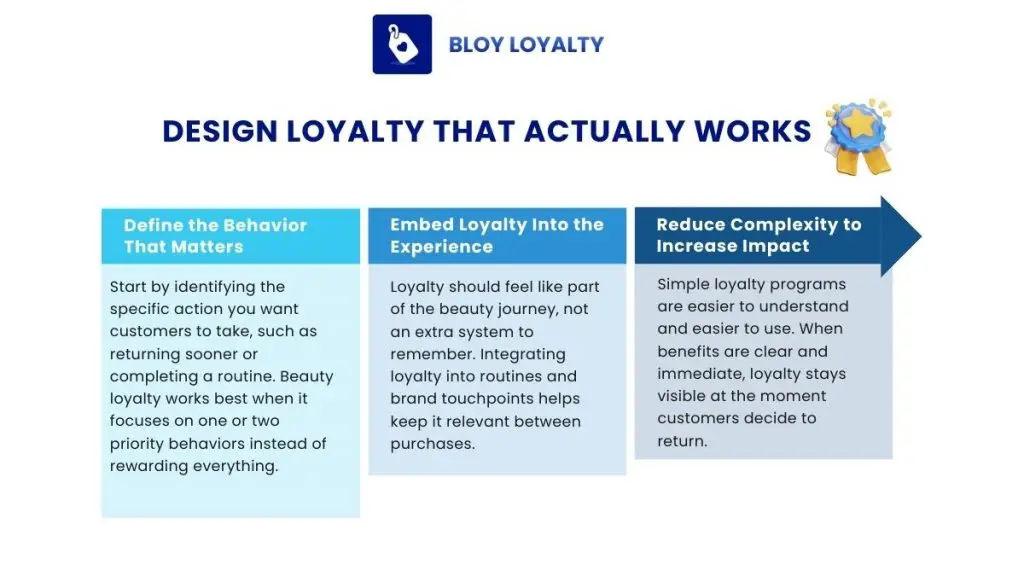
6.1. Start from behavior, not rewards
High-performing beauty loyalty programs begin by defining the specific behavior they want to influence. This could be encouraging customers to return within a defined time window, complete a routine, or engage more deeply with the brand ecosystem.
Industry data on behavior-driven loyalty design in ecommerce shows that programs built around clear behavioral goals outperform reward-first programs in both engagement and repeat purchase frequency. Brands that anchor loyalty to one or two priority behaviors often see more consistent gains than those trying to incentivize everything at once.
6.2. Loyalty should feel like part of the beauty experience
In beauty, loyalty works best when it feels like a natural extension of the brand experience, not a separate system customers need to remember. This means integrating loyalty into routines, education, and brand touchpoints rather than isolating it as a post-purchase bonus.
Research into customer experience and loyalty in beauty retail indicates that customers who perceive loyalty as part of the overall experience show higher long-term engagement and are more likely to return without relying on discounts. When loyalty reinforces the relationship, it stays relevant between purchases.
6.3. Simplicity compounds better than complexity
Adding more rules, rewards, or conditions rarely improves loyalty performance. In fact, complexity often accelerates disengagement. Beauty customers are willing to engage with loyalty when the value is clear and immediate, not when it requires effort to understand.
Benchmarks from loyalty usability and engagement studies show that simpler programs with fewer, clearer benefits consistently outperform complex structures in redemption and repeat behavior. Simplicity keeps loyalty visible and actionable at the moment of decision.
Conclusion
Beauty loyalty programs fail not because points are broken, but because points alone rarely influence repeat purchase decisions. In a category driven by emotion, routines, and trust, loyalty must do more than reward spending. It must actively participate in the customer’s decision to return.
Brands that design loyalty around behavior, recognition, and experience rather than accumulation, are better positioned to build long-term retention without relying on heavy discounts. The most effective beauty loyalty programs are not louder or more generous. They are simply more relevant.

Yến Lê Hải
Content author at BLOY, focusing on product-led content, SEO, and educational resources to help merchants improve conversion and customer engagement.