Top Shopify Loyalty Apps for Small Businesses – Compared by Use Case
Small businesses don’t struggle because they lack loyalty tools.
They struggle because choosing the wrong loyalty program app for small business often creates more friction than impact.
Many Shopify merchants install a loyalty app expecting more repeat purchases, only to see it quietly fade into the background. Points go unredeemed. Rewards feel generic. Customers sign up but never change their behavior. The problem isn’t loyalty itself, it’s using an app that doesn’t fit the business stage.
In this guide, we don’t rank the “best” Shopify loyalty apps. Instead, we compare Shopify loyalty apps for small businesses based on real-world use cases, from first-time loyalty programs, to low-engagement repeat customers, to lightweight VIP tiers, and even online + POS setups. The goal is simple: help you choose a loyalty program app for a small business that actually gets used, not just installed.
1. Why most “top loyalty app” lists don’t work for small businesses
Most “top Shopify loyalty app” lists are written to rank, not to help small businesses make better decisions. They usually compare apps based on feature depth, brand recognition, or pricing tiers – criteria that sound useful on paper but rarely reflect how small teams actually operate day to day.
For a small business, the real challenge isn’t finding a powerful loyalty tool. It’s choosing a loyalty program app for small businesses that fits limited time, limited resources, and an evolving customer base. An app packed with advanced rules, analytics, and customization options may look impressive, but it often requires ongoing management that small teams simply don’t have the capacity for.
This mismatch explains why loyalty programs often get installed but never used, slowly fading into the background without changing customer behavior. Customers earn points without understanding why, rewards feel generic, and over time the program becomes invisible rather than impactful.
2. How we compare Shopify loyalty apps in this guide
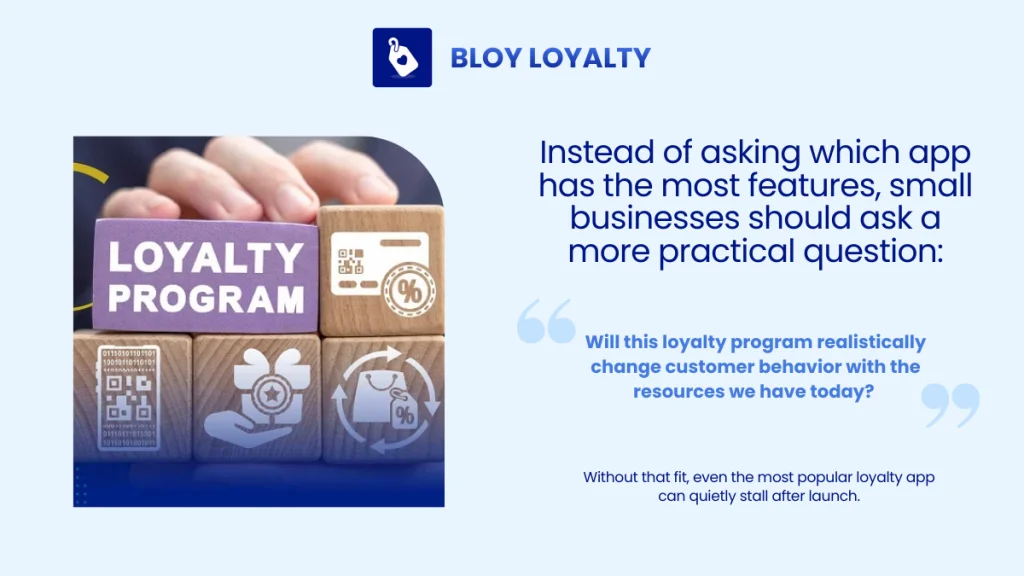
Instead of ranking apps from best to worst, this guide compares each Shopify loyalty app based on how it fits different small business situations. The goal is to help merchants understand when a loyalty app is likely to work and when it is likely to fail, based on real operational constraints.
Small businesses rarely fail at loyalty because of missing features. They fail because the loyalty program app does not match their team size, daily workload, or customer behavior. An app that works well for a growing brand with a dedicated marketing team may be a poor fit for a two person operation running on limited time.
To avoid that mismatch, every loyalty program app for small business in this guide is evaluated using the same practical criteria. These criteria focus less on what the app can do in theory, and more on what a small team can realistically manage over time.
💡 Each Shopify loyalty app in this guide is reviewed based on the following factors:
- Team size and ongoing resources required to manage the program
- Setup complexity and time to launch
- Core loyalty mechanics supported, such as points, rewards, or tiers
- Business stage where the app performs best
- Common failure scenarios for small businesses
This approach makes it easier to see why certain apps work well for first time loyalty programs, while others are better suited for businesses with existing repeat customers or more advanced needs.
3. Use case 1: First time loyalty for small teams
This use case applies to small businesses launching loyalty for the first time. These teams usually have limited time, no dedicated retention specialist, and little historical data to design complex reward systems. At this stage, the biggest risk is not choosing a weak tool, but choosing a loyalty program that is too complicated to maintain.
For first time programs, a loyalty program app for small business should reduce decision making, not add more. The goal is to make loyalty visible and easy for customers to understand, while keeping management simple enough that the program does not get abandoned after a few weeks.
3.1. What this business actually needs
At this stage, small teams do not need advanced segmentation, layered rewards, or deep analytics. What they need is clarity and speed. Many merchants underestimate how important it is to start a loyalty program for a small business why most VIP tiers fail for small brands with only one or two clear earning actions that customers can immediately understand.
The most effective first time loyalty setups focus on simple behaviors such as purchases or referrals. Rewards are straightforward and achievable, allowing the business to learn from real customer behavior instead of overplanning features that may never be used.
Choosing a loyalty program app for small business at this stage is less about long term sophistication and more about creating early momentum. If customers understand the program and start redeeming rewards, the business can always expand later.
3.2. Apps that fit this use case
Smile.io
Why it fits this stage
- Provides a familiar and structured loyalty setup that is easy for first time small businesses to understand
When it works best
- Works best when merchants want a quick launch with standard point based rewards
When it becomes a limitation
- Becomes less effective if the business wants to experiment beyond simple earn and redeem mechanics
Rivo
Why it fits this stage
- Offers a lightweight approach that reduces setup decisions for small teams
When it works best
- Performs well for merchants who want to launch loyalty without ongoing configuration
When it becomes a limitation
- Can feel restrictive once the business wants to customize rewards or customer journeys
4. Use case 2: Small businesses with repeat customers but low engagement
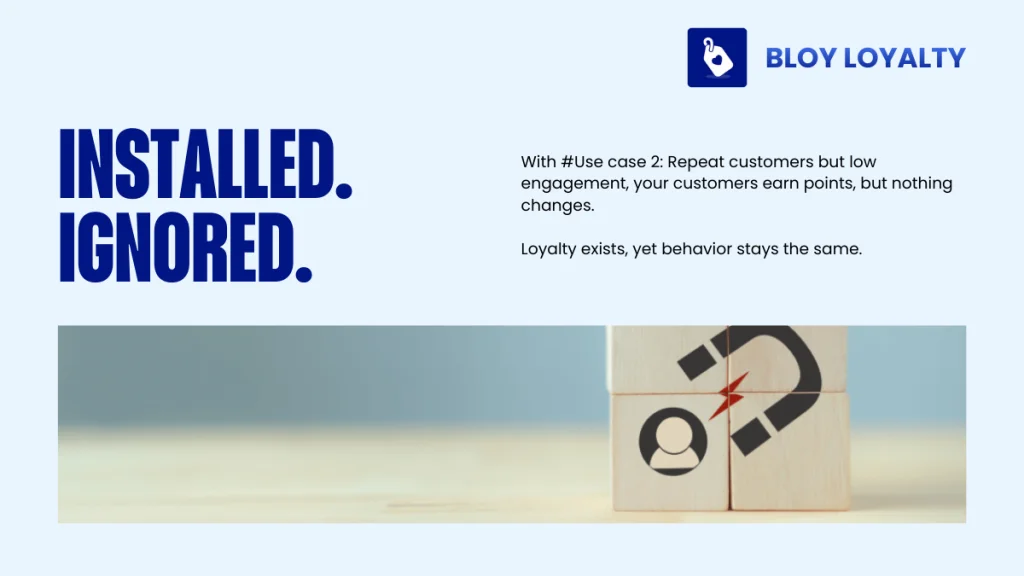
This use case is common among small businesses that already have repeat customers but see little impact from their loyalty program. Customers sign up, earn points occasionally, and then disengage. The program exists, but it does not meaningfully influence purchasing decisions.
In many cases, the issue is not customer interest. It is a mismatch between how the loyalty program is designed and how customers actually behave. A loyalty program app for small business that focuses only on transactions often fails to address why loyalty programs stop driving customer behavior once the novelty wears off.
4.1. The real problem is not missing features
When engagement is low, small businesses often assume they need more features. They add more rewards, more rules, or more earning actions. In reality, this usually increases confusion rather than participation.
The real problem is that rewards are not tied to behaviors customers care about. Points feel abstract, progress feels slow, and customers do not see a clear reason to return more often.
At this stage, a loyalty program app for small business should help merchants reconnect rewards to meaningful actions. This might include rewarding frequency, higher intent actions, or milestones that feel achievable. Without that behavioral link, no amount of configuration will fix engagement.
4.2. Apps that work better in this situation
Bloy
Why it fits this stage
- Designed for small businesses adjusting loyalty behavior without rebuilding the entire program
When it works best
- Performs well when merchants want to gradually improve engagement using simple rule changes
When it becomes a limitation
- Less suitable for businesses expecting deep enterprise level analytics from day one
LoyaltyLion
Why it fits this stage
- Supports more flexible loyalty mechanics beyond basic transactions
When it works best
- Works best when merchants are actively managing campaigns and testing reward logic
When it becomes a limitation
- Requires ongoing attention and can feel heavy for very small teams
5. Use case 3: Small brands experimenting with VIP or tiers
This use case applies to small businesses that already see differences in customer value and want to recognize their most engaged shoppers. At this stage, VIP or tier based loyalty is often introduced to encourage progression rather than just repeat purchases.
The main risk is moving too fast. Many brands copy tier structures from larger companies without enough customer volume or internal resources to support them, which explains why most VIP tiers fail for small brands despite good intentions.
5.1 What usually goes wrong with early VIP tiers
The most common mistake is designing tiers before understanding customer behavior. Tiers are launched with names and perks, but without clear logic for how customers move between levels. Progress feels slow or invisible, and customers lose interest.
Another issue is overcomplicating rewards. Too many perks or unclear benefits make tiers feel distant rather than aspirational, reducing their ability to influence real purchasing decisions.
At this stage, VIP tiers should simplify loyalty, not complicate it. If customers cannot easily understand how to reach the next tier, the program will struggle to gain traction.
5.2 What actually works for lightweight tier programs
Successful tier programs for small businesses focus on clarity and progression. Customers know exactly what actions move them forward and what benefits they unlock at each level. Tiers are limited in number, and rewards are closely tied to behaviors the business wants to encourage.
For small teams, flexibility matters more than depth. A tier program should be easy to adjust as customer behavior changes. This allows merchants to refine thresholds, rewards, or criteria without rebuilding the entire loyalty structure.
The goal of VIP tiers at this stage is not exclusivity for its own sake, but momentum. When customers feel visible progress and attainable rewards, tiers become a natural extension of the loyalty program rather than a separate initiative.
5.3. Apps suited for lightweight tier programs
Bloy
Why it fits this stage
- Makes it easier to test simple VIP tiers without adding operational overhead
When it works best
- Performs well when merchants want flexible tiers that evolve over time
When it becomes a limitation
- Not ideal if the business expects enterprise scale tier orchestration immediately
LoyaltyLion
Why it fits this stage
- Allows merchants to experiment with tier based rewards tied to customer behavior
When it works best
- Works best for brands willing to invest time in setting up and refining tier logic
When it becomes a limitation
- Can become complex for small teams without dedicated loyalty ownership
6. Use case 4: Small businesses running online and POS loyalty
This use case applies to small businesses selling both online and in physical locations. These merchants want a single loyalty experience that works across Shopify storefronts and in store purchases, without maintaining two separate programs.
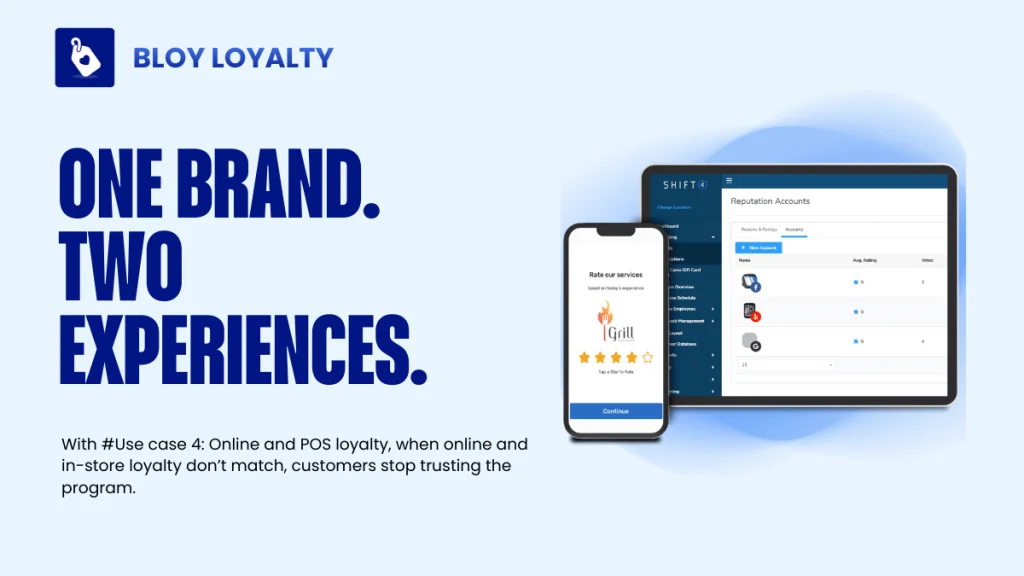
Many teams underestimate how quickly inconsistent loyalty experiences confuse customers, especially when points earned online cannot be easily redeemed in store or when staff struggle to explain how loyalty works at checkout.
6.1. The complexity most small teams underestimate
Problems usually appear when online and POS loyalty rules are designed separately. Customers earn points in one place but cannot easily use them in another, which breaks trust and reduces engagement.
At this stage, loyalty should reinforce familiarity rather than create friction. Businesses that design a simple omnichannel loyalty program with consistent rules across channels are far more likely to see repeat behavior.
6.2. What actually works for online and POS loyalty
Effective online and POS loyalty setups share one common trait. They use a single loyalty logic across channels. Customers earn points the same way, see the same rewards, and understand the program regardless of where they shop.
For small businesses, success comes from restraint. Fewer earning rules, clearer rewards, and consistent messaging matter more than advanced configurations. Staff training becomes easier. Customers build habits faster. Loyalty feels like part of the brand instead of a separate system.
The right approach is not to replicate enterprise omnichannel models, but to simplify them. A loyalty program that works both online and in store should feel familiar, predictable, and easy to maintain over time.
6.3. Apps for small businesses running online and POS loyalty
Smile.io
Why it fits this stage
- Provides a familiar loyalty experience that can extend across online and in store purchases
When it works best
- Works best for merchants with simple POS needs and consistent reward logic
When it becomes a limitation
- Can struggle when businesses require advanced offline behavior tracking
Bloy
Why it fits this stage
- Helps small businesses unify online and POS loyalty without complex configuration
When it works best
- Performs well when merchants want a single loyalty logic across channels
When it becomes a limitation
- Less suitable for retailers with highly customized offline workflows
7. Conclusion
There is no single best Shopify loyalty app for every small business. What works depends on where your business is today, how much time your team can realistically invest, and what kind of customer behavior you want to influence.
Across all four use cases, the same pattern appears again and again. Loyalty programs fail not because tools are weak, but because they do not fit the business stage. A loyalty program app for small business should make loyalty easier to run and easier to understand, not add operational weight.
For small teams, the smartest approach is to start simple, focus on behavior over features, and evolve only when customers show clear engagement. This is how you build a loyalty program that actually gets used, instead of one that quietly fades into the background.
8. FAQs about Shopify loyalty apps for small businesses
8.1 Does Shopify have a built in loyalty program?
Shopify does not offer a built in loyalty program by default. Merchants who want to run loyalty campaigns typically rely on third party solutions from the Shopify App Store.
This is why many small businesses choose a loyalty program app for small business instead of trying to manage rewards manually. Using a dedicated app makes it easier to track points, rewards, and customer progress without custom development.
8.2 How do you set up a loyalty program on Shopify?
To set up a loyalty program on Shopify, small businesses usually start by installing a loyalty app, defining one or two earning rules, and choosing simple rewards that customers can easily understand.
Most problems happen when merchants try to do too much too early. Businesses that set up a loyalty program on Shopify successfully focus on speed and clarity instead of advanced configurations. Once customers start redeeming rewards, the program can be expanded gradually.
8.3 How do you create a loyalty program for a small business?
Creating loyalty for a small business is less about features and more about behavior. The most effective programs reward actions that already happen, such as repeat purchases, instead of forcing customers to learn complex rules.
When merchants create a loyalty program for a small business, starting with a simple structure helps avoid abandoned programs later. A clear earning path and achievable rewards build early momentum and make loyalty feel relevant rather than promotional.
8.4 Is Smile or Rivo better for small businesses?
There is no single answer to whether Smile.io or Rivo is better for small businesses. The right choice depends on business stage, available time, and how actively the merchant plans to manage loyalty.
Some tools work well for fast launches, while others perform better when merchants want to test different reward logic over time. This is why choosing the right loyalty program app for small business should focus on fit rather than popularity.
8.5 Do small businesses really need a loyalty app?
Not every small business needs a loyalty app immediately. If a store has very low repeat purchases or limited traffic, loyalty may not be the first priority.
However, once repeat behavior exists, using a loyalty program app for small business makes it easier to encourage consistent engagement without relying only on discounts. The key is timing, not tool complexity.

Yến Lê Hải
Content author at BLOY, focusing on product-led content, SEO, and educational resources to help merchants improve conversion and customer engagement.