Loyalty rewards program for small business: Why most fail? (and how to think right)
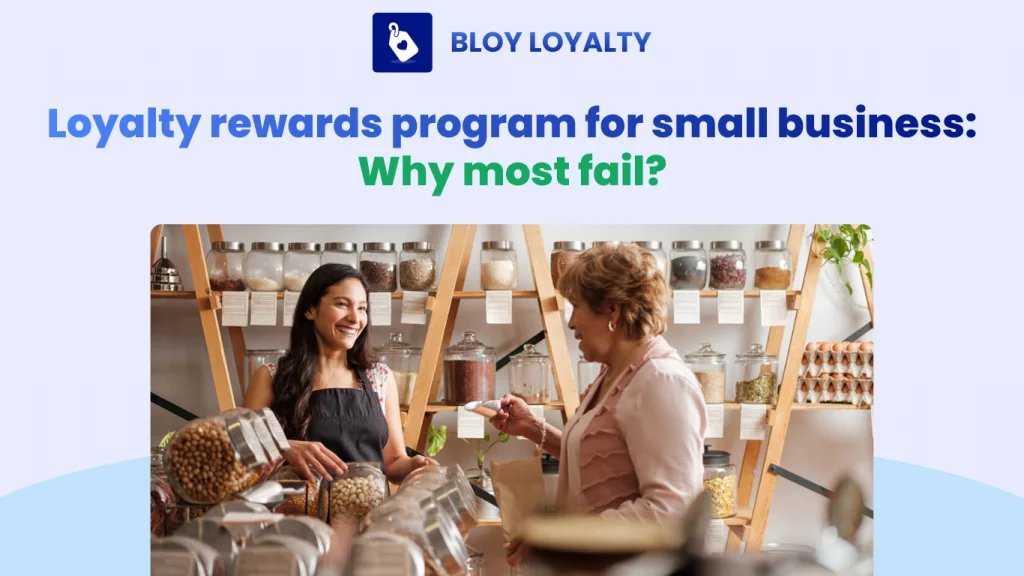
Most small businesses launch a loyalty rewards program after seeing customers disappear after their first purchase.
Points are added. Discounts are promised. An app is installed.
A few weeks later, nothing really changes: customers still don’t come back, and the program quietly becomes extra work the team stops paying attention to. The issue usually isn’t the rewards. It’s that the business wasn’t ready for loyalty in the first place: limited budget, small teams, and no clear repeat buying behavior to build on.
This article doesn’t explain how to set up a loyalty program. Instead, it introduces a simple framework to help small businesses decide whether loyalty makes sense now, later, or not at all.
1. Do small businesses really need a loyalty rewards program?
Many small businesses start thinking about loyalty after noticing a simple pattern: customers buy once, then disappear.
At that point, launching a loyalty rewards program feels like a logical next step. If customers are not coming back, rewarding them should fix the problem. In practice, this is where many programs start for the wrong reason.
A loyalty rewards program does not create repeat behavior from nothing. It amplifies behavior that already exists. If most customers are still first time buyers, loyalty has very little to work with.
For small businesses, the real question is not “Should we have a loyalty program?”
It is “Do our customers already show signs of coming back?”
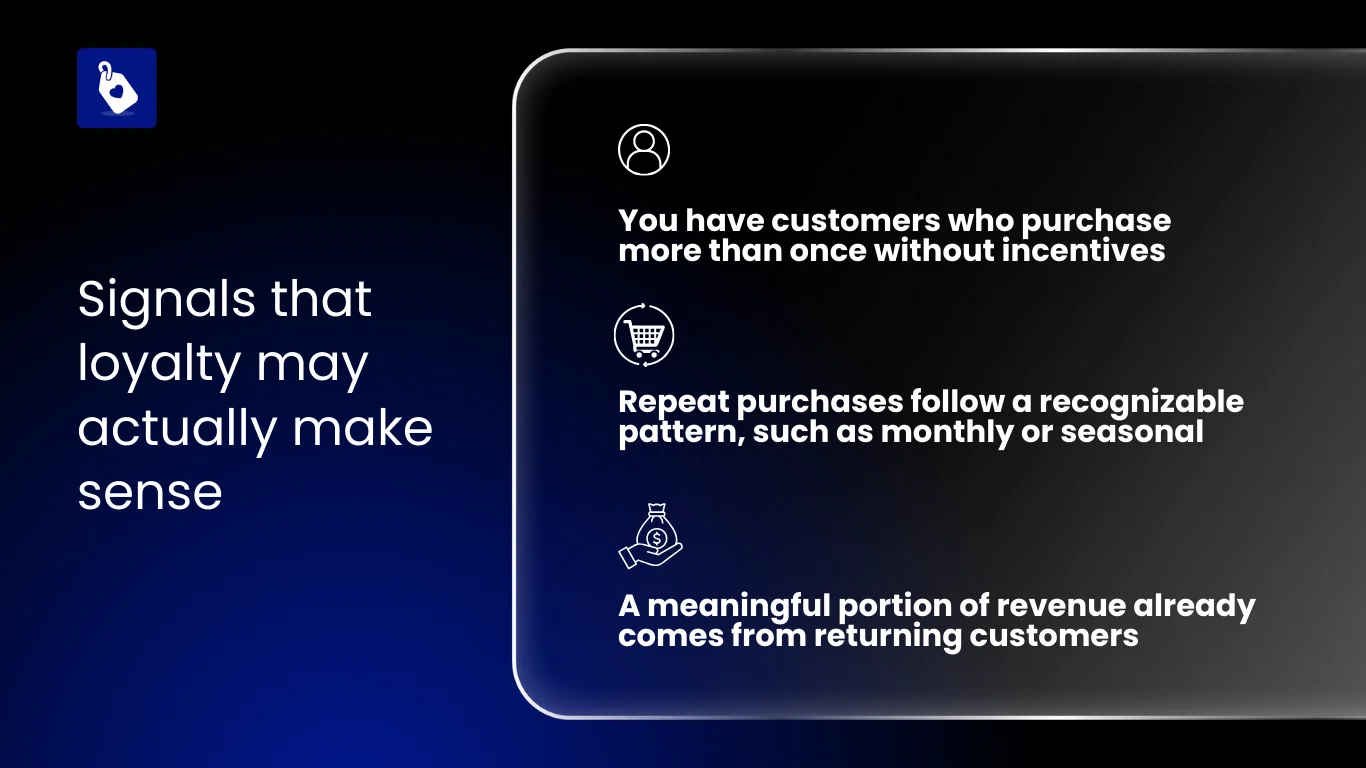
When these signals exist, loyalty can help reinforce habits and increase buying frequency over time.
When they do not, loyalty often turns into a disguised discount strategy. Rewards replace margin instead of changing behavior, and the business ends up doing more work without seeing real retention gains.
For many small businesses, the right move is not launching loyalty immediately. It is first understanding why customers do not come back yet. In some cases, improving the product, pricing, or post purchase experience will do more for retention than any rewards program ever could.
This is why loyalty is not a starting point. It is a multiplier. And multipliers only work when there is something to multiply.
2. Why loyalty programs often fail for small businesses?
Many loyalty programs do not fail all at once. They fade quietly.
A program launches with good intentions, gets brief attention, then slowly slips into the background as daily operations take over. For small businesses, failure rarely comes from one big mistake. It usually comes from several small structural issues.
2.1. The program is too complex for a small team
Small businesses often adopt loyalty setups designed for much larger brands. This creates friction quickly.
Common signs include:
- Too many earning rules to explain
- Rewards that customers struggle to understand
- Progress that feels slow or unclear
When a program is hard to explain, it becomes even harder to maintain.
2.2. The loyalty model does not match buying behavior
Not every loyalty structure works for every business.
For example:
- Tiered loyalty programs work best when customers purchase frequently
- Referral-driven loyalty programs rely on customers already being enthusiastic promoters
When these behaviors are not present, the program struggles to gain momentum.
2.3. Loyalty turns into a discount substitute
Another common failure pattern is using loyalty rewards as permanent promotions.
Instead of reinforcing habits, the program:
- Trains customers to wait for rewards
- Reduces margin without increasing return visits
- Shifts focus away from long-term behavior change
At that point, loyalty stops building relationships and starts replacing revenue.
2.4. The program requires more upkeep than expected
Even simple setups require consistency.
Without clear ownership and regular follow-up:
- Communication slows down
- Rules become unclear
- Engagement drops
Over time, even straightforward models like points-based loyalty programs lose momentum when they are not actively managed.
Loyalty programs rarely fail because the idea itself is wrong. Similar findings have been discussed in research on long-term customer value published by Harvard Business Review.
They fail when structure, behavior, and operational capacity are out of alignment.
3. What a loyalty rewards program actually means for a small business
For many owners, a loyalty rewards program for small business is seen as a simple way to encourage customers to return, even though the real impact depends on timing and execution.
In practice, loyalty is not about giving customers something extra. It is about reinforcing behavior that already exists and making it easier for customers to choose you again.
At its core, a loyalty rewards program helps a business answer one question clearly: What action do we want customers to repeat?
That action could be:
- Making another purchase
- Buying more frequently
- Referring a friend
- Engaging with the brand between purchases
The rewards are simply a tool to support that behavior.
3.1. A simple definition to keep things clear
A loyalty rewards program is a structured system that encourages repeat behavior by offering rewards in exchange for specific customer actions. The goal is not short term sales, but consistent engagement over time.
For example, in a points-based loyalty program, customers earn points when they shop and redeem those points later for rewards. This structure works well for small businesses because it is easy to understand, easy to communicate, and flexible across different buying cycles.
If you want to explore how this model works in detail, you can read our guide on points-based loyalty programs, where we break down common earning rules and reward structures.
3.2. Loyalty programs are behavior systems, not reward catalogs
Many small businesses design loyalty by starting with rewards. Free products, discounts, or exclusive perks come first, while behavior is treated as an afterthought.
This approach usually leads to weak results.
A more effective way to think about loyalty is to start with behavior, then choose the simplest structure that supports it. For some businesses, that might be a basic points system. For others, it could be a tiered loyalty program that recognizes long term customers, or a referral-driven loyalty program that fits naturally with word of mouth growth.
The key is not choosing the most exciting model.
It is choosing the model that fits how customers already interact with the business.
When loyalty aligns with real behavior, it feels natural to customers and manageable for small teams. When it does not, it quickly becomes another program that exists on paper but not in practice.
4. The most common loyalty models and when they make sense
Most loyalty rewards programs used by small businesses fall into a few common models. None of them are universally better than the others. What matters is whether the model matches how customers already behave.
Below are the three models small businesses use most often, along with the situations where each one tends to work best.
4.1. Points based loyalty programs
A points based model rewards customers every time they complete a specific action, most commonly making a purchase. Points accumulate over time and can be redeemed for rewards later.
This model makes sense when:
- Customers purchase relatively often
- The value of a single purchase is not extremely high
- You want a simple system that is easy to explain
Because of its simplicity, this is often the first loyalty structure small businesses try. When designed carefully, it can reinforce repeat purchases without adding much operational burden.
You can see how this model is applied in practice in our guide to points-based loyalty programs, which covers common structures and tradeoffs.
4.2. Tiered loyalty programs
Tiered loyalty programs group customers into levels based on how much or how often they engage with the business. As customers move up, they unlock better rewards or recognition.
This model tends to work when:
- Customers have a long relationship with the brand
- There is a clear difference between casual and loyal buyers
- Recognition matters as much as discounts
Tiered structures are often effective for brands that want to reward long term commitment rather than short term activity. For small businesses, the key is keeping tiers limited and rules easy to understand.
Our article on tiered loyalty programs explores how small teams can keep these structures simple and sustainable.
4.3. Referral driven loyalty programs
Referral based programs reward customers for bringing new customers to the business. Instead of focusing only on repeat purchases, they leverage word of mouth.
This model works best when:
- Customers already talk about the brand organically
- The product or service is easy to recommend
- Referrals feel natural rather than forced
Referral programs struggle when customers do not yet feel strongly about the brand. In those cases, incentives alone rarely create advocacy.
If referrals are already part of your growth, our guide on referral-driven loyalty programs breaks down how this model fits into a broader loyalty strategy.
4.4. Choosing simplicity over coverage
Small businesses often try to combine multiple models at once. Points, tiers, and referrals all launch together in an attempt to cover every scenario.
This usually creates confusion for customers and extra work for the team.
A better approach is to start with one model that clearly supports your primary behavior goal. Once that system is stable and understood, it becomes much easier to expand or adjust over time.
5. A simple framework to evaluate a loyalty rewards program before you build
Before choosing a model or launching any rewards, small businesses should step back and evaluate whether a loyalty program actually fits their situation. This framework focuses on clarity, behavior, and operational reality rather than features.
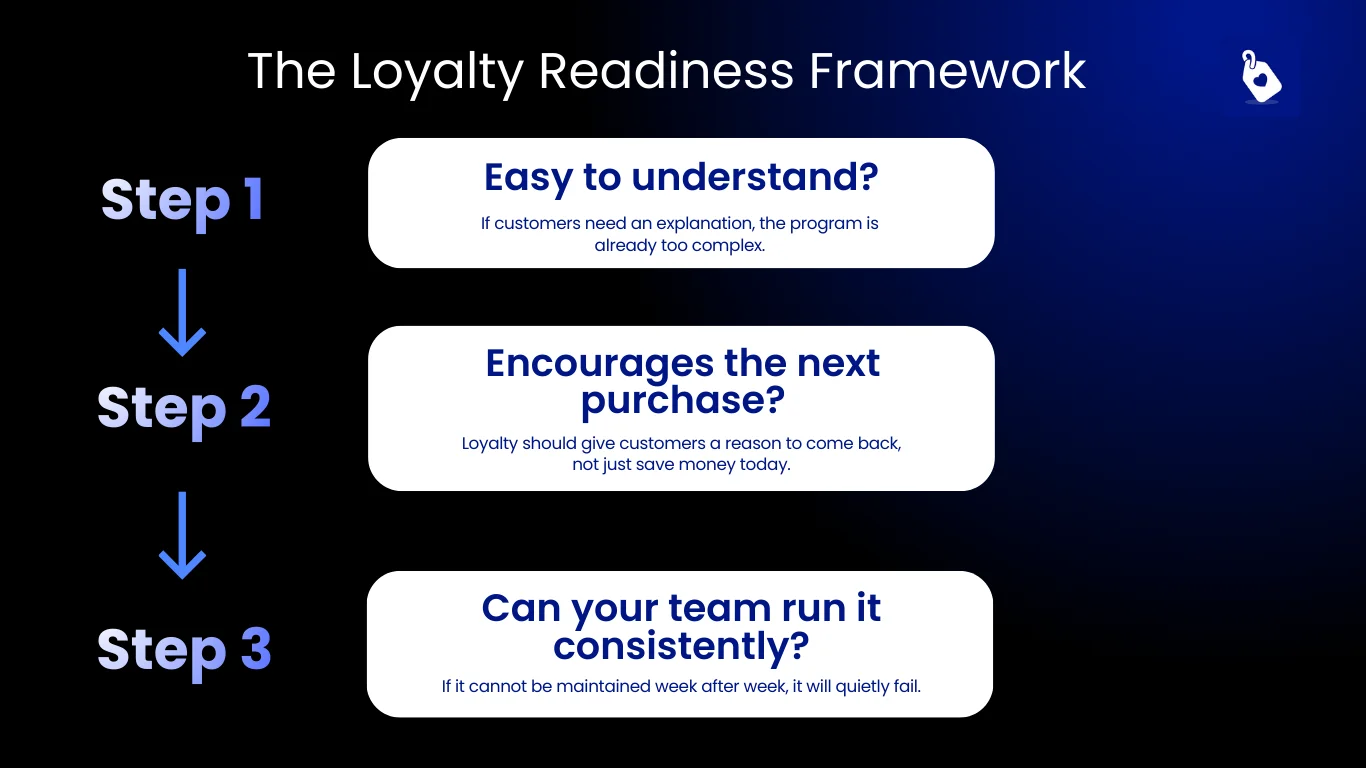
5.1. Is the program easy to understand at a glance?
If customers need an explanation, the program is already too complex.
A loyalty program should answer three questions immediately:
- What action earns rewards?
- What do customers get in return?
- How close are they to the next reward?
When these answers are not obvious, engagement drops quickly. Simplicity is not a limitation. It is what makes loyalty usable for small teams and busy customers.
5.2. Does it encourage the next purchase, not just a discount?
Effective loyalty programs focus on what happens after today’s order.
Ask yourself:
- Does this program give customers a reason to come back again?
- Or does it only reduce the price of the current purchase?
When rewards feel like ongoing discounts, customers learn to wait rather than engage. Loyalty should reinforce habits over time, not replace promotions.
5.3. Can your team realistically run this program every week?
Many loyalty programs look manageable on launch day and become a burden later.
A practical loyalty setup should fit:
- The size of your team
- The time available for ongoing updates
- The ability to communicate rules clearly and consistently
If a program cannot be maintained without constant effort, it will lose momentum no matter how good the idea is.
6. When should a small business start a loyalty rewards program?
Timing matters more than most small businesses expect.
Launching a loyalty rewards program too early often leads to disappointment. Launching it at the right moment can quietly strengthen retention without adding unnecessary complexity.
Instead of asking “Should we do loyalty?”, a better question is “Are the conditions right for loyalty to work?”
6.1. Signs a loyalty program is worth considering
Loyalty tends to work best when at least some repeat behavior already exists. This pattern is also reflected in broader research on customer retention, including insights shared by Shopify on how repeat customers contribute to long-term growth.
Common signals include:
- Customers return without needing discounts every time
- Purchases follow a recognizable rhythm such as monthly, seasonal, or event driven
- A noticeable share of revenue comes from returning customers
- Customers already engage through referrals, reviews, or social sharing
When these signals are present, loyalty can reinforce habits that are already forming.
6.2. Signs it may be too early
In many cases, loyalty struggles because the business is trying to solve the wrong problem.
Warning signs include:
- Most customers buy once and do not return
- The product or pricing is still being tested
- The team is stretched thin managing daily operations
- Retention issues are unclear or poorly understood
In these situations, loyalty often masks deeper issues instead of fixing them.
6.3. Loyalty works best as a multiplier, not a trigger
A loyalty rewards program does not create demand on its own. It amplifies what is already happening.
If customers are not coming back yet, improving the core experience usually has a bigger impact than introducing rewards. Once repeat behavior becomes visible, loyalty can help make that behavior more consistent and more predictable over time.
Starting loyalty at the right moment reduces friction for both customers and the team. Starting too early often turns loyalty into extra work without meaningful results.
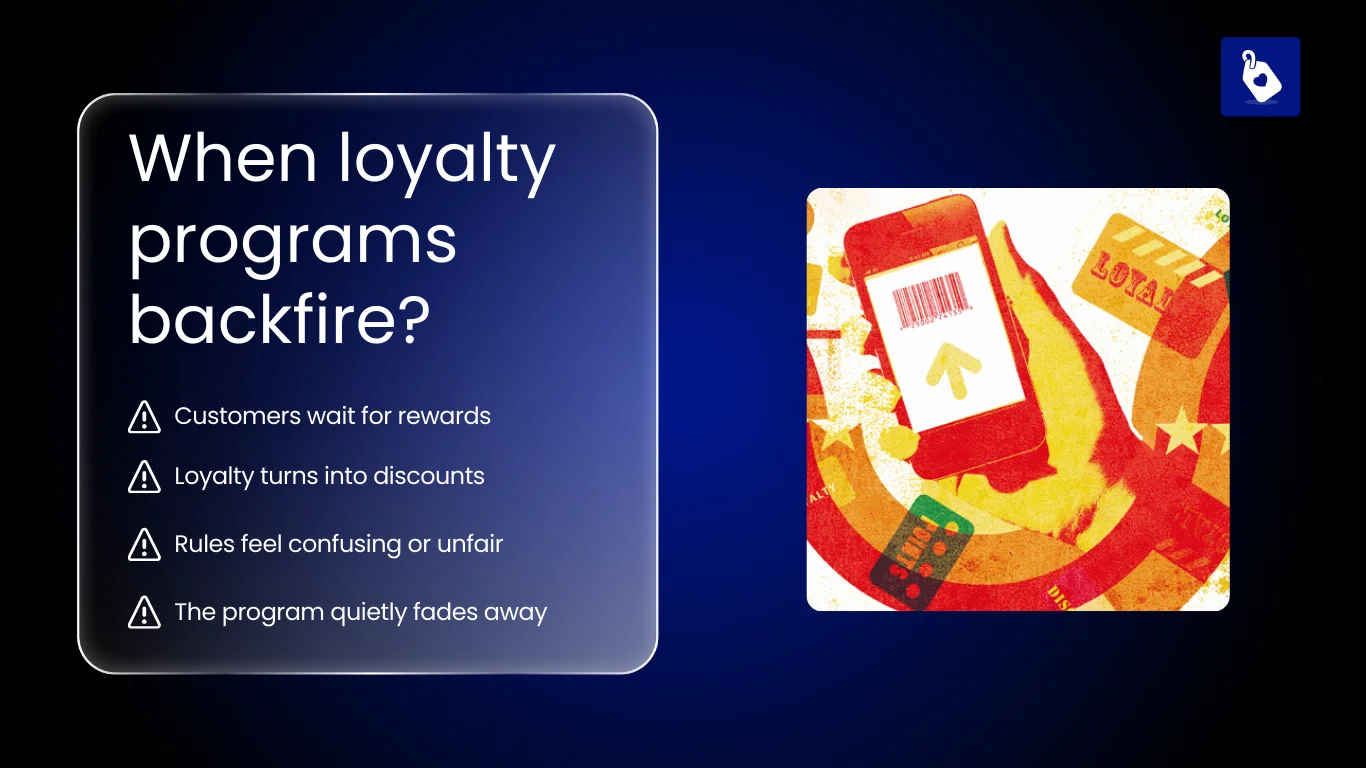
7. Can loyalty rewards programs backfire?
Yes. Loyalty rewards programs can backfire when they are misaligned with customer behavior or business capacity.
This usually does not happen all at once. It shows up gradually, through small signals that are easy to miss.
7.1. Rewards train customers to wait
When loyalty rewards closely resemble ongoing discounts, customers adjust their behavior.
Instead of buying when they need something, they:
- Wait for rewards or redemptions
- Delay purchases to maximize perceived value
- Respond only when incentives are present
Over time, loyalty stops encouraging repeat behavior and starts replacing margin.
7.2. Rules feel unclear or unfair
Trust erodes quickly when customers do not understand how rewards work.
Common issues include:
- Points that feel hard to earn
- Redemption conditions that change without explanation
- Rewards that appear out of reach
When customers feel confused or misled, engagement drops rather than increases.
7.3. The program adds friction instead of value
A loyalty program should simplify decisions, not complicate them.
When customers need to think too hard about:
- Which actions count
- Which rewards apply
- Whether participation is worth the effort
Loyalty becomes background noise instead of a meaningful reason to return.
7.4. The team loses confidence in the program
Internal trust matters too.
When loyalty feels ineffective or hard to manage:
- Updates slow down
- Communication becomes inconsistent
- The program quietly fades from focus
Once this happens, it becomes difficult to reengage customers without restarting from scratch.
8. Conclusion
A loyalty rewards program is not something every small business needs right away.
It works best when customers already show repeat behavior and when the team can support it consistently. Without those conditions, loyalty often adds complexity without improving retention.
Before launching any program, focus on understanding how customers buy today and what your team can realistically maintain. When loyalty fits both, it becomes a useful lever. When it does not, waiting is often the smarter decision.
If you decide a loyalty rewards program for small business is the right next step, you can try BLOY’s free trial to launch a simple points-based loyalty program that fits how small teams actually operate.

Yến Lê Hải
Content author at BLOY, focusing on product-led content, SEO, and educational resources to help merchants improve conversion and customer engagement.